
Where Ancient Paths Still Remember the Names of Heroes
Beyond the well-trodden islands, Greece's Peloponnese Peninsula unveils trails woven through myth, memory, and an unshakable devotion to homecoming.
SI
23 Jul 2026 · 5 MIN READ · UPDATED 17 AUG 2026
The Water Remembers Everything
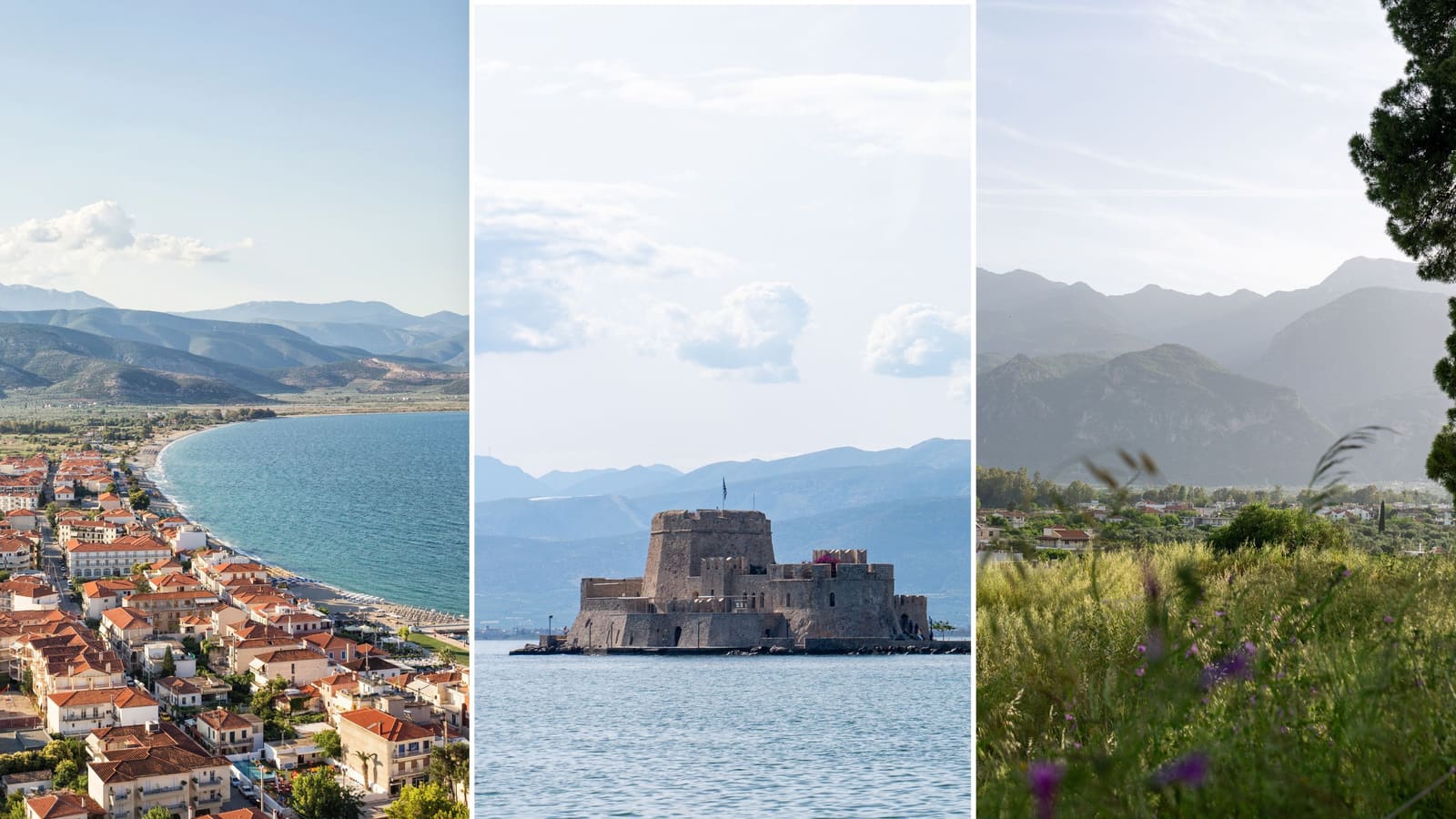
Stand long enough in the shallows off an uninhabited islet near Tolo, and you begin to understand what Greeks mean when they say they need to see the sea. The water is so transparent that individual stones announce themselves on the seabed, each one a small fact in a larger truth: that clarity, here, is not metaphorical. It is the condition of existence.
A local captain grills souvlaki on his boat while 1970s ballads drift across the bay. His niece ferries spanakopita to shore, pastry still warm from her grandmother's kitchen. This is the Argolic Gulf, where emerald fades to sapphire fades to cobalt, and where the ritual of arrival - by boat, on foot, through song - feels less like tourism than like remembering.
At Global Chic Voyage, we have watched Greece's smaller peninsulas and mountain villages begin to reclaim their place in the traveler's imagination. But the Peloponnese, hugged by three seas and veined with nearly 860 miles of jagged coastline, has remained curiously unvisited. Only three percent of international visitors ventured here in 2025, despite its proximity to Athens and its outsize role in shaping Western mythology, language, and identity. That quiet is ending.
A Landscape Written Into Legend
The peninsula is roughly the size of Slovenia, yet it contains multitudes: the place where Hercules wrestled his lion in Nemea's vineyards, where Zeus was born in Arcadia's high country, where the Mycenaean civilization first took root in Argolis. Odysseus, the wanderer-king whose ten-year journey home has obsessed storytellers for three millennia, is said to have lived, fought, and loved across these mountains and shores.
Christopher Nolan's film adaptation of The Odyssey, which premiered this year, was shot partially in Messinia, the southernmost region of the Peloponnese. Locations include Nestor's Cave, where the hero confronts the Cyclops, and Methoni Castle, where his son waits for a father who may never return. The production has drawn fresh attention to a peninsula that has long deserved it, though locals will tell you the land needs no cinematic endorsement. It has been holding its stories for thousands of years.
What the film does underscore, intentionally or not, is the Greek concept of nostos - homecoming - and xenia, the sacred contract between guest and host. Both ideas pulse through the Peloponnese today, as residents who left for Athens, London, or Melbourne in search of work begin to return, drawn by a slower cadence and a renewed belief that their birthplace can sustain them.
The Trails That Stitch Villages Back Together
Nikos Stakias spent two decades working in hospitality across England, Cyprus, and Athens before coming back to the peninsula. For the past three years, he has been part of a volunteer effort to establish the Peloponnese Trail Network, which now connects nearly 1,200 miles of ancient footpaths across the peninsula's five regions. It is the largest hiking network in Greece, and it is community-led, meaning the people who know these mountains best are the ones mapping them, marking them, and welcoming walkers onto land that has been, until recently, largely their own.
The trails are not new. Shepherds, schoolchildren, and traders have used them for centuries. What is new is the infrastructure of access - the signage, the guesthouses, the guides who can translate the landscape's layered past. Eleven official routes have opened so far, most of them outside Messinia, where international hotel brands have begun to cluster. Costa Navarino, the eco-retreat founded by shipping captain Vassilis Constantakopoulos in the early 2000s, now leases land to W Hotels and Mandarin Oriental. Four Seasons and Six Senses are expected to follow in the coming year.
But the trails lead elsewhere: into Argolis, where Ottoman-era stone staircases climb to Palamidi, a Venetian fortress overlooking the town of Nafplio; into Arcadia, where red limestone cliffs tower over the climbing mecca of Leonidio; and into Laconia, where villages with fewer than ten year-round residents are beginning to repopulate.
Walking Through Centuries in a Single Afternoon
The 64-mile Argolis Trail begins near one of Greece's best-preserved ancient theaters, Epidaurus. In the fourth century BC, this was a sanatorium where performances were prescribed as therapy. The trail moves forward through time: past Byzantine ruins, Venetian ramparts, Ottoman paths worn smooth by generations of footsteps.
Farther south, the 143-mile Parnon Trail encircles Mount Parnon, a range so massive it is visible from Athens on clear days. The route passes through Tsakonian villages, settlements founded by direct descendants of ancient Spartans. For centuries, the Parnon mountains isolated these communities, preserving a dialect that predates modern Greek by three thousand years. Today, fewer than 2,500 people still speak Tsakonian, most of them elders. Street signs in Leonidio now display both languages, a quiet assertion of survival.
On a four-hour section of the Parnon Trail, wild rosemary, thyme, oregano, and sage scent the air. Lemon and olive groves give way to mountain cherry and juniper forests. At your feet, hairy pink flax - the wild cousin of the plant Odysseus and his men used to weave sails - blankets the path. Sheep bells echo from unseen hillsides. A lone chapel dedicated to Prophet Elias offers walnuts, oranges, and koulourakia, biscuits made with local olive oil and citrus zest. Then the trail curves back toward the coast, and the vertical red cliffs of Leonidio rise like a declaration.
The Women Who Refuse to Let Memory Fade
In a 19th-century stone mansion in Leonidio, Eleni Manou greets visitors in traditional Tsakonian dress: a striking red, black, and gold skirt that catches the wind. Manou is an author and educator who has published children's books in Tsakonian and organized language workshops in an effort to keep the dialect alive. "Language is not just words," she says. "It is a culture alive." Each July, an annual festival translates Tsakonian traditions into contemporary practice, blending folk music, dance, and storytelling.
A day's drive west, in the Laconian village of Geraki, Chrysoula Stamatopoulou welcomes students into a room filled with vertical looms. Here, weavers of all ages pass wool threads between warps, creating kilims - large heirloom rugs patterned with Tsakonian geometry and symbols such as the sun and the tree of life. Women in Geraki have been weaving on these looms for five thousand years. Penelope, too, sat behind one in The Odyssey, weaving a burial shroud each day and unraveling it at night to delay her suitors.
Five years ago, Stamatopoulou was the only person weaving in Geraki. Today, students come from across Greece and Europe to learn for free at one of only two places that still teach the craft. "It gives me joy to have people here," she says, her smile carrying the weight of continuity.
The practice is now recognized as part of Greece's National Intangible Heritage, but recognition alone does not guarantee survival. What does, perhaps, is the quiet determination of people like Stamatopoulou and Manou, who understand that culture is not a museum artifact but a living exchange between past and present.
The Villages Coming Back to Life
Elsewhere in the peninsula, signs of renewal are accumulating. Vamvakou, a village in Laconia that once had nine year-round residents, now counts thirty, thanks to a revival project led by four young entrepreneurs with family ties to the area. In Arcadia, social entrepreneur Maria Monastirioti left Athens to work with rural women, organizing agro-tourism experiences that include making trachanokeftedes, fermented milk pasta balls that have been a staple of mountain diets for generations.
Monastirioti calls the Peloponnese "blessed land," and she is not alone in her conviction. The dream of revitalizing the peninsula began with Captain Constantakopoulos in the 1980s, when he envisioned transforming his birthplace into a premier destination while stemming the exodus of residents to the capital. The Peloponnese Trail Network is the latest manifestation of that vision, a means of drawing the world in without erasing what makes the place distinct.
Modern roads built in the 1950s first connected the peninsula's remote villages to the outside world. New highways and tunnels in the early 2000s shortened the commute from Athens. But infrastructure alone does not create homecoming. What does is the willingness of people to return, to rebuild, to teach their children the language their grandparents spoke and the crafts their ancestors practiced.
The Acropolis That No One Photographs
The journey ends at the Acropolis of ancient Sparta, a sprawling site of ruins and olive groves overlooking the Taygetus mountains. A few miles from here, Spartans built a sanctuary dedicated to Helen, who eventually returned home from Troy. The site is magnificent, yet it draws a fraction of the visitors who crowd the Parthenon in Athens.
Standing among the stones, it is easy to think of the Peloponnese itself as undergoing a kind of nostos, a homecoming decades in the making. The peninsula has always been here, holding its myths and its mountains with equal steadiness. What has changed is the willingness of the world to meet it, and the willingness of its people to welcome that meeting on their own terms.
The trails do not promise ease. They are steep, remote, and often unmarked except by the footsteps of those who came before. But they offer something rarer than convenience: the chance to walk through a landscape that has shaped not only Greek identity but the entire architecture of Western storytelling. To follow them is to understand that some places do not need to be discovered. They need only to be remembered.
Credit: Yulia Denisyuk
Spot something wrong? Email editors@globalchicvoyage.com. We log every correction publicly.
RELATED
SEE ALL →
22 Jul 2026 / 5 min
31 Jul 2026 / 5 min
29 Jul 2026 / 5 min
8 Jul 2026 / 5 min