
When Speed Meets Elegance on the Water
Two European powerhouses join forces to reimagine what a performance catamaran can be, and the result is a 55-footer that blurs the line between racing hull and floating salon.
AM
29 Jul 2026 · 5 MIN READ · UPDATED 17 AUG 2026
A Union of Disciplines
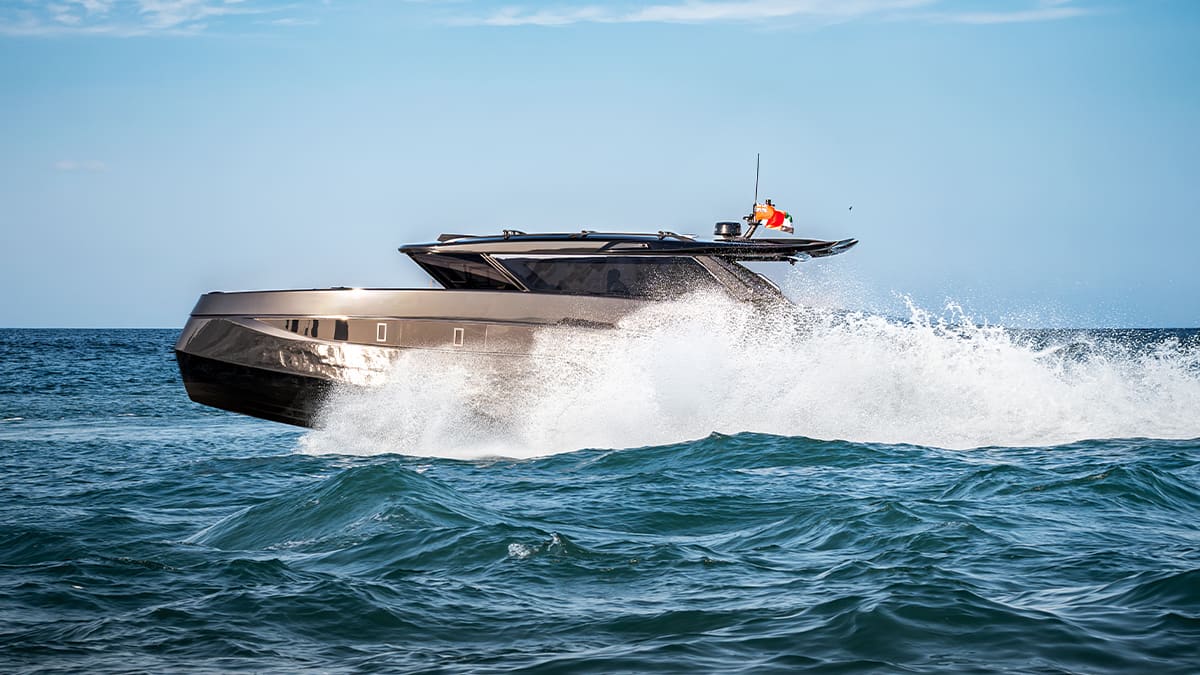
There is a moment, just before a high-performance catamaran breaks free from displacement mode, when the hull trembles with latent energy. The water changes its voice. The bow lifts. And suddenly, what was a vessel becomes something closer to flight. It is in that instant that you understand why some collaborations matter more than others.
The partnership between Sunreef, the Polish yacht builder known for its composite expertise, and Brabus, the German automotive tuner synonymous with extreme performance, has yielded a vessel that lives in that liminal space. The Brabus Ultima 55 is not simply a fast catamaran or a luxurious one. It is an argument, rendered in carbon fiber and leather, that these qualities need not exist in opposition.
At Global Chic Voyage, we have watched the luxury marine sector wrestle with a familiar tension: the desire for speed often compromises comfort, while the pursuit of elegance traditionally sacrifices velocity. This 55-foot catamaran suggests a third path.
Engineering the Threshold
Beneath the Ultima 55's sculpted profile lie twin six-cylinder engines, each delivering 725 horsepower. The result is a top speed exceeding 40 knots, a figure that places this catamaran squarely in performance territory. Yet the hull itself is constructed from carbon fiber, a material choice that speaks to weight reduction but also to a certain aesthetic philosophy: that the vessel's structure should be as refined as its surface.
The use of carbon fiber cladding on the exterior is not merely functional. It creates a visual language of tension and restraint, the weave pattern catching light in ways that shift with the angle of the sun. This is design that acknowledges its own engineering, rather than attempting to disguise it.
What strikes us about this approach is its honesty. In an era when many luxury vessels rely on visual excess to communicate value, the Ultima 55 opts for material integrity. The carbon fiber is not painted over or hidden. It is the aesthetic statement itself.
Spaces That Breathe
Step aboard, and the logic of the collaboration becomes clearer. The exterior deck is organized around twin principles: open sightlines and tactile luxury. Sunbeds upholstered in what Brabus calls its Masterpiece fabric line the foredeck, their low profile ensuring that views remain unobstructed. These are not the bulky loungers common to charter yachts, but rather sleek platforms that prioritize geometry over cushion depth.
The helm station is another study in restraint. Rather than overwhelming the captain with screens and controls, the layout is spare, almost minimalist. This is a space designed for someone who wants to feel the vessel's response, not manage it through layers of digital mediation.
Aft, a hydraulic platform provides direct access to the water, a feature that has become standard on yachts of this class but is executed here with particular attention to the transition between interior and sea. The platform does not simply lower; it creates a threshold, a place where the vessel opens itself to the environment rather than merely tolerating it.
The Brabus Signature
Inside, the collaboration's automotive roots become more evident. Brabus has built its reputation on transforming German sedans into objects of extreme performance and bespoke luxury, and that sensibility translates directly to the Ultima 55's interiors. The same Masterpiece fabrics used on the deck reappear below, their texture a counterpoint to the carbon fiber's visual hardness.
What we find most compelling is the restraint in material choice. There is no explosion of exotic woods or excessive metallic accents. Instead, the palette is tightly controlled: carbon, leather, and carefully selected textiles. The effect is one of coherence, each surface reinforcing the next.
This is not a floating hotel suite attempting to recreate the textures of land-based luxury. It is an interior that acknowledges it exists on the water, that speed and motion are part of its identity. The furnishings are low, the sightlines horizontal. Even at rest, the space suggests velocity.
A Shift in Expectations
The Ultima 55 arrives at a moment when the boundaries of catamaran design are being redrawn. For decades, multihulls were associated primarily with sailing, their twin hulls prized for stability and interior volume. The power catamaran, by contrast, was often seen as a compromise: faster than a monohull displacement yacht but lacking the soul of a true performance craft.
This vessel challenges that assumption. By pairing the hull efficiency and deck space of a catamaran with engines and construction techniques borrowed from high-performance sectors, Sunreef and Brabus have created something that occupies its own category. It is neither a tender nor a weekender, but rather a vessel for those who refuse to choose between arriving quickly and arriving well.
At Global Chic Voyage, we have noted a broader pattern in luxury design: the erosion of old taxonomies. Just as hotels are becoming more like private residences and automobiles are borrowing cues from architecture, the marine sector is beginning to allow categories to blur. The Ultima 55 is both a symptom and an accelerant of that shift.
The Question of Scale
At 55 feet, this catamaran occupies an interesting middle ground. It is large enough to offer genuine living space, yet compact enough to be operated without a permanent crew. This is significant. Many of the most interesting vessels we have encountered in recent years exist at this scale, where owners can maintain a direct relationship with the act of navigation without sacrificing comfort.
The twin-hull configuration amplifies this advantage. Unlike a monohull of similar length, the Ultima 55 offers beam width that translates into usable interior volume. The result is a vessel that feels larger than its length suggests, without the draft or fuel consumption of a traditional motor yacht.
This efficiency extends to the carbon-fiber construction. Lighter hulls require less power to achieve the same speeds, which in turn allows for smaller engines, reduced fuel loads, and a virtuous cycle of weight savings. The engineering is elegant not because it is invisible, but because every choice reinforces the next.
The Horizon Ahead
What does a vessel like the Ultima 55 signal about the future of luxury marine design? We would argue that it points toward a synthesis: the integration of performance engineering with spatial luxury, the willingness to borrow techniques from adjacent industries, and a move away from ornamentation toward material honesty.
The collaboration between Sunreef and Brabus is notable not because it is unprecedented, but because it suggests a model. As the luxury sector continues to fragment into ever-more-specialized niches, partnerships that bridge disciplines become more valuable. The yacht builder brings expertise in composite structures and marine engineering; the automotive tuner contributes a philosophy of performance and a library of bespoke materials. The result is greater than the sum of its parts.
For those who spend time on the water, the Ultima 55 offers something increasingly rare: a vessel that does not ask you to compromise. It is fast enough to compress distances, stable enough to serve as a platform for extended stays, and resolved enough in its design language to feel cohesive rather than cobbled together.
In the end, the most successful collaborations are those that create their own vocabulary. The Brabus Ultima 55 does not fit neatly into existing categories, and that may be its greatest strength. It is a vessel for those who understand that the journey and the destination are not separate experiences, but two aspects of the same pursuit.
Credit: Sunreef
Spot something wrong? Email editors@globalchicvoyage.com. We log every correction publicly.
RELATED
SEE ALL →
31 Jul 2026 / 5 min
14 Jun 2026 / 5 min
8 Aug 2026 / 5 min
8 Aug 2026 / 5 min