
When a Fleet Completes Itself: Explora VI and the Architecture of Slow Sailing
With its sixth ship launching in August 2028, Explora Journeys finalizes a global deployment strategy that privileges overnight stays, extended port calls, and the deliberate pace of ocean travel.
SI
29 May 2026 · 5 MIN READ · UPDATED 17 AUG 2026
A Ship Completes a Constellation
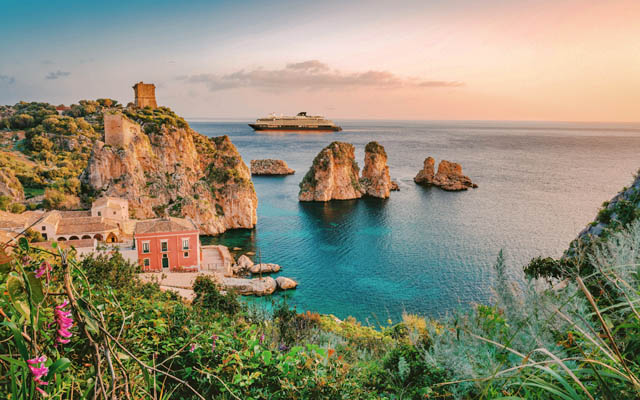
There is a particular satisfaction in watching a fleet come into being—not all at once, but ship by ship, each vessel slotting into place like the final piece of a maritime puzzle. By August 2028, when Explora VI embarks on its maiden voyage from Rome to Barcelona, Explora Journeys will have realized the full ambition of its six-ship fleet: a global deployment spanning 178 destinations in 27 countries, operating simultaneously across the Mediterranean, Northern Europe, Iceland, Greenland, Alaska, and the North American East Coast. At Global Chic Voyage, we've watched this brand construct not just ships, but a philosophy—one that privileges the overnight stay, the extended port call, the deliberate pace that allows a traveler to inhabit a place rather than merely pass through it.
The Summer 2028 Journeys Collection, now open for booking, represents the operational maturity of that philosophy. Explora VI will operate 13 Mediterranean itineraries between August and November, threading through Sicily, Sardinia, the French Riviera, and the Adriatic coast. Meanwhile, its five sister ships will disperse across latitudes: Explora I and Explora II anchoring Mediterranean routes from April through October; Explora III returning to Alaska for the May-to-September season; Explora IV and Explora V navigating Northern Europe, the Baltic Sea, Iceland, Greenland, and the eastern seaboard of North America. This is not a brand chasing volume. It is a brand choreographing presence.
The Geometry of Slower Travel
What distinguishes Explora's 2028 program is not the number of ports, but the duration of engagement with them. The itineraries are structured around overnight stays and extended calls in cities like New York, Reykjavik, and Istanbul—places that resist the compression of a six-hour shore excursion. The decision to spend a night in port is an editorial one: it acknowledges that certain destinations demand evening light, the rhythm of local life after the cruise crowds have departed, the possibility of a late dinner in a neighborhood bistro rather than a pre-scheduled dining slot.
This approach extends to maiden calls in lesser-trafficked ports. Korčula, the fortified Adriatic island where Marco Polo was said to have been born, and the Faroe Islands, that wind-scoured archipelago between Iceland and Norway, are not new to maritime tourism—but they are new to Explora's routing. The inclusion of such destinations signals a willingness to veer from the well-worn circuits of Mediterranean and Northern European cruising, to seek out places where infrastructure is modest but cultural texture is high. It is a strategy that aligns with what we've observed across the luxury segment: a shift away from port-hopping toward deeper, more localized immersion.
Regional Deployment as Strategic Architecture
The deployment of Explora's fleet across four major regions—Mediterranean, Alaska, Northern Europe, and North America—reflects a calculated balance between seasonality, guest demand, and operational efficiency. The Mediterranean, with its long cruising season and dense constellation of historic ports, can support two ships (Explora I and II) operating concurrently from April to October. Alaska, a summer-only destination with high demand and limited berth availability, justifies the dedicated presence of Explora III from May to September. Northern Europe, Iceland, Greenland, and the North American East Coast—regions where summer weather is brief but spectacular—receive the combined attention of Explora IV and V.
This is fleet management as choreography: each ship positioned where it can maximize guest experience while minimizing deadhead repositioning. The result is a network that feels global without being scattershot, with each vessel operating in a region where it can sustain a consistent itinerary rhythm rather than constantly chasing the next port.
Explora VI: The Inaugural Season and the Question of Parity
Explora VI's maiden voyage in August 2028 will be closely watched—not because it represents a radical departure from the fleet's established design language (all six ships are built to the same specifications), but because it will test whether the brand can deliver a debut season that feels as polished as those of its older sisters. The itineraries across Sicily, Sardinia, the French Riviera, and the Adriatic are familiar territory for Explora I and II; Explora VI will be sailing routes that have already been refined through two years of operational learning.
For early bookers, the brand has opened access to preferred rates and suite selections—a standard incentive structure, but one that acknowledges the value of a guest who is willing to commit to an unproven ship. The question is not whether Explora VI will be seaworthy (it will), but whether it will feel as lived-in, as operationally seamless, as ships that have already completed multiple seasons. In the luxury segment, where consistency is currency, the inaugural season of a new ship is always a test of systems, crew cohesion, and the intangibles that separate a smooth voyage from a memorable one.
Why It Matters: The Completion of a Thesis
The completion of Explora Journeys' six-ship fleet is significant not because it marks expansion for expansion's sake, but because it completes a thesis about what ocean travel can be in an era when speed and volume dominate the industry. The brand has staked its identity on the proposition that slower is richer—that the overnight stay, the extended port call, and the maiden call to a less-visited destination are worth more than the ability to tick off a dozen ports in a fortnight.
This is a thesis that resonates with a particular kind of traveler: one who has already done the grand tour, who values depth over breadth, who understands that the best way to know a place is to linger. It is also a thesis that requires operational discipline. Overnight stays and extended calls reduce the number of ports a ship can visit in a season, which in turn requires higher per-guest revenue to maintain profitability. Explora's bet is that there is a sufficient market of travelers willing to pay for that depth—and that the completion of its fleet will allow it to scale that model without diluting it.
The Horizon After Completion
With Explora VI's launch in August 2028, the brand will have reached a state of operational maturity: six ships, global deployment, a refined itinerary model. The question then becomes not how many more ships to build, but how to deepen the experience on the ships it has. At Global Chic Voyage, we'll be watching whether Explora uses this moment of completion to refine its onboard programming, to deepen its partnerships with local guides and cultural institutions, to explore itineraries that push further into the edges of its operating regions—the Arctic, the sub-Antarctic, the less-traveled corners of the Mediterranean.
The Summer 2028 Journeys Collection is not just a schedule of sailings. It is the culmination of a fleet, the realization of a philosophy, and the beginning of a new chapter in which the question is no longer how many ships, but how well can we use them. For travelers who value the slow reveal of a destination, the overnight stay, the extended conversation with a place—this is a fleet that has been built with you in mind.
Spot something wrong? Email editors@globalchicvoyage.com. We log every correction publicly.
RELATED
SEE ALL →
27 Jul 2026 / 5 min
27 Jul 2026 / 5 min

27 Jul 2026 / 5 min
24 Jul 2026 / 5 min