
When a Chinese Cruise Line Comes to Port Klang: What It Means for Southeast Asia's Homeport Race
Adora Cruises' first overseas deployment signals a shift in how regional cruise markets are being redrawn—and who gets to define 'Muslim-friendly' at sea.
AM
9 Jun 2026 · 5 MIN READ · UPDATED 17 AUG 2026
The Ship That Crossed a Threshold
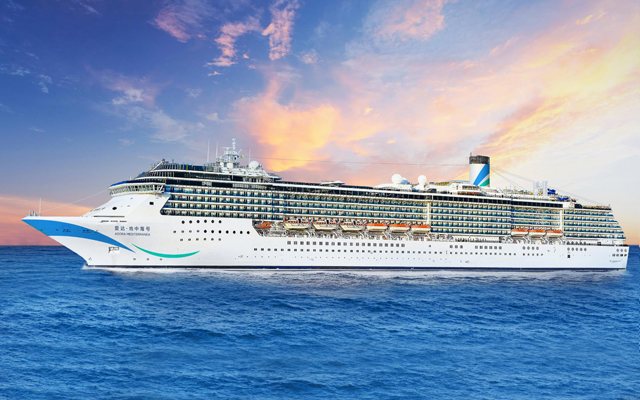
There is a moment, late in the planning of any maiden voyage, when a ship stops being a vessel and becomes a statement. For Adora Mediterranea—a 2,680-passenger liner dressed in Mediterranean pastels and bound for Port Klang this November—that moment arrived not at sea, but at a trade show in Shanghai. The announcement was modest: an exclusive charter season, three weeks in duration, eight sailings across four itineraries. Yet the implications ripple outward. This is the first time Adora Cruises, a state-backed Chinese operator, has homeported a ship outside mainland China. And the destination it chose—Malaysia's industrial gateway west of Kuala Lumpur—says as much about the future of regional cruise markets as it does about the ship itself.
At Global Chic Voyage, we've watched the Asian cruise industry recalibrate in the years since the pandemic. What was once a zero-sum game—ships either served China or they served Southeast Asia—has given way to something more fluid. Operators are testing hybrid models: shorter charters, culturally tailored programming, partnerships with local agencies that understand the nuances of Muslim-majority markets. Adora's move is the latest iteration of this shift, and perhaps the most telling.
The Homeport as Strategic Signal
Port Klang is not glamorous. It handles containers, not cruise passengers—at least not at the scale of Singapore or Hong Kong. But that is precisely why Adora's choice matters. According to the cruise line, Malaysia represents a key pillar in its international expansion strategy. The partnership with Hwajing Travel & Tours, a Malaysian cruise specialist, frames the deployment as both commercial opportunity and cultural experiment: can a Chinese operator deliver what it calls a "Muslim-friendly cruise holiday experience" to travelers who have historically been underserved by the global cruise industry?
The answer hinges on details. All sailings from Port Klang will offer Muslim-friendly meal options. Crew members will be fluent in Mandarin, English, and Bahasa Malaysia. The itineraries themselves—three-day hops to Penang, four-day loops to Langkawi or Phuket, a six-day one-way voyage to Nha Trang and Guangzhou—are designed for regional mobility, not the traditional fly-cruise model that brings international passengers to a distant homeport. Fares start at 499 ringgit (approximately US$118) for the shortest sailing, a price point that positions the product firmly in the accessible-luxury category.
What Adora is testing, in other words, is whether a Chinese cruise brand can operate as a regional carrier—not merely exporting Chinese tourists to Southeast Asian ports, but serving Southeast Asian travelers on their own terms. The precedent, if it holds, could reshape how other operators think about homeporting in secondary markets.
The 'Art Ship' and the Question of Identity
Adora Mediterranea is marketed as an "Art Ship," a designation that refers less to onboard galleries than to a design language borrowed from southern Europe: terracotta tones, wrought-iron motifs, piazzas reimagined as atriums. The vessel, which spans 12 decks and houses 1,057 cabins, was refurbished before its Malaysian deployment. It features what the cruise line describes as Mediterranean-inspired interiors, international dining, live entertainment, themed bars, and family-friendly facilities.
The aesthetic choice is deliberate. By invoking the Mediterranean—a region synonymous in cruise marketing with leisure, romance, and cultural refinement—Adora sidesteps the question of whether a Chinese ship can feel "authentically Southeast Asian." Instead, it offers a third identity: cosmopolitan, borderless, aspirational. Whether that resonates with Malaysian and Singaporean passengers remains to be seen. But the strategy is not without precedent. European cruise lines have long sold Caribbean itineraries to North American passengers aboard ships designed to evoke Italian villas or French rivieras. The disconnect, if it exists, has rarely been a commercial liability.
Still, there is a tension here worth noting. The Muslim-friendly programming—halal dining, multilingual crew, culturally sensitive onboard policies—suggests an operator attuned to local sensibilities. The Mediterranean branding suggests the opposite: a ship designed for export, for travelers who want to sample a version of Europe without leaving Asian waters. How these two narratives coexist onboard will define the passenger experience in ways no press release can capture.
The Timing and the Bigger Picture
The charter season runs from late November through mid-December 2026, a period that coincides with Hwajing Travel's 37th anniversary and the broader Visit Malaysia 2026 campaign. The alignment is strategic. Malaysia's tourism authority has prioritized cruise arrivals as part of its post-pandemic recovery plan, and Port Klang—while not a natural cruise destination—offers logistical advantages: proximity to Kuala Lumpur, existing port infrastructure, and a geographic position that allows for quick turnarounds to northern Malaysia and Thailand.
Adora's deployment also arrives at a moment when Chinese cruise operators are under pressure to diversify. Domestic demand has rebounded, but the market is crowded. International expansion, particularly into Muslim-majority countries, offers both revenue potential and diplomatic soft power. The cruise industry, after all, is never only about tourism. It is also about presence, about flagging new markets, about demonstrating that a brand can operate in regions where Western competitors have traditionally dominated.
That Adora chose Malaysia over, say, Indonesia or the Philippines, is telling. Malaysia's cruise infrastructure is more developed. Its Muslim-majority population is affluent and travel-savvy. And its government has actively courted Chinese investment in tourism and transport. The homeport deployment, in this light, is as much a test of bilateral economic relations as it is of consumer appetite.
What This Means for the Region
If the Port Klang season succeeds—if Adora fills its sailings, if passengers respond positively to the Muslim-friendly programming, if the economics justify further deployments—the ripple effects will extend beyond Malaysia. Other Chinese operators may follow. Southeast Asian ports may begin positioning themselves not as turnaround stops but as viable homeports for regional carriers. And the definition of what constitutes a "cruise market" in Asia may shift from fly-cruise internationals to drive-to-port domestics.
We are not there yet. Eight sailings across three weeks is a pilot program, not a paradigm shift. But the architecture is in place. Adora has demonstrated that a Chinese cruise line can operate outside Chinese waters, can partner with local agencies, can tailor its product to non-Chinese passengers. Whether other operators—Chinese or otherwise—choose to replicate the model depends on what happens between November 24 and December 14, 2026.
For now, the Adora Mediterranea will arrive in Port Klang as an experiment. What it leaves behind—whether a template or a cautionary tale—will depend on whether Southeast Asian travelers see themselves reflected in the ship, or merely accommodated by it.
The Quiet Recalibration
There is something quietly ambitious about a ship that crosses borders without fanfare. Adora Mediterranea will not arrive in Port Klang with fireworks or press junkets. It will dock, load passengers, and sail north to Penang or west to Phuket, as if this were the most natural thing in the world. But the ease of the operation belies the complexity beneath: the logistics, the cultural negotiation, the risk of entering a market where no Chinese cruise line has homeported before.
At Global Chic Voyage, we have long argued that the future of Asian cruise travel lies not in mega-ships serving mega-ports, but in smaller, more flexible deployments that meet travelers where they are. Adora's move is a step in that direction. It is not revolutionary. It is not even particularly bold. But it is consequential. And in an industry where inertia often masquerades as strategy, consequence is enough.
Spot something wrong? Email editors@globalchicvoyage.com. We log every correction publicly.
RELATED
SEE ALL →
31 Jul 2026 / 5 min

28 Jul 2026 / 5 min

27 Jul 2026 / 5 min

22 Jul 2026 / 5 min