
The Volcanic Island Where Thermal Waters Meet the Tyrrhenian Sea
Beyond the tourist circuits of the Amalfi Coast, Ischia offers a quieter communion with the Mediterranean - one shaped by millennia of geothermal activity and the slow rhythms of island life.
SI
24 Jun 2026 · 5 MIN READ · UPDATED 17 AUG 2026
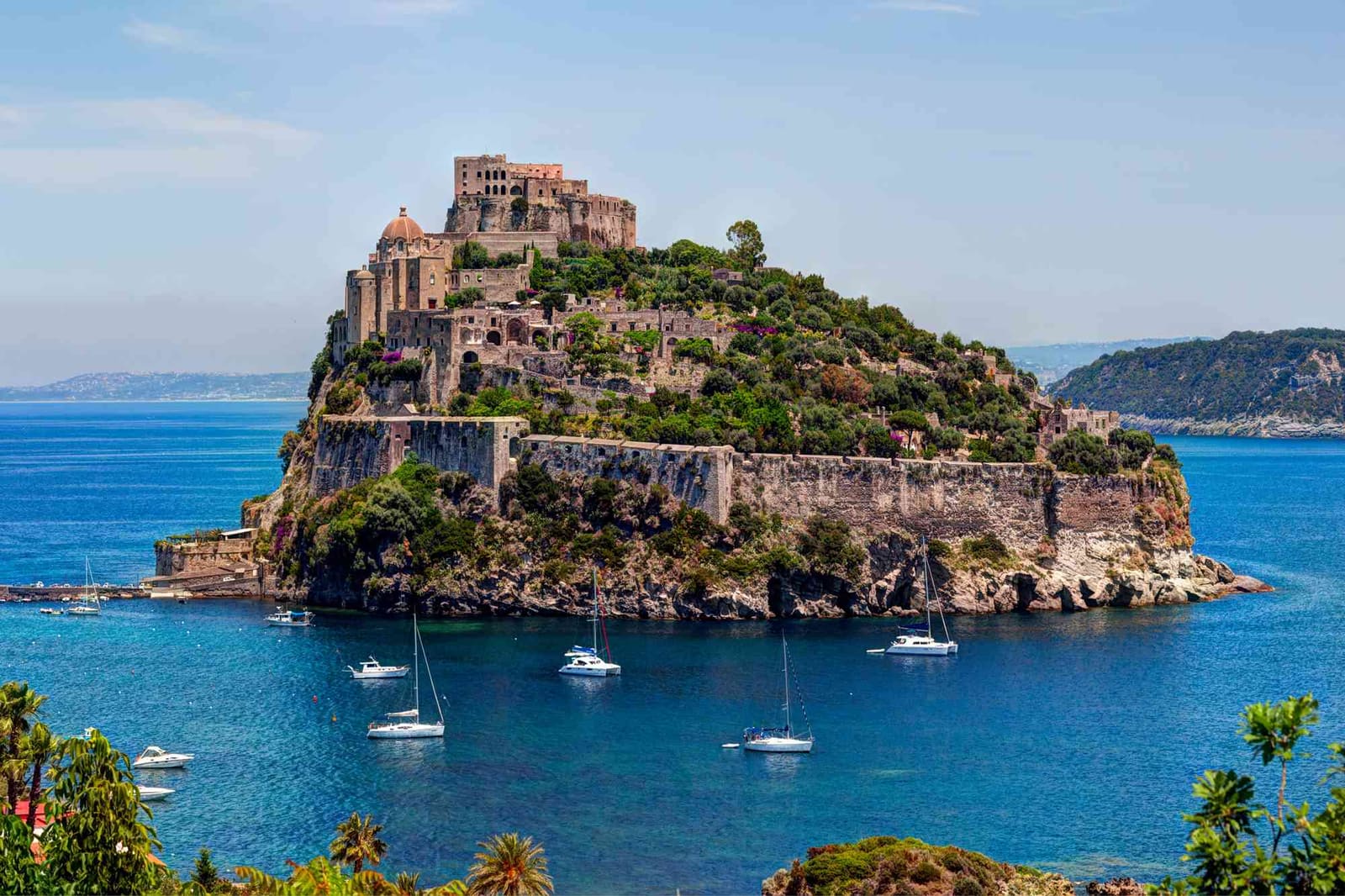
An Island Born of Fire
There is a particular quality to light on volcanic islands - something in the way the sun refracts off stone that has been shaped by subterranean heat, cooled by seawater, and worn smooth by wind. On Ischia, the largest island in the Bay of Naples, this light falls across terraced vineyards, pine forests that cling to steep hillsides, and coastlines where thermal springs bubble up through rock fissures to meet the cold Tyrrhenian currents. At Global Chic Voyage, we've watched as travelers increasingly seek out islands like this one: places where the geological drama is as compelling as the social calendar, where the pull is not toward spectacle but toward a slower, more elemental encounter with place.
Ischia sits roughly eighteen miles from Naples, visible from the mainland on clear days as a green silhouette rising from the water. Unlike Capri, which lies just to the south and has long been synonymous with a certain kind of high-season glamour, Ischia has retained a quieter identity. This is not an island of yacht parades or piazzas designed for being seen. Instead, it offers something increasingly rare in the Mediterranean: the possibility of solitude, even in summer, and a landscape shaped more by its volcanic origins than by tourism.
The island's defining feature is Mount Epomeo, a dormant volcano that rises nearly two thousand five hundred feet above sea level. Its last eruption occurred in the fourteenth century, but the island remains geothermally active. Hot springs emerge along the coastline and inland, feeding a network of thermal parks and natural pools that have drawn visitors since antiquity. The Romans built baths here; later, European aristocrats came for the waters, seeking cures for rheumatism and respiratory ailments. Today, the appeal is less clinical but no less profound - a recognition that immersion in mineral-rich water, particularly water heated by the earth itself, offers a kind of restoration that no spa treatment can replicate.
The Geography of Quiet
Ischia is divided into six comuni, each with its own character. Ischia Porto, the main town, is where ferries arrive and where most visitors first encounter the island. It is compact, functional, and architecturally unassuming - a place to provision and orient oneself before moving on. Ischia Ponte, connected to the main island by a causeway, is dominated by the Aragonese Castle, a medieval fortress perched on a rocky islet. The castle is open to visitors, and the climb to its upper terraces offers sweeping views of the bay and, on clear mornings, the distant outline of Vesuvius.
To the west, the island becomes more rugged. Forio, the second-largest town, is known for its Chiesa del Soccorso, a whitewashed church that juts out over the water like the prow of a ship. The town has a working harbor and a handful of family-run restaurants where the menu is dictated by the day's catch. Further along the coast, the villages of Serrara Fontana and Barano d'Ischia cling to hillsides, their narrow streets lined with bougainvillea and lemon trees. This is where the island feels most like itself - unhurried, agricultural, indifferent to trends.
The northern coast is where the thermal parks are concentrated. Negombo, Poseidon Gardens, and the smaller Castiglione Thermal Park each offer a different experience, but all share a common premise: the channeling of naturally heated water into a series of pools set within landscaped gardens. At Negombo, the design is more contemporary, with minimalist stone terraces and plantings of Mediterranean succulents. Poseidon Gardens, by contrast, feels more classical, with columns and statuary that evoke the island's Roman past. The water temperatures vary from pool to pool, ranging from tepid to nearly scalding, and the mineral content - rich in sulfur, iodine, and trace elements - is said to benefit circulation and skin health.
Beaches Shaped by Lava
Ischia's beaches are not the powdery crescents of the Caribbean or the Maldives. They are, instead, products of volcanic geology: dark sand beaches formed from weathered lava, rocky coves accessible only by boat, and stretches of pebble shore where the water is so clear that you can see the seabed twenty feet down. Maronti Beach, on the southern coast, is the island's longest, a sweep of dark sand backed by cliffs. In certain spots along the beach, steam rises from the sand where geothermal heat reaches the surface - a reminder that the island's volcanic activity is ongoing, if subdued.
Citara Beach, near Forio, is smaller and more sheltered, with a handful of beach clubs that rent sunbeds and umbrellas. The water here is calm, protected by headlands on either side, and the bay catches the late afternoon light in a way that turns the sea a deep, saturated blue. For those willing to hike, Sorgeto Bay offers a more dramatic experience: a narrow cove where a hot spring flows directly into the sea, creating pockets of warm water among the rocks. The approach is via a steep staircase carved into the cliff, and the bay is at its best in the early morning or at dusk, when the light is soft and the crowds thin.
The Hotels We Return To
Accommodation on Ischia tends toward the intimate rather than the grand. The island has no international luxury chains, and most hotels are family-owned, often for generations. This gives the hospitality a different texture - more personal, less scripted. At Global Chic Voyage, we've found that the best properties here are those that integrate the island's thermal resources into the guest experience, not as a gimmick but as a fundamental part of the architecture and daily rhythm.
Mezzatorre Resort & Spa, perched on a promontory near Forio, occupies the site of a former watchtower. The property cascades down the hillside in a series of terraces, with rooms that open onto private balconies overlooking the sea. The spa draws on thermal water from a source deep beneath the property, and the treatment philosophy is rooted in thalassotherapy and hydrotherapy traditions. The restaurant emphasizes Ischian ingredients: rabbit stewed with tomatoes and herbs, pasta with sea urchin, wines from the island's own vineyards planted in volcanic soil.
Regina Isabella, in the town of Lacco Ameno, has a mid-century elegance that recalls the island's heyday as a retreat for European film stars. The interiors are restrained - cream linens, terrazzo floors, modernist furniture - and the thermal baths are fed by the island's most famous spring, the Terme di Lacco Ameno, known for its high concentration of radioactive radon, which, in controlled doses, is believed to have therapeutic properties. The hotel's beach club occupies a small cove, and the bar serves Aperol spritzes and chilled prosecco at sunset, a ritual that feels less performative here than it might elsewhere.
For those seeking something smaller, Albergo Il Monastero, located within the Aragonese Castle complex, offers a handful of rooms in what was once a convent. The accommodations are spartan - stone walls, simple wooden furniture, narrow windows - but the location is unmatched. At night, after the last ferry has departed and the castle grounds empty of day visitors, guests have the place to themselves, the only sounds the wind and the waves against the rocks below.
A Cuisine Rooted in Terroir
Ischian cooking is shaped by the island's volcanic soil, which is exceptionally fertile and well-suited to viticulture. The island's signature grape is Biancolella, a white varietal that produces wines with a crisp minerality and notes of citrus and herbs. The reds, made from Piedirosso and Per'e Palummo, are lighter and more aromatic than the heavy wines of the mainland, meant to be drunk young and slightly chilled.
The island's most famous dish is coniglio all'ischitana, rabbit braised in white wine and tomatoes, a recipe that dates back centuries and reflects the island's agrarian traditions. Seafood is, of course, central: spaghetti alle vongole, octopus salad, fritto misto of calamari and small fish pulled from the bay that morning. The restaurants we favor are those that resist the temptation to innovate for the sake of it - places like Da Ciccio, a trattoria in Ischia Porto where the menu has not changed in decades, or Il Focolare in Barano, where the dining room is a converted wine cellar and the kitchen still uses a wood-fired oven.
The Rhythm of Island Time
What distinguishes Ischia from more trafficked destinations in the region is not any single feature - not the thermal springs, nor the beaches, nor the hotels - but rather the cumulative effect of these elements, and the pace at which they are encountered. This is an island that resists hurry. The ferries from Naples run on a schedule, but once you arrive, time loosens. Days are structured around meals, swims, the slow ascent to a hilltop village, an afternoon spent in a thermal pool watching the light change.
There is, too, a sense of discovery that has become rare in the Mediterranean. Unlike Capri, where every vista has been photographed a thousand times and every restaurant reviewed, Ischia retains pockets of the unknown. A narrow path that leads down to a hidden cove. A farm that sells its own wine and cheese from a roadside stand. A church interior decorated with majolica tiles that no guidebook mentions. These are the encounters that define travel at its best - not the ticked boxes of an itinerary, but the unplanned moments that linger in memory.
Why We Keep Returning
At Global Chic Voyage, we measure a destination not by its amenities or its Instagram potential, but by the quality of experience it offers - and by how that experience deepens with familiarity. Ischia is an island that rewards return visits. Each time we come back, we notice something we missed before: the way the morning light falls on the vineyards, the particular shade of blue the sea turns at midday, the rhythm of conversation in a village café. It is an island that does not reveal itself all at once, and that is part of its appeal.
In an era when much of the Mediterranean feels increasingly curated, Ischia remains stubbornly itself. It is not trying to be Capri, or Positano, or anywhere else. It is simply an island shaped by fire and water, where the thermal springs still flow, where the beaches are empty even in August, and where the hotels, for the most part, are still run by families who have lived here for generations. For travelers seeking not just a destination but a place to inhabit, even briefly, Ischia offers something increasingly rare: the chance to slow down, to pay attention, and to let the island set the pace.
Spot something wrong? Email editors@globalchicvoyage.com. We log every correction publicly.
RELATED
SEE ALL →
23 Jul 2026 / 5 min
8 Jul 2026 / 5 min
7 Jul 2026 / 5 min
30 Jul 2026 / 5 min