
The J-Class Revival: When Sailing's Most Elegant Giants Return to the Mediterranean
A century after their America's Cup debut, the world's most beautiful racing yachts are back - piloted by a new generation of owners who understand what it means to sail into history.
CG
20 Jul 2026 · 5 MIN READ · UPDATED 17 AUG 2026
The Theater of Canvas and Wind
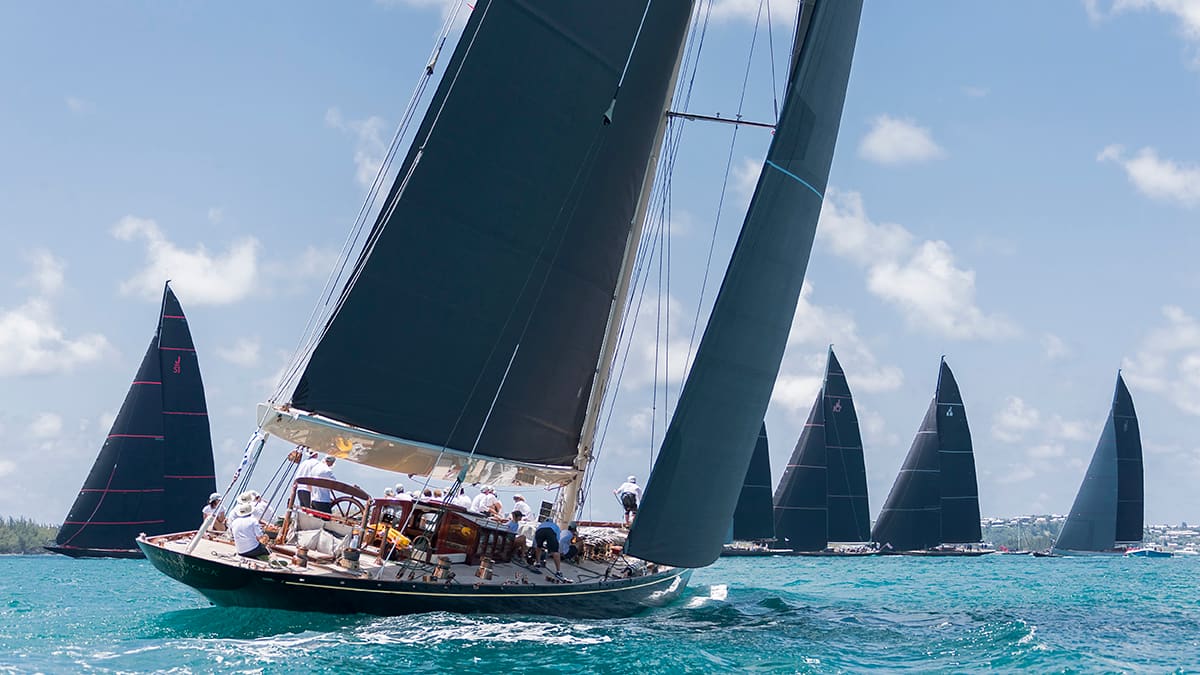
There is a moment, just before the sail unfurls, when the sea seems to hold its breath. Then seven thousand square feet of canvas catches the wind, and a hull designed in the 1930s begins to move with the kind of authority that silences conversation on every nearby deck. Twenty-five crew members shift in practiced synchrony, lines tighten, and the yacht leans into the turn with a grace that belongs to another era entirely.
At Global Chic Voyage, we have watched this choreography return to the Mediterranean over recent seasons, but this year the phenomenon has reached critical mass. A fleet of J-Class sailing yachts, ranging from 119 to 140 feet, has descended on these historic waters, bringing with them not merely a revival of vintage racing but a rekindling of what Louise Morton, class secretary of the J-Class Association, calls "the ultimate yacht to own and race." These are not museum pieces. They are working vessels piloted by a generation of owners who take the helm themselves, who understand the heritage they are stewarding, and who are willing to bear the considerable costs of keeping these giants competitive.
Replicas with Real Ambition
Rainbow offers a telling case study. The yacht is a 2012 replica of the 1934 original commissioned by railway magnate Harold Vanderbilt, and it now belongs to Peter Harrison, chief executive of Richard Mille EMEA. Harrison captains the vessel himself, a detail that distinguishes this new cohort from the industrialists of the 1930s who often left the sailing to hired professionals. Hanuman, a 2009 replica of Endeavour II, has similarly passed into the hands of Italian sailor Giovanni Lombardi Stronati, who acquired the yacht from Netscape founder Jim Clark and has taken over piloting duties.
Both will face Svea when the fleet gathers at Les Voiles de Saint-Tropez in late September. Svea, owned by Swedish entrepreneur Niklas Zennström, holds a particular place in the lineage: at 143 feet, it is the longest J-Class yacht ever constructed. Based on 1937 plans by a Swedish naval architect, the design took eight decades to realize, finally launching in 2017. Since then, Svea has dominated the race circuit with a consistency that suggests the original designers understood something about hydrodynamics that still holds true. Rainbow and Svea met earlier in the season at the Superyacht Cup Palma Richard Mille, and the competition was close enough to promise drama in Saint-Tropez.
Lionheart, built in 2010 to historic specifications, rounds out the roster of crowd favorites. These replicas showcase the original J-Class proportions - the slender hulls, the towering sail plans, the long overhangs that seem to defy practicality - while incorporating modern aluminum construction, composite rigging, and sail technology that would have astonished the yacht clubs of Newport and Cowes.
The Survivors and Their Restorations
In the 1930s, ten original J-Class yachts competed on the international regatta circuit. Of those, only three British vessels survived: Shamrock V, Endeavour, and Velsheda. The six American examples were dismantled for scrap, a fate that seemed to seal the class into history. In the early 1980s, American heiress Elizabeth Meyer intervened, bringing Shamrock V and Endeavour back to racing condition and prompting a renewed fascination with the class.
Shamrock V, originally built for Sir Thomas Lipton, remains the most storied of the survivors. The yacht has just emerged from a four-and-a-half-year restoration involving 247,000 man hours, according to the J-Class Association. Plans call for participation in two regattas in Greece, followed by a guest appearance at the 38th America's Cup in Naples next year. The new owner, a longtime sailor who prefers to keep a low profile, describes coming off the boat "feeling as if you've honored the elements and the core of our sport," admitting to wearing an "ear-to-ear grin whenever we're sailing in a blow."
These restorations have remained faithful to the original lines while incorporating modern engineering and operating systems, plus larger interiors that make extended cruising feasible. Velsheda, for instance, has sailed to New Zealand via the Panama Canal, while others have logged thousands of miles under hull. The yachts were designed for speed, but they have proved remarkably capable as long-range cruising vessels - a testament to the original naval architects who understood that elegance and seaworthiness need not be mutually exclusive.
Why the J-Class Endures
Six modern replicas have now been completed, and a seventh - a replica of the 1930 America's Cup defender Yankee - is currently under construction. If realized, Yankee would return the global J-Class fleet to ten strong, the same number that raced in the class's heyday. Wick Hillege, a naval architect with Dykstra, the Dutch firm involved in the refit or rebuild of six J-Class yachts plus Yankee, believes the central mission should remain racing, just as it was in the glory days. "We focus on making sure their maximum performance potential can be achieved," Hillege notes.
The replicas may be faster, benefiting from advances in materials and computational fluid dynamics, but the visual appeal remains rooted in proportions established nearly a century ago. "That's the styling that somehow always works," Hillege observes. "Especially that link to the past." The slender hulls, the immense sail plans, the long bow overhangs - these elements create a silhouette that registers as both powerful and refined, a combination rare in contemporary yacht design.
At a time when the superyacht world often prioritizes volume over line, the J-Class offers a counterargument. These yachts command attention not through sheer mass but through movement, through the way they lean into a gust, through the choreography of their crews. They are theatrical in the best sense, vessels that transform sailing from sport into spectacle without sacrificing competitive edge.
The New Stewards
What distinguishes this revival is the character of the new owners. Many are accomplished sailors in their own right, entrepreneurs and executives who have chosen to invest not merely in a trophy asset but in an active participation in sailing culture. They take the helm, they race, they accept the considerable costs of maintaining a yacht that requires a full-time crew and specialized support. This is not passive ownership.
The phenomenon suggests something broader about the luxury travel landscape. As we have noted in previous observations, there is a growing appetite among high-net-worth individuals for experiences that demand mastery, that connect to heritage, that cannot be replicated through technology alone. The J-Class revival fits neatly into this pattern. These are yachts that require skill to sail, that carry the weight of history, that offer a form of beauty increasingly rare in a world optimized for efficiency.
When the fleet gathers in Saint-Tropez in late September, the spectacle will be as much about continuity as competition. The sight of four or five J-Class yachts racing, sails billowing above those graceful hulls, is - as Louise Morton suggests - simply breathtaking. It is also a reminder that certain designs transcend their era, that elegance has a longer half-life than fashion, and that the past, when stewarded with care, can still move faster than the present.
Photo: Carlo Borlenghi
Spot something wrong? Email editors@globalchicvoyage.com. We log every correction publicly.
RELATED
SEE ALL →
14 Jul 2026 / 5 min
29 May 2026 / 5 min

29 Jul 2026 / 5 min

8 Aug 2026 / 5 min