
The Earth’s Landscapes That Feel Unreal, Yet Exist (Part 1)
c
HG
14 Feb 2026 · 5 MIN READ · UPDATED 17 AUG 2026
Some places on the Earth make you do a double take, where colors look edited, horizons melt away, and rock formations feel straight out of fantasy. But these landscapes aren’t illusions. They’re the real work of wind, water, and time on an epic scale. In a world of filters and CGI, the planet still delivers scenes that feel unreal in the best way. From mirror-like salt flats to glowing canyons and surreal stone towers, these destinations prove that wonder doesn’t need special effects. It’s already waiting out there, just beyond the familiar.
1) Salar de Uyuni, Bolivia
At more than 10,000 square kilometers, Salar de Uyuni is Earth’s largest salt flat, and when the rainy season arrives, it becomes the world’s biggest natural mirror. A thin film of water transforms the ground into a flawless reflection of sky and cloud, dissolving the horizon into an infinite blue loop. Walking here feels like stepping into a dream where gravity loosens its grip and distance becomes a trick of the eye. Beneath the blinding white crust lies a vast store of lithium-rich brine, but the surface itself is what mesmerizes: hexagonal salt patterns etched like sacred geometry across the plain. Sunrises ignite the flats with pastel fire; sunsets soften them into pearlescent quiet. Photographers chase the illusion, travelers linger in stunned silence, and even the wind seems to tread lightly, as if afraid to disturb the mirage.

Photo Credit: Heiko Meyer, laif/Redux
2) Fly Geyser, USA
In the middle of Nevada’s arid plains, Fly Geyser looks like a sci-fi prop left behind by another civilization. Superheated water erupts from a man-made well that was accidentally drilled in the 1960s, creating a constantly growing mound of mineral terraces. Thermophilic algae paint the rock in neon greens, fiery reds, and buttery yellows, while steam rises in ghostly plumes. The colors shift with temperature and light, giving the formation a living, breathing quality, as if the earth itself were exhaling pigment. Water trickles down the bulbous cones in warm rivulets, forming small, shimmering pools that reflect the sky. Against the stark desert backdrop, the geyser’s otherworldly palette feels almost artificial. Yet every hue is natural, created by heat, minerals, and microscopic life collaborating in a slow, ongoing artwork that never looks the same twice.

Photo Credit: Wonder Out
3) Antelope Canyon, USA
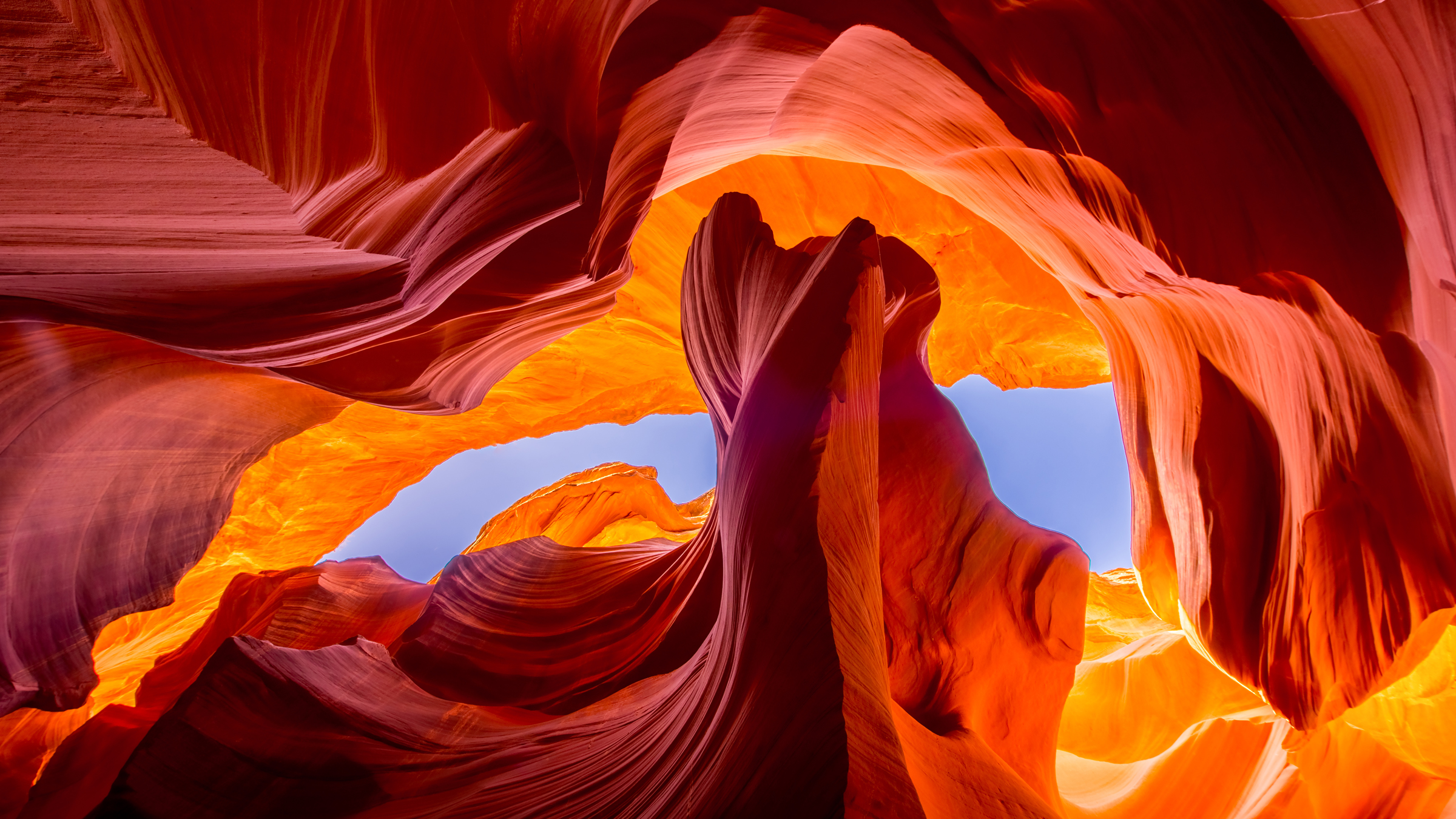
Carved by flash floods and time, Antelope Canyon is a cathedral of curves hidden beneath the desert. Its narrow corridors twist into flowing walls of rust, rose, and gold, polished smooth by rushing water. At midday, sunbeams pierce the ceiling and scatter into glowing shafts that look like solid light, drifting through the dust. The canyon breathes color as the hours pass - cool violets in the morning, molten oranges by noon, deep umbers at dusk. Every step reshapes the scene; every turn reveals a new sculpture of stone. The silence feels reverent, broken only by the hush of sand underfoot. Though the canyon’s beauty is gentle, its creation was sudden and fierce - storms that roared through in minutes, chiseling elegance from violence. It’s a reminder that the most delicate forms can be born from the wildest forces.

Photo Credit: Highländer Reisen GmbH
4) Pamukkale, Türkiye
From afar, Pamukkale looks like a hillside dusted in snow, but step closer and you’ll find warm mineral water pooling in luminous terraces of white travertine. Calcium-rich springs cascade down the slope, leaving behind scalloped basins that glow turquoise under the sun. The textures are soft to the eye and glassy to the touch, a chalky dreamscape sculpted drop by drop over millennia. As you wade barefoot from pool to pool, steam lifts into the air and the light refracts through rippling water, painting the stone with shifting blues. Ancient travelers once came here for healing; modern ones come for awe. The contrast is surreal: a wintery palette in a Mediterranean climate, warm water flowing over cool-white steps. At golden hour, the terraces blush peach and pearl, turning the hillside into a living sculpture garden.

Photo Credit: Barry Neild
5) Wulingyuan Scenic Area, China
A labyrinth of quartz-sandstone pillars, ravines, and forested valleys, Wulingyuan feels like a vertical planet layered onto our own. Thousands of rock columns surge skyward, some crowned with trees that cling to impossibly narrow ledges. Waterfalls thread through the cliffs, and distant peaks dissolve into vapor, creating depth that seems to fold in on itself. Paths and suspension bridges reveal shifting perspectives - one moment you’re gazing down into emerald hollows, the next you’re level with cliff faces streaked in mineral hues. The scale is dizzying, but the details are intimate: moss softening stone, birdsong echoing through canyons, the faint perfume of pine. As clouds drift, entire mountains appear and vanish, turning the landscape into a slow-motion magic trick. It’s not just dramatic; it’s dynamic, always rearranging itself with light and weather.

Photo Credit: John Misachi
6) Socotra Island, Yemen
Socotra Island feels like a biological remix of Earth, a place where evolution took an experimental turn and never looked back. Towering dragon blood trees spread their umbrella canopies over rocky plateaus, their crimson sap giving the landscape a mythic aura. Succulent bottle trees swell with stored water, twisting into forms that look sculpted rather than grown. More than a third of Socotra’s plant life exists nowhere else, turning every hike into a walk through a living museum of oddities. The coastline is equally surreal: chalk-white dunes spill into electric-blue water, and limestone caves yawn open like secret doors to another era. Isolation has preserved this ecosystem in a state of beautiful strangeness, where familiar rules of shape and proportion seem gently ignored. Being here doesn’t just feel remote, it feels like visiting a parallel version of our planet.

Photo Credit: Rachel Carr
7) Namib Desert, Namibia
The Namib Desert is a study in color and emptiness: rust-red dunes rising from pale sands, their curves sharpened by wind into calligraphy. At dawn, long shadows paint the ridges in ink-black lines; by noon, the dunes glow ember-bright against a cobalt sky. Dead trees in ancient clay pans stand frozen mid-gesture, their dark silhouettes stark against blinding ground - life paused in a place where time stretches thin. Fog from the Atlantic creeps inland at night, beading moisture onto beetles and grasses that survive on breath alone. The silence is vast, but the desert is alive with micro-miracles: footprints that vanish by afternoon, whispering sands that sing underfoot, and heat that shimmers the horizon into mirage. It’s a landscape that feels elemental, pared down to the raw poetry of light, wind, and space.

Photo Credit: Rebecca Lancaster
8) Lake Hillier, Australia
Bubblegum-pink from shore to shore, Lake Hillier looks like it was poured from a paint tin onto the coast. The color holds year-round, believed to come from salt-loving algae and microorganisms that tint the brine. From above, the lake glows neon against a ribbon of white salt and the deep navy of the Southern Ocean - three colors, impossibly saturated, arranged like a graphic designer’s dream. Up close, the water remains rosy in your hands, the hue stubbornly real. The lake’s surface is calm and glassy on still days, reflecting sky into a pastel gradient. It’s the kind of sight that short-circuits skepticism; you expect the pink to fade as you approach, but it doesn’t. Nature, unapologetically bold, keeps the pigment turned all the way up.

Photo Credit: Cotswold Outdoor
9) Fairy Pools, Scotland
On the Isle of Skye, clear mountain streams tumble into the Fairy Pools - tiered basins of water so transparent they look unreal. The pools glow aquamarine against dark volcanic rock, fed by waterfalls that ribbon down from jagged peaks. Mist drifts low, softening edges; sudden sun breaks turn the water into liquid light. The setting feels enchanted, as if the landscape itself is whispering old stories into the wind. Brave swimmers plunge into the glacial cold, their breath blooming into the air, while others linger on the stones, hypnotized by the flow. The soundscape is pure elemental music: rush, splash, hush. With every bend in the path, another pool reveals itself, each slightly different in color and depth, like a string of gemstones laid across the valley floor.

Photo Credit: Mark Bulmer
10) Giant's Causeway, Northern Ireland
The Giant’s Causeway looks engineered by myth. Tens of thousands of interlocking basalt columns step down into the sea, their hexagonal tops fitting together like a cosmic puzzle. Formed by ancient volcanic flows cooling and cracking, the stones create natural causeways, amphitheaters, and honeycomb pavements along the coast. Waves slap against the dark rock, sending spray into the air as seabirds wheel overhead. In shifting weather, the columns change mood - slick and obsidian under rain, silvered with salt in sun. Legends of giants striding across the water linger in the atmosphere; the geometry feels too intentional to be accidental. Stand on the stones and the coastline curves away in rhythmic patterns, a reminder that geology can be as precise and poetic as any human design - only slower, deeper, and far more patient.

Photo Credit: Andrea Pistolesi
What makes these places unforgettable isn’t just how unreal they look, it’s how real they feel when you’re standing there. Cold stone under your hands. Wind in your ears. Silence stretching wide. The illusion fades into awe. These landscapes don’t just photograph well; they reset your sense of scale and possibility. Travel far enough, and the world stops feeling ordinary, not because it’s fake, but because it’s far more imaginative than we expect.
Spot something wrong? Email editors@globalchicvoyage.com. We log every correction publicly.
RELATED
SEE ALL →
21 May 2026 / 5 min
20 May 2026 / 5 min
24 Apr 2026 / 5 min
20 Apr 2026 / 5 min