
Where The Trails Still Hold Silence: Following The Manaslu Circuit Before The World Arrives
Manaslu Circuit
SI
20 May 2026 · 5 MIN READ · UPDATED 17 AUG 2026
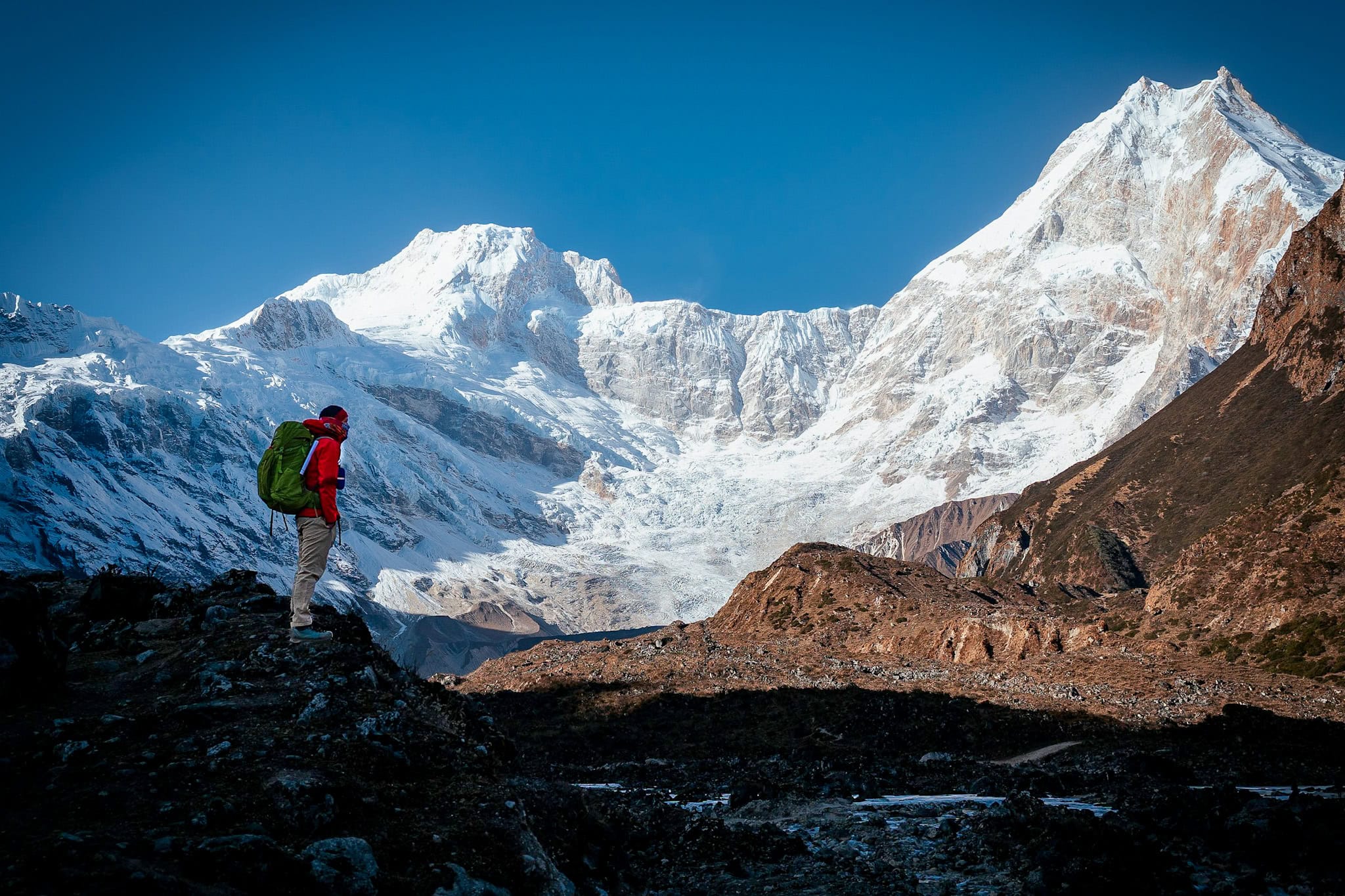
The Last Light Before Larke Pass
The guide's name is Raju, and at sunrise he is a silhouette - one arm raised, the other steadying a trekking pole, his figure cut sharp against a sky the color of apricot and ash. We are somewhere above 4,800 meters, an hour's walk from Larke Pass, and the cold is the kind that finds the seams in your down jacket and stays there. No one speaks. The trail is a thin scar of switchbacks, and the only sound is boot on stone, breath measured in the thin air. This is the Manaslu Circuit, and for now, perhaps not for long, it remains what the Annapurna Circuit once was: a trek through a landscape that has not yet been paved, packaged, or Wi-Fi'd into submission.
We've watched Nepal's trekking corridors undergo a kind of gentrification over the past decade - teahouses upgraded to lodges, trails widened for porters with solar panels, the wilderness incrementally tamed. The Manaslu Circuit, which arcs through the restricted northern reaches of Nepal along the Tibetan border, has largely escaped this. Not because it isn't stunning, it is, relentlessly so, but because it remains difficult. Twelve days, most of them steep. One high pass at 5,106 meters. No road access for much of the route. And a permit system that, until recently, required trekkers to travel with a guide and in groups, a regulation that kept the Instagram hordes at bay.

Photo Credit: Circuit Trek Manaslu
A Geography of Verticality
The circuit begins in Soti Khola, a river town in the humid lowlands where the Budhi Gandaki River churns through a gorge so narrow that in places the trail is blasted into the cliff face. You climb. For days, you climb. Through subtropical forest thick with rhododendron and bamboo, past terraced fields of millet and barley that cling to slopes at angles that seem to defy both physics and hope. The villages - Lapubesi, Jagat, Philim - are small, stone-built, their roofs weighted with slate. Prayer flags snap in the wind. Children watch from doorways. Yaks, indifferent and massive, block the trail.
What strikes you first is not the altitude but the architecture of the land itself. This is a vertical world, where every gain in elevation comes with a corresponding view into geological time. The Budhi Gandaki has carved a canyon so deep that at midday, sunlight reaches the trail for only a few hours. The river, gray with glacial silt, roars below. You cross it on suspension bridges that sway and creak, the kind of crossings that require a certain fatalism and a good breakfast.
By the time you reach Samagaon - roughly the halfway point, at 3,500 meters - the landscape has shifted. The jungle is gone. The air is thinner, drier, scoured by wind that comes down off the Tibetan Plateau. The villages here are Tibetan Buddhist, their gompas older than the trails themselves. Manaslu, the eighth-highest mountain in the world at 8,163 meters, dominates the skyline, a white fang that seems to float above the ridgeline, detached from the earth. You begin to understand why the mountain's name, in Sanskrit, means "Mountain of the Spirit".

Photo Credit: Skyline Treks and Expedition
The Rhythm of the Remote
What the Manaslu Circuit offers, more than views or vertigo, is a kind of temporal displacement. Life here still follows the cadence of subsistence agriculture, of harvest and monsoon, of yak caravans that move salt and wool between Nepal and Tibet. There are no roads. Supplies arrive on the backs of porters or animals. Electricity, where it exists, is solar or micro-hydro, prone to failure. In the teahouses, simple lodges where trekkers sleep in unheated rooms and gather around woodstoves for dal bhat and conversation, the evenings are long and analog. No one checks their phone because there is no signal to check.
This is not poverty tourism, nor is it some Shangri-La fantasy. The people who live along the circuit are not museum pieces. They have smartphones, when there's signal in the larger villages. They watch Bollywood films on solar-charged tablets. But the infrastructure of modernity - roads, clinics, schools with more than two rooms - has not yet arrived in force, and so the rhythms of life remain legible in a way they are not in Kathmandu or Pokhara. You see it in the way women still card wool by hand, in the gompas where monks chant at dawn, in the stone walls that have been rebuilt, stone by stone, after every earthquake.
And there have been earthquakes. The 2015 quake that devastated Nepal also hit this region hard. In some villages, the old gompas are still cracked, their murals faded and patched. The recovery has been slow, underfunded, carried out largely by the communities themselves. This, too, is part of the circuit's reality - a reminder that remoteness is not always romantic.

Photo Credit: Treklanders
Larke Pass and the Long Descent
The crossing of Larke Pass is the trek's crux, both literally and psychologically. You leave before dawn from Dharamsala, a cheerless collection of stone huts at 4,460 meters, and climb for four hours in the dark. The air is so cold it burns. The trail is a moraine of loose scree and ice, and every step requires negotiation. By the time the sun rises, you are above 5,000 meters, and the landscape has become purely mineral—no vegetation, no water, just rock and snow and sky.
From the pass itself, the view is almost absurdly cinematic: Manaslu to the west, Cheo Himal and Himlung Himal to the north, the Annapurna range distant and hazy to the south. You take photos, though no photograph will convey the cold or the thinness of the air or the strange, lightheaded euphoria that comes with altitude. Then you descend. Steeply. For hours. By the time you reach Bimthang, your knees are shot and your lungs are grateful for the thicker air, and you sleep the sleep of the justifiably exhausted.
The final days of the circuit are a long, gentle descent through pine forest and terraced fields back toward the roadhead at Dharapani, where jeeps wait to carry trekkers back to Kathmandu. The transition is abrupt, almost jarring. One day you are in a village where the only sound is wind and prayer bells; the next, you are in a dusty town where motorcycles roar and Hindi pop blares from teahouse speakers. The circuit, in this sense, is also a circuit of time - a loop that takes you backward and then snaps you forward, the whiplash of re-entry.

Photo Credit: Mark Barnes
A Guide to the Manaslu Circuit Adventure
Typically completed within 14-18 days, the trek is considered moderate to challenging due to its altitude, rugged terrain, and long trekking hours. Proper preparation is essential. Trekkers are advised to train with endurance walks or hikes before the journey and allow enough time for acclimatization to reduce the risk of altitude sickness. Packing layered clothing is highly recommended, as temperatures can shift dramatically between sunny valleys and high mountain passes.
As the Manaslu region is a restricted area, travelers must obtain special permits and trek with a licensed guide in a group of at least two people. Hiring local guides and porters not only enhances safety and navigation but also supports mountain communities along the route. The best trekking seasons are spring (March to May) and autumn (September to November), when weather conditions are most stable and visibility across the Himalayas is at its clearest. During these months, visitors can also experience vibrant local culture, from Buddhist monasteries and prayer wheels to traditional stone villages shaped by centuries of Himalayan life.
For a more comfortable experience, it is advisable to carry cash, portable chargers, water purification tablets, and basic medication, as facilities become increasingly limited in higher elevations. Choosing teahouse accommodations along the route also offers a unique opportunity to connect with local hospitality while experiencing the slower rhythm of mountain life.
Why It Matters
The Manaslu Circuit will not remain quiet forever. Nepal's government, eager to spread trekking traffic beyond the overcrowded Annapurna and Everest Base Camp routes, has been gradually easing restrictions. Solo trekking is now permitted with the right permits. Lodges are being upgraded. A road, paved in sections, is slowly creeping up the Budhi Gandaki Valley, and with it will come the usual entourage of modernity - motorbikes, litter, the noise.
This is not necessarily a tragedy. Roads mean access to healthcare, education, markets. They mean that porters do not have to carry 40-kilo loads on their backs for days. But they also mean that the circuit, as it exists now, will change. The silence will be punctured. The sense of remoteness, of having to earn the landscape through effort and discomfort will diminish. What we are witnessing, in real time, is the closing of a window.
For those of us who believe that travel, at its best, is not about comfort but about encounter with landscape, with culture, with the limits of one's own endurance the Manaslu Circuit remains one of the few places in the Himalayas where that encounter is still possible on terms that feel unmediated. It asks something of you. It does not apologize for its difficulty. And in return, it offers what cannot be built or bought: the experience of moving through a world that is still, for the moment, larger than you are.
The Window, While It's Open
We returned to Kathmandu in the back of a jeep, the kind with no shocks and a driver who treated the dirt road like a rally course. Raju, the guide, sat beside me, scrolling through photos on his phone—pictures of his daughter's school play, of his wife's vegetable garden in Pokhara. He had walked the circuit more than 30 times. I asked him if it had changed much.
"Every year, a little," he said. "More lodges. More trekkers. But still, it is quiet. For now."
For now. That is the phrase that hangs over every remote place, every trail that has not yet been paved into accessibility. The Manaslu Circuit is not a secret, it appears in guidebooks, on trekking agency itineraries, in the aspirational Instagram feeds of adventure travelers. But it remains, for the moment, a place where the journey is still difficult enough to matter. Where the mountains are still bigger than the infrastructure. Where the silence, at dawn, is still unbroken. Go now, or go prepared to find something different. Either way, go.
Spot something wrong? Email editors@globalchicvoyage.com. We log every correction publicly.
RELATED
SEE ALL →
11 Apr 2026 / 5 min
24 Mar 2026 / 5 min

21 May 2026 / 5 min
24 Apr 2026 / 5 min