
The Adriatic Peninsula Where Limestone Cliffs Meet Forgotten Villages
Gargano's quiet coves and Michelin tables offer a slower, more intimate portrait of coastal Italy than the crowded trails of Liguria.
SI
27 Jun 2026 · 5 MIN READ · UPDATED 17 AUG 2026
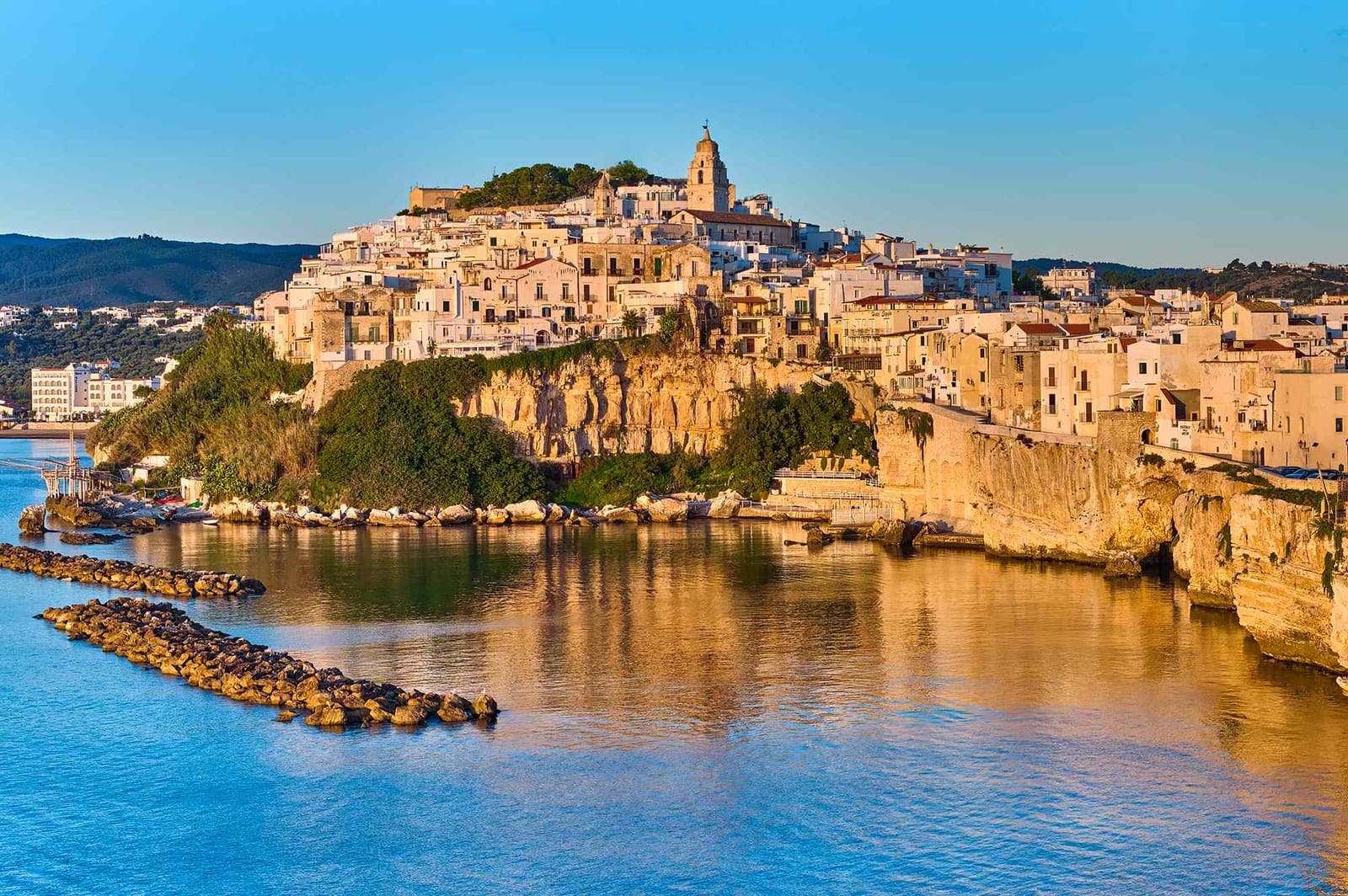
The Geography of Solitude
There is a moment, late afternoon on the Gargano Peninsula, when the light turns the Adriatic the colour of oxidised copper and the limestone cliffs seem to exhale. The tourists who filled the piazzas of Rome and Venice are elsewhere; here, in the spur of Italy's boot, the coast belongs to fishermen hauling octopus pots and elderly women selling figs from wicker baskets. At Global Chic Voyage, we have watched the pendulum of Italian tourism swing predictably between the same gilded names, season after season. Gargano remains outside that rhythm, a dramatic promontory in Puglia where the infrastructure of mass travel has yet to flatten the contours of daily life.
The peninsula juts into the Adriatic like a geological afterthought, its interior a patchwork of ancient forest and karst plateau, its coastline a succession of secret coves accessible only by footpath or small boat. Unlike the Cinque Terre, where painted villages cling to cliffs in orchestrated harmony, Gargano's settlements feel accidental, grown organically from the needs of defence, fishing, and pilgrimage rather than the demands of the camera lens.
Villages That Refuse the Script
The towns here do not perform. Vieste, perched on a spit of white rock, retains the spatial logic of its medieval past: narrow streets designed to confuse invaders, whitewashed houses that deflect the summer glare, a cathedral built from the same limestone as the cliffs beneath it. Peschici, further west, tumbles down its promontory in a cascade of cube-shaped dwellings, their flat roofs a nod to centuries of Arab influence. There are no queue systems, no timed entry slots, no influencers staging the same shot on the same staircase.
What these villages offer instead is a quality increasingly rare along Italy's coasts: the possibility of solitude. You can walk the lungomare at dawn and encounter only the rhythmic slap of fishing boats against their moorings. You can sit in a family-run trattoria and eat orecchiette with cime di rapa prepared by the same hands that kneaded the dough, no English menu in sight. The charm is not curated; it is structural, embedded in an economy that has not yet reorganised itself entirely around the visitor.
The Coves That Cartographers Forgot
Gargano's true treasures lie between its towns, in the coves and sea caves that punctuate the coastline like ellipses in a long, geological sentence. These are not beaches in the Amalfi sense, groomed and umbrellaed and accessible by funicular. They are pebbled crescents reached by steep descents, limestone grottoes that glow turquoise at midday, stretches of sand so small they appear on no official map.
The Baia delle Zagare, flanked by twin sea stacks, can be approached by a serpentine road that tests both nerve and suspension, or by boat from Mattinata. The reward is a beach hemmed in by cliffs so white they seem to vibrate in the sun, water so clear you can count the ribs of sand beneath the surface. There is a single beach club, modest and family-run, selling cold beer and panini. The rest is silence and the slow metronome of waves.
Further along, the Grotta Smeralda and the Grotta Campana Piccola reveal the sculptural work of millennia, seawater carving chambers and arches into the karst. These are not attractions in the commercial sense; there are no ticket booths, no guided tours on the hour. You hire a local fisherman in Vieste or Peschici, and he takes you at his own pace, pointing out the places where light refracts in ways that seem almost sacramental.
Tables Where the Land Speaks
In recent years, Puglia has emerged as one of Italy's most dynamic food regions, and Gargano has quietly contributed to that narrative. The peninsula's Michelin-starred tables are few, but they share a common philosophy: hyper-locality, an almost forensic attention to the produce of the immediate landscape. The macchia mediterranea, the dense scrubland that blankets much of the interior, yields wild fennel, capers, and herbs that appear on menus with the reverence usually reserved for truffles.
At a small restaurant in the hills above Peschici, the chef forages daily, returning with puntarelle, agretti, and wild asparagus that will appear that evening alongside line-caught branzino and handmade cavatelli. The wine list leans heavily on Puglian varietals, Nero di Troia and Bombino Bianco, wines that taste of sun and limestone and the particular minerality of this coast. The dining room overlooks the sea, but there is no attempt to compete with the view; the food is confident enough to hold your attention.
This is not the Michelin dining of white tablecloths and synchronized service. It is something quieter, more rooted, a conversation between kitchen and landscape that happens to take place in a room with a star by the door. The experience is cumulative: the tomatoes grown in volcanic soil, the olive oil pressed from centuries-old groves, the bread baked in wood-fired ovens that have never been turned off. It is a cuisine of place, not concept, and it resists export.
The Pilgrim Roads and the Forests In Between
Gargano is also a landscape of devotion. The sanctuary of Monte Sant'Angelo, perched at the peninsula's highest point, has drawn pilgrims since the fifth century, when the Archangel Michael is said to have appeared in a cave. The town itself is a vertical maze of stone, its streets so steep they require handrails, its cathedral a palimpsest of Norman, Byzantine, and Baroque layers. The pilgrimage route, the Via Sacra Langobardorum, winds through the interior, connecting Monte Sant'Angelo to the coastal towns in a network that predates modern tourism by more than a millennium.
Between the sanctuary and the sea lies the Foresta Umbra, one of the last remnants of the ancient forest that once covered much of southern Italy. Beech and oak rise to cathedral heights, filtering the light into a green dimness that feels almost northern. There are walking trails, some marked, some not, and in autumn the forest floor is carpeted with porcini. It is a landscape that asks for slowness, for attention to the particular quality of silence that exists only under old trees.
Why Gargano Endures
The question is not why Gargano remains overlooked; the question is how long it can stay that way. The mechanisms that transformed the Cinque Terre from working fishing villages into a UNESCO-listed theme park are already visible here in nascent form: the boutique hotels opening in restored masserie, the tour operators beginning to include Gargano in their Puglia itineraries, the first tentative appearances of the peninsula on travel blogs and Instagram grids.
But for now, the balance holds. The coast is still dramatic enough to deter the casual visitor, the infrastructure still modest enough to prevent the kind of volume that erodes authenticity. The villages still function primarily for the people who live in them, and the restaurants still cook for local palates first, tourists second. The coves remain secret not because they are hidden, but because they require effort, a willingness to walk down a cliff path or negotiate with a fisherman in halting Italian.
At Global Chic Voyage, we have learned to recognise the signs of a place on the cusp, that brief window when a destination is known enough to have the essentials but unknown enough to retain its character. Gargano is in that window now. The Michelin stars are lighting up, the design hotels are arriving, but the essential rhythms, the ones dictated by tide and season and the stubborn persistence of tradition, have not yet been overwritten.
The traveller who arrives now will find a coast that still feels like a discovery, villages that have not yet learned to perform their own histories, tables where the food tastes of a specific hillside rather than a global aesthetic. It is a rare configuration, and it will not last forever. But for this moment, on this particular stretch of the Adriatic, the drama is still geological rather than commercial, and the quiet is still real.
Photo: Andrea Pistolesi / Getty Images
Spot something wrong? Email editors@globalchicvoyage.com. We log every correction publicly.
RELATED
SEE ALL →
30 Jul 2026 / 5 min
29 Jul 2026 / 5 min
8 Aug 2026 / 5 min
7 Aug 2026 / 5 min