
Five Days in Mongolia: A Journey Between Ancient Stone and Living Tradition
From horseback rides across the steppe to quiet evenings in ger camps, a first-time visitor's route through one of the world's last nomadic landscapes.
YN
22 Jul 2026 · 5 MIN READ · UPDATED 17 AUG 2026
The Steppe Opens, Slowly
There is a particular silence that settles over the Mongolian steppe at dusk. Not the absence of sound, but something denser: the wind threading through wild grasses, the distant clatter of a herd moving toward water, the creak of a ger's wooden lattice as the temperature drops. At Global Chic Voyage, we've long believed that Mongolia rewards the traveler willing to move at a slower cadence, to let the landscape reveal itself in layers rather than landmarks. For those arriving for the first time, the question is rarely what to see but how to see it, how to balance the immensity of the land with the intimacy of its human rhythms.
The itinerary that follows is not a checklist. It is a framework built on the understanding that Mongolia's allure lies as much in its continuities as in its contrasts: the persistence of nomadic lifeways alongside a capital city humming with galleries and design studios, the conversation between ancient rock art and contemporary visual practice. We've structured five days to allow for both movement and stillness, for encounters with families whose ancestors have herded these valleys for generations, and for moments alone on horseback when the only direction is forward into the endless open.
Day One: Ulaanbaatar and the Weight of History
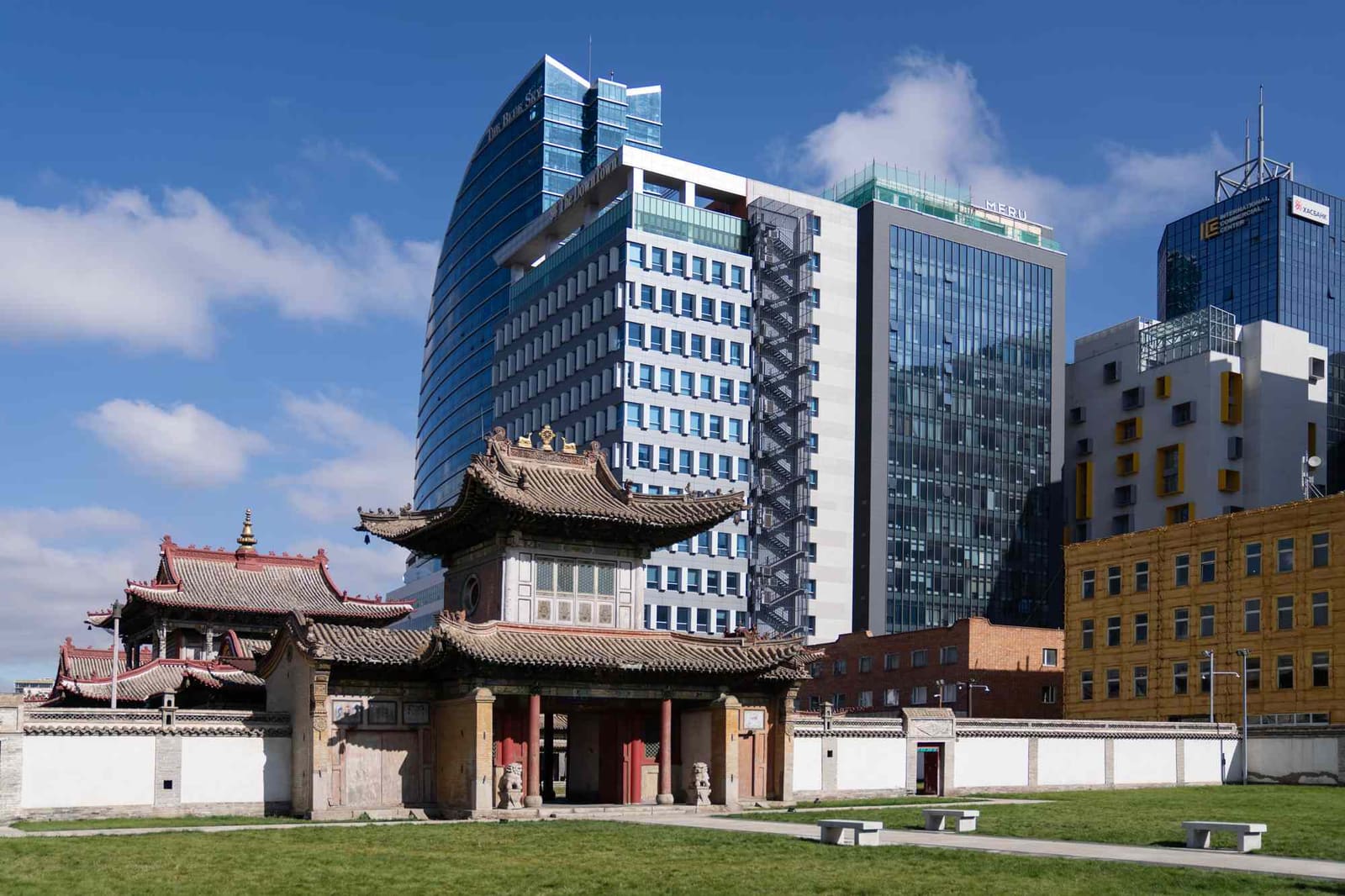
Begin in Ulaanbaatar, not as a gateway to be rushed through but as a city worth pausing in. The National Museum of Mongolia offers context that will deepen everything that follows: galleries devoted to Bronze Age deer stones, Xiongnu burial goods, the material culture of pastoralism. Spend the morning here, then walk south to Zanabazar Fine Arts Museum, where Buddhist sculpture and thangka paintings trace the spiritual lineage of the region. The city's Soviet-era apartment blocks and glass-fronted hotels create a visual dissonance that is, in itself, part of the story: Mongolia's negotiation between tradition and modernity is not resolved but ongoing, visible in architecture and daily life alike.
By late afternoon, make your way to one of the contemporary art spaces that have proliferated in the past decade. The 976 Art Gallery and Mongolian National Modern Art Gallery both showcase work by painters, photographers, and installation artists grappling with questions of identity, land, and diaspora. At Global Chic Voyage, we've watched Mongolia's art scene mature into one of Asia's most compelling, largely unnoticed by the international circuit. Dinner at a restaurant serving buuz and khuushuur, the steamed and fried dumplings that anchor Mongolian home cooking, grounds the day in flavor and ritual.
Day Two: Into the Steppe, Toward Stone and Sky
Leave Ulaanbaatar early, heading west or southwest depending on which petroglyph sites you prioritize. The drive itself is part of the education: paved roads give way to dirt tracks, settlements thin out, and the steppe unfolds in waves of green and gold. The petroglyphs, carved into dark basalt boulders thousands of years ago, depict ibex, wild horses, hunting scenes, shamanic figures. They are scattered across valleys and ridgelines, often unmarked, requiring a local guide to locate and interpret.
What strikes most visitors is the unmediated encounter with these images. There are no ropes, no explanatory plaques, no admission fees. You stand where the carvers stood, tracing the grooves with your fingers if you choose, the wind constant and the horizon unbroken. The petroglyphs are not museum pieces but living markers in a landscape still used, still inhabited. Nearby, you may see a herding family's ger, smoke rising from the central chimney, horses hobbled in the foreground. The continuity is startling: the same animals, the same mobility, the same relationship to weather and season.
Overnight in a ger camp, a semi-permanent tourist facility that offers a taste of traditional dwelling without the full immersion of staying with a nomadic family. The gers are felt-lined, warmed by a wood-burning stove, furnished simply with low beds and painted chests. Dinner is communal, often featuring mutton stew, airag (fermented mare's milk), and thick slices of bread. After dark, the sky opens into a planetarium of stars, the Milky Way visible in its full arc, undimmed by artificial light.
Day Three: Horseback Across the Valley
Mongolia is best understood from the back of a horse. Arrange a half-day or full-day ride with a local guide, setting out across the steppe at a pace that allows for observation: the roll of the land, the sudden appearance of a creek cutting through grassland, the way a herd of yaks moves as a single organism. Mongolian horses are small, sturdy, and sure-footed, descendants of the mounts that carried Chinggis Khan's armies. They are not schooled for dressage or showjumping but for endurance, for covering distance over terrain that has no roads.
Your guide may lead you to a high overlook, a river crossing, or simply out into the open where the only landmarks are geological: a lone ovoo (stone cairn), a distant ger, the shadow of a cloud moving across the valley. There is a meditative quality to the ride, a rhythm that quiets the mental chatter common to urban life. At Global Chic Voyage, we've found that this is often the day travelers remember most vividly, not for any single event but for the accumulation of small sensations: the creak of the saddle, the smell of horse sweat and wild thyme, the silence broken only by hoofbeats and wind.
Return to camp in the late afternoon. If your hosts are willing, spend time observing the evening routine: milking the mares, bringing in the herd, preparing the fire. These are not performances but daily necessities, the tasks that structure nomadic life. Ask questions, offer to help, but be prepared for the language barrier and the possibility that the family prefers to work without interruption. Respect is shown through attention, not intrusion.
Day Four: A Visit with a Nomadic Family
Arrange a visit to a nomadic family's ger, ideally through a guide who has an established relationship and can facilitate conversation. This is not a cultural exhibit but a home, and the etiquette matters: step over the threshold with your right foot, move clockwise inside the ger, accept the bowl of airag or tea offered upon arrival. The interior is a study in efficiency and symbolism: the hearth at the center, the altar on the north wall, storage chests and bedding arranged around the perimeter, everything within arm's reach.
The family may show you how felt is made, how a ger is disassembled and transported, how cheese is dried on the roof, how a lasso is thrown. These are skills passed down through generations, adapted but not abandoned. Children as young as five or six ride confidently, helping to herd sheep and goats. The economic realities are complex: many families move seasonally, some maintain a second residence in the nearest town for schooling, and the pressures of climate change and market fluctuations are real and growing. But the core practice, the decision to live mobile and land-based, persists.
Conversations, when possible, reveal a worldview shaped by vastness and impermanence. Nomadic families speak of the land not as property but as relationship, a web of knowledge about water sources, grazing cycles, weather patterns. At Global Chic Voyage, we've come to see these visits as lessons in adaptive living, in making do with less, in reading the environment rather than controlling it. Leave a small gift, cash if appropriate, or supplies like flour, tea, or batteries. Avoid photographing people without permission, and be mindful that not every moment is meant to be documented.
Day Five: Return to Ulaanbaatar and the Contemporary Pulse
Drive back to the capital, arriving by early afternoon. Use the remaining hours to revisit the city with fresh eyes, having spent days in the steppe. The contrast is jarring but instructive: traffic, noise, concrete, the bustle of markets and cafés. Stop by the Choijin Lama Temple Museum, a complex of ornate wooden buildings that survived Soviet-era purges, now housing religious art and ceremonial objects. Then return to the contemporary art galleries or seek out smaller studios and design shops where young Mongolian makers are reinterpreting traditional motifs in textiles, jewelry, and printmaking.
Dinner on your last evening might be at a restaurant that bridges the culinary divide: dishes rooted in pastoral ingredients but plated with urban sophistication, airag served alongside natural wine, mutton prepared with techniques borrowed from French or Japanese kitchens. The meal becomes a metaphor for the trip itself, a negotiation between heritage and innovation, between the deep past and the improvised present. At Global Chic Voyage, we've learned that Mongolia's power lies not in its exoticism but in its refusal to be static, in the way it holds multiple temporalities at once.
What to Carry, What to Leave Behind
A few practical notes for those planning a similar journey. Pack layers: the steppe is cold at night even in summer, and weather shifts quickly. Bring a headlamp, a water bottle with a filter, and sun protection. Respect the land by carrying out all waste, including toilet paper. Learn a few phrases in Mongolian (thank you, hello, goodbye) as a gesture of goodwill. And perhaps most importantly, adjust your expectations of comfort and connectivity. Ger camps offer warmth and meals but rarely hot showers or Wi-Fi. The landscape is not designed for convenience but for resilience, and the best way to experience it is to meet it on its own terms.
Mongolia is not an easy destination. It requires patience, flexibility, and a willingness to sit with discomfort. But for travelers seeking something beyond the familiar circuits of luxury hospitality, beyond the curated and the scripted, it offers a rare and necessary recalibration. The steppe teaches slowness. The nomadic families teach humility. The art scene teaches that tradition is not a museum category but a living argument. And the journey itself, whether five days or five weeks, teaches that the most meaningful travel is not about covering ground but about learning to see.
Photo: Kokkai Ng / Getty Images
Spot something wrong? Email editors@globalchicvoyage.com. We log every correction publicly.
RELATED
SEE ALL →
29 Jul 2026 / 5 min
8 Aug 2026 / 5 min
7 Aug 2026 / 5 min
31 Jul 2026 / 5 min