
A Thousand-Year-Old Tower and the Chianti Hills Beyond
In the folds of Tuscany's wine country, a medieval estate where history, hospitality, and hilltop solitude meet.
SI
2 Jul 2026 · 5 MIN READ · UPDATED 17 AUG 2026
A Stone Sentinel in the Vineyards
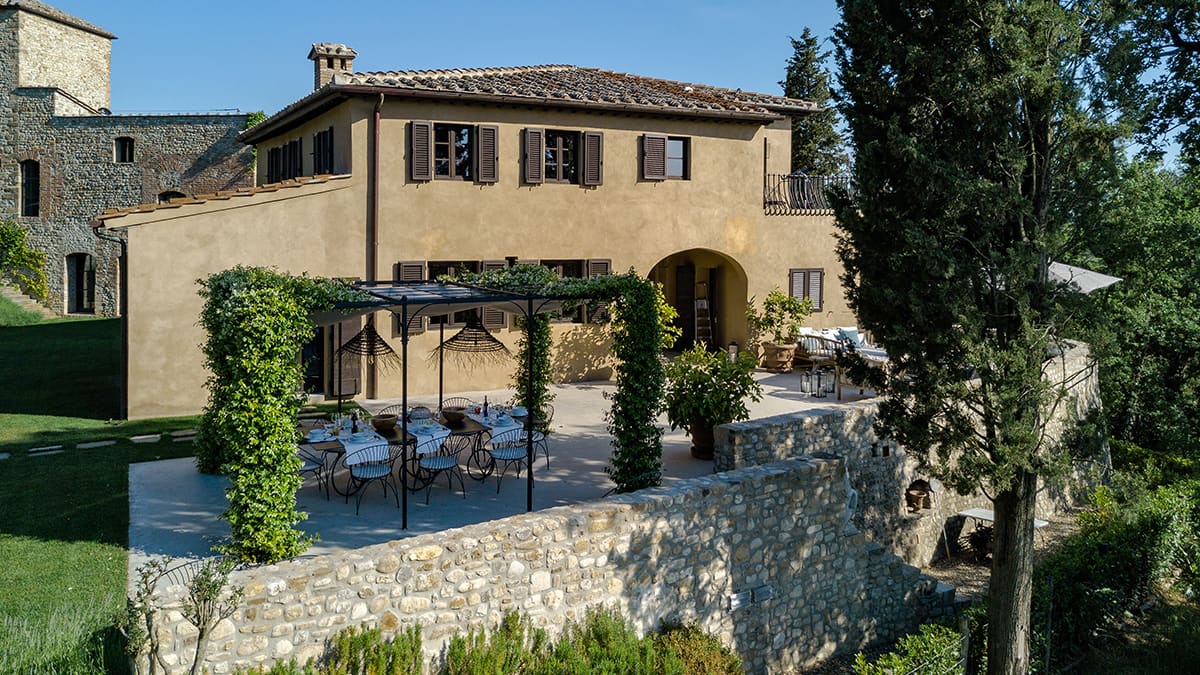
Stand on the terrace of Villa Uglione at dusk and you'll see the Castello di Santa Maria glowing faintly on the next ridge, the Apennine Mountains folding into shadow behind it. The air smells of jasmine and wild fennel. Somewhere below, among the rows of Sangiovese vines, cicadas begin their evening chorus. And rising from the compound like a relic from another century, there is the tower: a thousand years old, built of rough-hewn stone, its walls thick enough to have withstood siege and storm and the slow erosion of time.
At Global Chic Voyage, we've watched Tuscany's real estate market swing between spectacle and substance, between properties that trade on postcard views and those that offer something deeper. Villa Uglione, perched high above the villages of Tavarnelle Val di Pesa and Barberino Val d'Elsa in the heart of Chianti, falls firmly into the latter camp. This is not a villa dressed up for Instagram. It is a working estate, layered with history, where medieval fortifications meet modern wellness architecture and the kind of quietude that money, increasingly, cannot buy.
The property is now on the market through Engel & Völkers Siena, listed at 9.8 million euros. What that figure buys is not simply square footage or a swimming pool with daybeds. It buys continuity, a rare commodity in an age when luxury often feels transient.
The Architecture of Accumulation
Villa Uglione is not a single building but a compound, a palimpsest of eras and intentions. The main residence, about 6,700 square feet across three structures, holds eight bedrooms and seven bathrooms spread over fifteen rooms. The layout reflects centuries of addition and adaptation: the main house with its whitewashed brick and heavy timber ceilings, the medieval tower now converted into guest quarters, and a recently constructed spa annex that functions as a self-contained wellness pavilion.
The main house itself is a study in contrasts. Walk through the living spaces and you'll find Tuscan rusticity, arched brick doorways and wood-beamed ceilings, set against clean-lined midcentury furniture and an eclectic collection of textiles and antiques. The kitchen is sleek and modern, all stainless steel and stone, yet the dining room retains the rough charm of old brick. Downstairs, a wine cellar carved into the hillside offers a cool retreat. Upstairs, the entire top floor is given over to the primary suite: a private terrace, a study, a walk-in closet, and a bathroom large enough to double as a spa.
The tower, once a defensive structure, now houses four bedrooms, two bathrooms, and a spacious living area. Its stone walls are several feet thick, the kind of construction that keeps interiors cool even in the height of summer. The spa annex, by contrast, is entirely contemporary, equipped with a jetted tub, sauna, Turkish bath, and laundry facilities, plus two additional bedrooms for guests or staff. It is a building designed for restoration, both literal and metaphorical.
The Grounds and Their Possibilities
The estate sits on 3.7 acres of terraced land, a modest footprint by Tuscan standards but one that feels expansive thanks to the topography. Olive groves and vineyards cascade down the hillside, and from the highest points, the views stretch uninterrupted toward the Apennines. Planning permission has already been secured for a small guest cottage, a standalone structure with its own living room, bedroom, and bath, an addition that would bring the estate's total footprint to just over 7,000 square feet.
Outside, the grounds are designed for gathering and retreat in equal measure. A gazebo wrapped in jasmine provides a shaded spot for alfresco meals. A bocce court, that quintessentially Italian pastime, occupies a level patch near the main house. The swimming pool is flanked by oversized daybeds, and hidden speakers wired throughout the gardens ensure that music, when desired, follows you from terrace to vineyard path.
There is an intentionality to the landscape, a sense that every element has been placed not for show but for use. This is a property where you can host a dozen friends for a long weekend or disappear into solitude for a month, and both modes feel equally natural.
The Tower as Anchor
If the estate has a symbolic center, it is the tower. Built roughly a millennium ago, it predates the Renaissance, the rise of Florence, the entire modern conception of Italy as a nation. It has witnessed the ebb and flow of empires, the shifting borders of duchies and city-states, the slow transformation of Chianti from a contested frontier into a landscape of ordered vines and stone farmhouses.
Towers like this one were built for defense, but they also served as markers of status and permanence. To own land in medieval Tuscany was one thing; to fortify it was another. The tower at Villa Uglione is not merely an architectural curiosity. It is a statement of continuity, a reminder that luxury, at its most meaningful, is not about novelty but about rootedness.
Today, the tower functions as guest quarters, but its presence shapes the entire estate. It anchors the compound visually and psychologically, a vertical counterpoint to the horizontal sprawl of vineyards and olive groves. It is the reason that Villa Uglione feels less like a villa and more like a small hamlet, a cluster of buildings bound together by history and stone.
A Market Context
Tuscany's high-end real estate market has long been a magnet for international buyers, drawn by the combination of cultural cachet, climate, and proximity to Florence and Siena. But the market is not monolithic. Coastal properties near Porto Ercole or Monte Argentario command different premiums than inland estates in Chianti or Montalcino. And within Chianti itself, there is a hierarchy: proximity to San Gimignano or Greve in Chianti, the condition of the vineyards, the presence or absence of historical structures.
Villa Uglione occupies a particular niche. It is not a working winery, though the land could support small-scale production. It is not a palazzo in the center of a medieval town. What it offers instead is privacy, altitude, and a sense of historical weight. The villages of Tavarnelle Val di Pesa and Barberino Val d'Elsa are quiet, functional places, not tourist magnets, which means the estate benefits from proximity to infrastructure without the crowds.
At just over eleven million dollars, Villa Uglione is priced below the trophy properties in Montalcino or the coastal estates of the Maremma, but above the renovated farmhouses that proliferate across the region. It is a property for someone who values provenance and quietude over brand-name recognition.
The Wellness Turn
The addition of the spa annex reflects a broader shift in luxury hospitality and residential design. Wellness, once a niche concern, has become central to the way high-net-worth individuals think about their homes. The pandemic accelerated this trend, but it was already underway: the rise of private gyms, meditation rooms, cold plunge pools, and infrared saunas as standard features in high-end properties.
At Villa Uglione, the wellness pavilion is not an afterthought but a fully realized structure, complete with a Turkish bath and sauna, designed to function independently of the main house. It is the kind of amenity that transforms a villa from a place you visit into a place where you could genuinely live for months at a time, self-sufficient and insulated from the outside world.
This is the new calculus of luxury real estate: not just beauty or history, but functionality and resilience. The ability to retreat, to restore, to create a world within a world.
The Long View
Villa Uglione will not be for everyone. It lacks the sleek minimalism of a new-build villa on Lake Como, the dramatic clifftop setting of an Amalfi Coast estate, the proximity to nightlife that defines properties in Porto Cervo or Forte dei Marmi. What it offers instead is depth: architectural, historical, experiential.
This is a property for someone who wants to wake up in a medieval tower, who finds pleasure in the slow work of tending olive trees, who values the kind of silence that only comes from being perched on a hilltop in the middle of Chianti. It is for someone who understands that luxury is not always about being seen but about the quality of the hours spent unseen.
The market will decide whether that vision finds its buyer. But standing on the terrace as the light fades and the hills turn violet, it is hard not to feel that Villa Uglione has already made its case. Some properties sell themselves on potential. This one sells itself on permanence.
Spot something wrong? Email editors@globalchicvoyage.com. We log every correction publicly.
RELATED
SEE ALL →
9 Jul 2026 / 5 min
9 Jul 2026 / 5 min
8 Aug 2026 / 5 min
7 Aug 2026 / 5 min