The Breakers Unveils a Mediterranean Reverie at Its Reimagined Beach Club
After 14 years of thoughtful evolution, Palm Beach's storied resort completes its latest chapter with a dining space that channels coastal ease and Italian light.
A Grande Dame in Constant Conversation
Palm Beach has always been a place of contradictions: old money that buys new things, tropical ease wrapped in formal manners, a resort town that takes itself seriously. The Breakers has embodied all of it for 130 years, surviving fires, wartime requisitions, and the shifting tastes of American leisure. It has burned twice and been rebuilt twice; it has housed soldiers and socialites; it has remained, above all, a symbol of a particular kind of seaside luxury that refuses to fade.
The 534-room resort has never been static. Over the past decade and a half, its interiors have undergone a quiet, sustained transformation under the guidance of Alessia Genova, a designer with the New York firm Tihany Design. Guest rooms, suites, the lobby, lounges, restaurants: each has been rethought, layer by layer, in a process that has felt less like renovation and more like a slow, deliberate conversation between past and present. The latest space to emerge from that dialogue is the Beach Club, a poolside restaurant that has long been a gathering place for guests but had, until recently, retained the heavy panelling and beige carpets of an earlier era.
From Shadows to Sunlight
The old Beach Club was dark. Mahogany cladding absorbed the light; thick fabrics muted the sound. It was a space that felt insulated from the very landscape it overlooked, a curious condition for a restaurant steps from the Atlantic. Genova saw an opportunity not just to lighten the interiors but to reorient them entirely, to make the architecture itself an invitation to the outdoors.
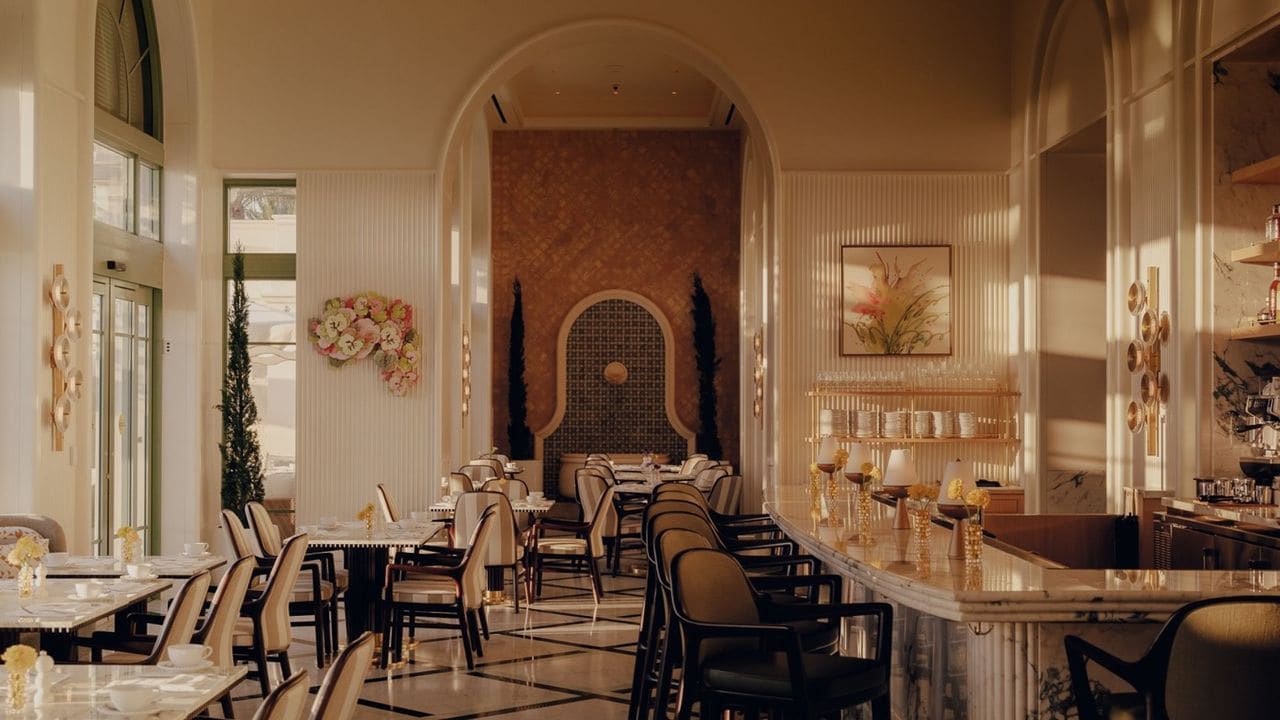
Her team enclosed an existing arched loggia, a move that added square footage and introduced a rhythm of repeated arches that now define the space. The gesture was both practical and poetic: it created more room while lending the interiors a sense of procession, a feeling of moving through light and shadow that recalls the covered walkways of Italian villas. The aim was to bring a residential sensibility to the hotel, to make the restaurant feel less like a hotel amenity and more like a private club where the architecture itself has a point of view.
A Palette Borrowed from the Coast
The colour story is restrained but deliberate. White dominates: fluted plaster walls, inlaid stone floors, and striped fabrics that nod to beach umbrellas and cabanas. But Genova was careful to avoid the sterility that can come with an all-white scheme. The arches are edged in pale turquoise, a colour that reads as both water and sky. Select dining alcoves are lined with scenic wallpaper depicting lush foliage, a subtle nod to the tropical setting without veering into literalism.
Yellow appears as punctuation: ceramic flowers mounted on the walls, their petals glazed in the bright, acidic hue of fresh lemons. The intent, Genova explains, was to evoke the feeling of a beachside trattoria somewhere along the Mediterranean, a place where the food is simple, the wine is cold, and the light changes throughout the day. Palm Beach has its own vocabulary of colour, a tradition of bold prints and graphic patterns, but the Beach Club interprets that legacy with a quieter hand.
The Bar as Anchor
At the heart of the dining room sits a two-sided marble bar, a piece of furniture that functions as both a practical element and a spatial organizer. It serves guests in the main dining area as well as those seated in the enclosed arcade, creating a visual and social centre that draws the eye and encourages lingering. The bar's presence lends the space a sense of permanence, a counterweight to the breezy fabrics and open views.
The restaurant is open only to hotel guests and club members, a detail that shapes the atmosphere. There is no need to perform for passersby, no pressure to fill seats with transient diners. The result is a space that feels more relaxed, more confident in its own identity. The design reflects that ease: furniture is comfortable without being overstuffed, finishes are refined without being precious.
Terrace and Transformation
Beyond the dining room, through glass doors, a new fountain trickles, marking the transition from interior to exterior. The terrace unfolds in a checkerboard of white and green pavers, a graphic pattern that replaces the plain terra-cotta of the previous design. Iron furniture with piped cushions clusters beneath large umbrellas, arranged to capture views of the pool and, beyond it, the ocean.
The outdoor space is animated by its geometry: the repeating pattern of the pavers, the rhythm of the umbrellas, the interplay of hard stone and soft fabric. It is a setting designed for long afternoons, for the kind of leisurely meals that blur into evening without anyone noticing the transition. At night, the lighting softens, the space contracts slightly, and the terrace takes on a different character, intimate and flickering.
Italian Ease, American Ambition
The menu has been reimagined as well, with an all-day Italian focus that complements the Mediterranean mood of the interiors. Fresh scallops, langoustine scampi, champagne by the glass: dishes that speak to the setting without requiring elaborate presentation. The food is meant to feel effortless, even when it is not, a performance of ease that mirrors the design.
This tension, between the appearance of simplicity and the labour required to achieve it, is central to the Beach Club's identity. The transformation was extensive: the enclosure of the loggia, the replacement of floors, the careful calibration of colour and light. Yet the result is a space that feels as though it has always been this way, as though the arches and the turquoise trim and the lemon-yellow flowers were inevitable, the only possible outcome.
The Ongoing Narrative
Genova has spent 14 years shaping the interiors of The Breakers, a tenure that has allowed her to develop a coherent vision across the property. The Beach Club is the latest chapter in that story, but it is unlikely to be the last. Hotels of this scale and history are never finished; they are always in the process of becoming, responding to the expectations of new generations while honouring the memories of those who came before.
The Beach Club's redesign is not a radical break with the past but a refinement, a recalibration of tone. It acknowledges that Palm Beach has changed, that the clientele has changed, that the very idea of what a luxury resort should offer has evolved. Yet it also insists that certain values, certain aesthetics, remain relevant: the pleasure of a well-proportioned room, the comfort of natural light, the satisfaction of a space that feels both special and welcoming.
The transformation has been well received. Guests who remember the old Beach Club speak of the new one with a kind of surprised delight, as though they had not realized how much they wanted the space to change until it did. The design has given them permission to see the hotel differently, to understand that tradition and innovation are not opposites but partners in a long, ongoing conversation. And in a place like Palm Beach, where the past is both burden and asset, that conversation is always worth having.