Where the Pacific Writes the Rules
Thirty-four kilometres of shoreline have made Malibu a study in contrasts: a refuge for fame and a proving ground for those who come to meet the waves on their own terms.
A Geography of Edges
The thing about Malibu is that it runs in one direction. Twenty-one miles of it, strung along the Pacific Coast Highway like beads on a thread that refuses to break inland. To the south, the sprawl of Los Angeles; to the north, Ventura County's quieter ranch land. But here, between the Santa Monica Mountains and the surf, the city holds to a single, unyielding idea: that the coast is enough.
It has been enough for decades. Enough for the Chumash people, who built villages in these canyons long before the Spanish arrived. Enough for the ranchers who grazed cattle on the hillsides in the nineteenth century. Enough, more recently, for those who sought distance from the machinery of Hollywood whilst remaining within its gravitational field. The famous have always come here not to be seen, but to see less of everything else.
The Architecture of Seclusion
Malibu's residential landscape reads like a seminar in modernist restraint. The Case Study houses, John Lautner's cantilevered dreams, the glassy pavilions that Richard Neutra and Pierre Koenig sketched into the bluffs, all share a philosophy: the structure should frame the view, not compete with it. Here, the horizon does the work.
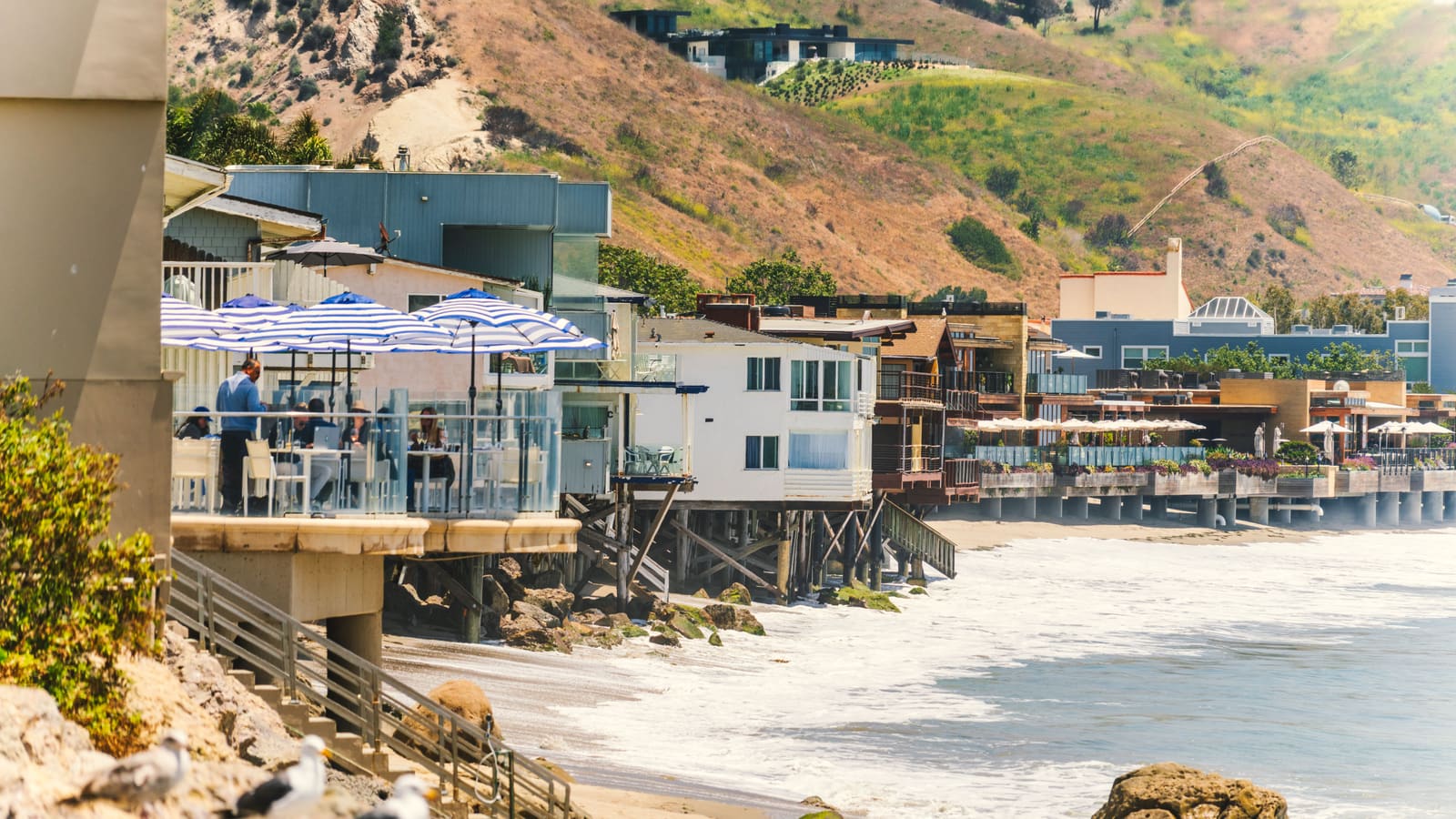
Walk Broad Beach or Carbon Beach at the right hour and you will see how the houses negotiate their relationship with the public strand. Some sit behind gates and hedgerows; others, particularly the older cottages, open more generously onto the sand. The tension between private ownership and public access has shaped Malibu's legal history as much as its skyline. Coastal access lawsuits have been waged for decades, a slow-burning reminder that even in a city built on exclusivity, the tide belongs to everyone.
Surf, Salt, and the Pursuit of Clean Lines
Surfrider Beach, just south of the pier, remains the break that put Malibu on the map for wave riders in the 1950s and 1960s. The right point break here can peel for hundreds of metres when the swell and sand align. It is a forgiving wave by some standards, which has made it a proving ground for longboarders and a theatre for those who prefer style to aggression.
But the surf culture that flourished here was never only about the water. It was about a certain refusal: of urgency, of convention, of the nine-to-five. That ethos seeped into the wider California imagination, shaping everything from fashion to film. Even now, when the beaches are crowded and the parking costs more than a decent lunch, something of that original impulse lingers. The people who paddle out at dawn are still negotiating with the same horizon.
Canyons, Fires, and the Cost of Beauty
Living in Malibu has always meant living with fire. The Santa Ana winds arrive each autumn, hot and dry, turning the chaparral into kindling. The Woolsey Fire in 2018 burned nearly forty thousand hectares and destroyed more than four hundred homes in the area. It was not the first time, nor will it be the last.
Yet people rebuild. They replant. They return to the same ridgelines and the same views, because the calculation is not purely rational. The beauty here is not incidental; it is the entire premise. The canyons, Solstice and Corral and Latigo, carve through the mountains like the arguments of water and time, and the light at the end of each one is always the ocean.
This is not to romanticise the risk. It is simply to acknowledge that Malibu exists because people have chosen, again and again, to live at the edge of something larger and more indifferent than themselves.
What Draws the Eye Now
Today's Malibu operates in multiple registers. There is the Malibu of the Getty Villa, where antiquities are displayed in a meticulously reconstructed Roman peristyle garden overlooking the Pacific. There is the Malibu of farm-to-table cafés along the Cross Creek corridor, where the morning queue for organic grain bowls stretches onto the pavement. There is the Malibu of the Adamson House, a Spanish Colonial Revival showpiece tiled in Malibu Potteries ceramics, now a museum documenting the region's layered past.
And there is the Malibu that most visitors see first: the long, serpentine drive along the PCH, where the road clings to the cliffs and every curve offers another variation on blue. It is a stretch of highway that rewards patience. Rushing through it is possible, but it misses the point.
The Unspoken Compact
Malibu has never been a city in the conventional sense. It incorporated only in 1991, a defensive move to fend off annexation and preserve local control over zoning and development. The population hovers around thirteen thousand, though that figure swells on weekends and during summer. There is no real downtown, no central plaza. The city is a series of enclaves, each with its own microclimate and its own unwritten rules.
What binds them is not civic infrastructure but something closer to shared vigilance. Vigilance over the coastline, over the ridgelines, over the balance between access and privacy. It is a place where the local planning commission meetings can feel as consequential as any ballot measure, because the stakes are visible from every window.
The Undertow of Change
Climate projections suggest that much of Malibu's coastline will face accelerated erosion and higher storm surges in the coming decades. Some beaches are already narrowing. Some homeowners have installed riprap and seawalls; others argue for managed retreat. The debates are technical, legal, emotional, and they are nowhere near resolution.
Meanwhile, the real estate market continues its own logic. Oceanfront parcels trade hands for sums that would fund small municipalities. New construction adheres to ever-stricter fire codes and coastal setbacks, yet the appetite for building at the edge has not waned. If anything, scarcity has sharpened it.
This is the central contradiction of Malibu: it is a place defined by natural beauty and shaped by the very human desire to possess it. The tension is not new, but it is becoming harder to ignore.
The Long View
Stand at Point Dume at sunset and you can see the curve of the Santa Monica Bay stretching south towards Palos Verdes. To the north, the Channel Islands rise from the haze like distant rumours. The cliffs drop sharply to the beach below, where tidepools collect the day's leavings: kelp, shell fragments, the occasional starfish.
People come here to take photographs, to propose, to scatter ashes. The point has been a landmark for as long as there have been people to mark it. What it offers is not comfort, exactly, but perspective. The sense that the coast will outlast the houses built along it, that the waves will continue their work long after the last gate has rusted open.
Malibu rewards those who come without expecting it to perform. It is not a theme park, not a resort in the packaged sense. It is a narrow, fire-prone, achingly beautiful stretch of California where the tension between public and private, between preservation and change, plays out in real time. The twenty-one miles are there for anyone willing to slow down and look. What you see depends on what you bring.