What Money Cannot Build: The Quiet Philosophy of La Siesta
A ten-room hotel in Hanoi's Old Quarter has become, by Tripadvisor's 2026 count, the sixth finest in the world. Its founder will tell you the reason is not the building, and never was.
Every marketer chases a certain kind of moment and almost never finds it: the one that cannot be arranged, cannot be briefed, cannot be bought. It arrives on its own or not at all.
Nhung Grace has spent nearly thirty years away from Vietnam, most of them in Singapore, where she is Marketing Director of Raffles Medical Group, the island's fifty-year-old healthcare institution and one of its proudest corporate names. Her whole craft is the manufacture of feeling on behalf of others, which is precisely what leaves her unmoved by it. And yet, over a modest breakfast in Hanoi, a dish of pumpkin, egg and mayonnaise undid three decades of professional composure in a single bite. She set down her chopsticks, reached for her phone, and filmed a review that no one had thought to request.
"I've known you almost twenty years, and not once has anyone here said: please, review us. Never. But one bite, and it sinks in so deep you cannot help but speak."
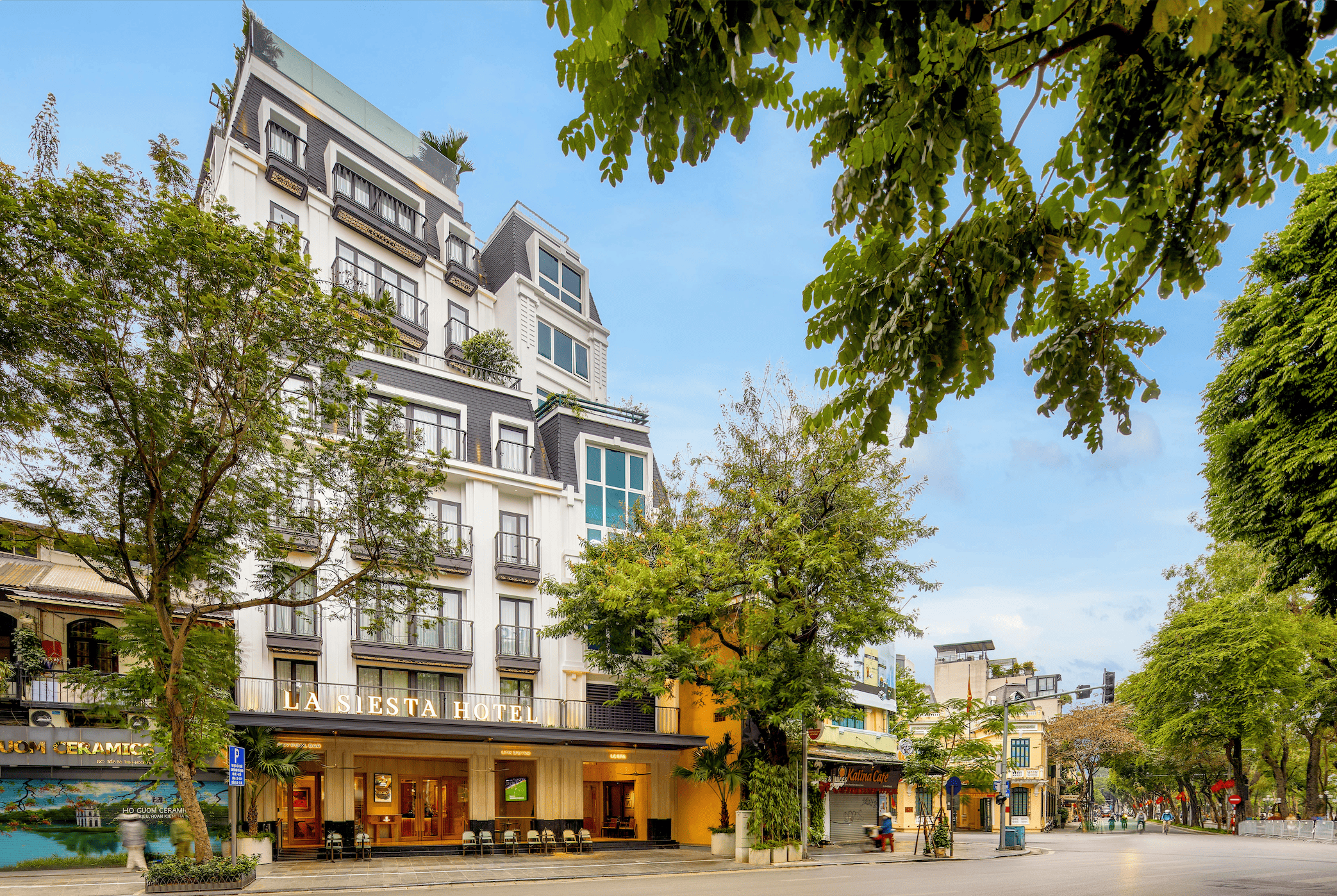
The man she was addressing was Do Van Dan, chairman of Elegance Hospitality Group, who opened a ten-room hotel in Hanoi's Old Quarter and now presides over seven La Siesta hotels and resorts across Hanoi, Saigon and Hoi An, together with a constellation of spas and restaurants. Earlier this year, Tripadvisor placed La Siesta Hoi An Resort & Spa among its Best of the Best: sixth in the world, second in Asia, first in Vietnam. He let the morning pass without naming the honour once. For more than two decades he has built his house on a conviction that contradicts every communications manual ever printed, which is that the most important things about a brand must be spoken by someone else.

Beneath that conviction lies the question that quietly unsettles the whole of Asian hospitality. When the architecture, the concept, the menu and even the practised smile can all be reproduced within a season, what remains that is genuinely one's own?
Home, not house
Every hotel in the world offers the phrase "feels like home," worn so thin by brochures and receptionists that the words no longer register. At La Siesta the word is not a flourish of copywriting. It is the first lesson the founder asks of a new employee, who must define it in two English words of their own before serving a single guest.
"A person can own many houses. But a house is just bricks, cement, sand and steel. It holds no memory, and anyone can copy it. A home takes time. Home is memory, a place to return to, a keepsake. A home must carry lived experience."
Memory sits in no line of a construction budget, and no contractor can present it on the day the scaffolding comes down. Capital raises a house in months; a home must be lived into existence, slowly, by people who mean it. When employees grasp that they are raising a home rather than operating a house, the founder says, obligation falls away. "They do it for themselves. Every day they come to work asking how to be one percent better than yesterday." A single percent a day, compounded over twenty years and a thousand people, is the one figure in this industry that no amount of money can hurry.
Asked once, without ceremony, whether he feared his culture might one day be copied, he gave an answer that has the shape of a confession and the substance of a boast.
"I have nothing to tell you. Because I have thousands of small details inside, accumulated over two decades to arrive at today. That is precisely why I wouldn't know which one to pick."
A brand that folds neatly into a slogan can be taken overnight. A brand assembled from a thousand unnamed details, each one drilled into instinct over years, is beyond the reach of any imitator.
The great houses understand this in their own way. Not long ago, as a global luxury brand prepared to open beside Hoan Kiem Lake, its sales team travelled to Saigon to court a major travel partner. The partner's executives put a single question that stilled the room: "You hold a golden location and a global name. But have you been to La Siesta to study service?"
A century-old international name asking the way to a hotel that began with ten rooms is the kind of story no campaign could compose. "We don't need to talk about ourselves," Mr. Dan tells his staff. "Let our partners, let our customers talk about us."
To know what a leader believes, watch where he takes his lunch
A philosophy, however finely phrased, remains ornamental until it appears in the least glamorous of decisions.
A chairman with a standing invitation to any celebrated table in the country keeps, instead, a quieter habit: he eats in the staff canteen, and not for the camera. "To truly feel whether my people are eating well enough, whether their health is looked after. Only when I can care for the smallest things can I inspire my staff to care for guests."
When conflict abroad drove fuel prices upward, the group's first instinct was not to trim costs but to subsidise petrol for its employees. To Mr. Dan, the fashionable language of being "customer-centric" belongs to a young company still anxious about the rice on the table. "About ten years ago, we began thinking differently: put people at the center, employees, customers, community, partners alike. If we don't care for our own family, how can we possibly care for anyone else?"
Even the idea of leadership arrives here inverted. "Being able to serve your employees is a gift. Being able to correct their mistakes is also a gift. It means others have given you the chance to serve. It is not a burden to carry." The sentiment is closer to a spiritual teaching than to management doctrine, and it accounts for the rarest luxury a hotel can possess: its people stay.
Nhung still remembers the bellman named Hung, who opened the door for her and whom she first met more than ten years ago. Then Doan, and Chi, more than ten years as well. In a trade defined by its turnover, they remain season after season, long enough for a returning guest to know their names, long enough to become part of someone else's memory. That is the threshold at which a house quietly becomes a home.
People ask him, often, how he holds it all in mind, so many properties and so many faces. His reply deserves its place on any manager's desk.
"I remember because I consider it my business. The moment you treat something as someone else's business, you will never remember it."
Close your eyes, and still know where you are
If a home requires its people, it requires one thing more: an address, in the deepest sense of that word.
It happened in Hoi An, over the menu for his resort. The property keeps two restaurants, one Vietnamese and one European, and the European kitchen had built its list on ingredients flown in from America, Japan and Australia. He offered no reproach. He asked a single question.
"If we placed this menu in Dubai, in Singapore, in Korea, and covered the logo, would guests know where we are?"
The kitchen went quiet, because such ingredients can be procured anywhere on earth.
"But if we could cover the logo and guests could close their eyes and still know this is Hoi An, because we use the very ingredients grown and made on this land, that is what guests remember most. Only here does this dish exist."
From one menu he drew a lesson for a generation of Vietnamese houses eager to be seen abroad: "We don't need to do grand things. Do the smallest things, and repeat them, and the world will surely know where Vietnam is."
He and Nhung belong to the same generation, the one raised in the lean years after the war. One of them left to build a life in a distant country; one remained to build a name from nothing. Three decades later, the two journeys converged over breakfast in Hanoi. "We were fortunate to be born in a country that knew war and poverty," he said, "so we carry an extraordinary resilience." Singapore, Nhung answered, has Singapore Airlines, a national brand its citizens speak of with pride, and La Siesta, to her, is becoming precisely that for Vietnam.

The hardest thing
How does a Vietnamese house, newly arrived on the world stage, meet corporations with a century's head start? His reply is not to give chase, but to choose a different road, and the steepest one.
"The more technological and mechanized the world becomes, the more it loses human-to-human connection. And when people reach the peak of everything, what they crave most is connection. What is the ultimate purpose of service? Human, person to person. The ordinary things, the big groups have already done. We come later, so we do what is hardest."
What saves this from mere nostalgia is a paradox at its centre. The man who has wagered everything on the human touch is the same one who, two years ago, brought AI literacy to his entire senior and middle management, teaching them to write, to edit video and to lead their own classes. Chided by someone for it, "why do you abuse AI so much?", he corrected each word in turn.
"Use the right term: mastering AI. Mastering means we command it; it serves as our assistant. Only humans with knowledge can be masters. Technology is the assistant. Human is the product."
Within the group, even wealth has been given a new definition. "Your greatest richness is not money. It is the knowledge you gain every day." His staff describe an appetite for learning that rises like a rocket, in which anyone may teach and everyone carries a story to hand to the person beside them. When they crowned him "the king of content," he declined the title. "I have never written anything untrue, so why would I need to make content? You tell me the stories; guests tell me the stories. I am merely the one who retells a story exactly as it happened."
A keeper of other people's memories
By the close of that breakfast, Nhung had stopped calling him a founder. "You are like my little brother. And this place is a part of me, every time I come back to Vietnam."
One may live thirty years from home, but no one lives apart from memory. Certain houses, in the end, become the keepers of other people's: of the traveller far away who recovers her country in a single dish, of the young employee who becomes a finer version of himself one percent at a time, of a nation once poor that finds, in a hotel, the proof that it can stand among the world's best without borrowing anyone else's name.
That is the inheritance this story leaves the luxury of Asian hospitality, a field in which capital can conjure a five-star hotel in eighteen months, yet where no sum will ever purchase twenty years of a thousand kindnesses repeated each day. Brands build houses. Legacies build homes.
The story is not finished. A coffee label carrying the spirit of La Siesta is preparing to meet the world, and by year's end the whole of it will be set down in a book written by the very people who lived it, faithful to the founder's belief that the story of a home belongs to those who live inside it. As for the title, like a thousand other small details here, it is best left to wait, and to be discovered in person.