The Caribbean Island Where Every Shore Meets a Reef
Bonaire's protected underwater gardens and walk-in dive sites have quietly redefined what accessible marine wilderness can look like.
A Different Kind of Access
There is a particular quality to mornings on Bonaire that divers elsewhere in the Caribbean rarely experience. No engine noise, no crowded boat deck, no waiting for a dive master to brief twenty strangers on hand signals. Instead, the ritual is simpler: park a truck by the shore, walk across warm sand or weathered limestone, wade into water that is already the temperature of a bath, and descend onto coral gardens that begin where the shallows end.
The island, a small crescent of limestone and volcanic rock in the southern Caribbean, has built its reputation not on resorts or nightlife but on a singular commitment to its underwater terrain. More than eighty dive sites ring the coastline, the majority accessible directly from land. This is shore diving at a scale and quality found almost nowhere else in the region, and it has shaped both the island's ecology and the rhythms of those who come to explore it.
Protection as Infrastructure
Bonaire's reefs have been legally protected since 1979, when the island established its marine park, one of the first in the Caribbean. The designation was not merely symbolic. Anchoring on coral was prohibited. Spearfishing was banned. Collection of marine life, even shells, became illegal. Mooring buoys were installed at boat-accessible sites, and a system of fees funded rangers, education, and enforcement.
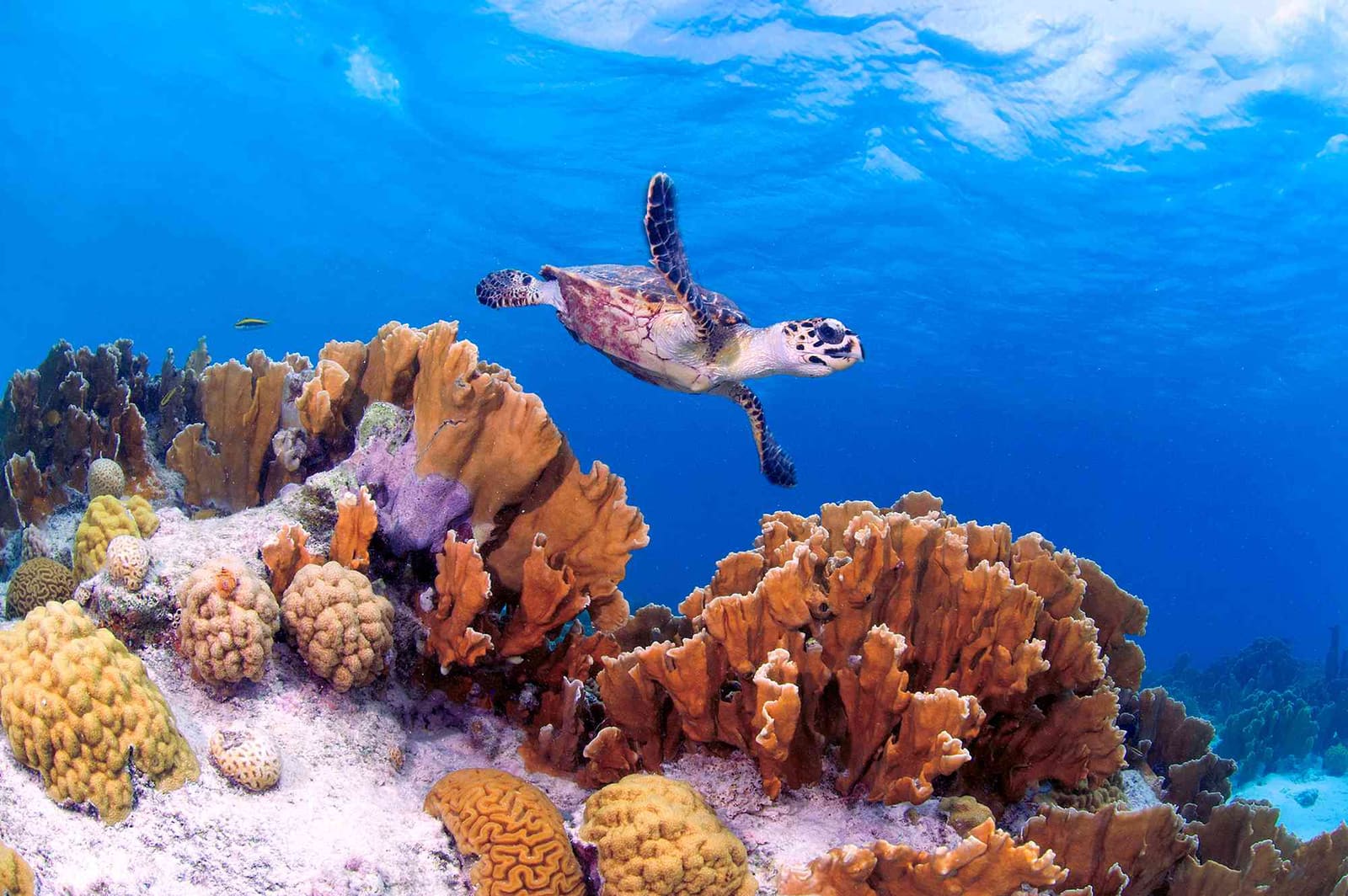
The result, nearly five decades later, is a reef system that has largely avoided the bleaching, overfishing, and physical degradation that have compromised so many other Caribbean dive destinations. Coral cover remains high. Fish populations are dense and visibly unafraid. Elkhorn and staghorn corals, species that have declined precipitously elsewhere, still form thickets in the shallows. The reefs are not pristine, but they are resilient, and that resilience is engineered as much as it is ecological.
The park's design also reflects a pragmatic understanding of tourism. By concentrating access along the coast and limiting boat traffic, Bonaire has managed to support a steady flow of divers without overwhelming its underwater ecosystems. The model is instructive: conservation here is not about keeping people out, but about structuring how they enter.
The Geography of Convenience
What makes Bonaire unusual is not just the health of its reefs but their proximity to the surface world. Many of the island's most celebrated dive sites lie within a few strokes of the shoreline. At sites like 1000 Steps or Bari Reef, the descent begins almost immediately after entry. Within minutes, divers are suspended above coral slopes that drop into deeper water, surrounded by schools of blue tang, parrotfish, and occasional eagle rays gliding past.
This accessibility changes the character of diving itself. There is no schedule to follow, no boat to catch, no pressure to surface before the captain moves on. Divers can enter and exit at their own pace, linger over a particular outcrop, or return to the same site at different times of day to observe shifts in light and marine behavior. The experience is less expedition than immersion, less about ticking off sites than about inhabiting them.
The island's leeward position, sheltered from prevailing winds and currents, contributes to calm conditions year-round. Visibility regularly exceeds one hundred feet. Water temperature hovers between seventy-eight and eighty-four degrees. These are not incidental details. They make Bonaire forgiving for newer divers while still offering depth and complexity for those with thousands of dives logged.
What Lives Below
The marine life on Bonaire is not exotic in the sense of being rare or isolated. Most of the species here are found throughout the Caribbean. What distinguishes the island is abundance and density. Reefs that elsewhere might host a handful of fish are here crowded with them. Cleaning stations, where larger fish pause to have parasites removed by smaller species, are common and easy to observe. Sea turtles, both hawksbill and green, are a near-constant presence, grazing on sponges and seagrass with an indifference to human observers that suggests long habituation.
Night dives reveal a different population. Octopuses emerge from crevices, their skin shifting through patterns of brown and red. Tarpon, silver and prehistoric in profile, cruise the shallows. Bioluminescent plankton flicker in the beam of a dive light. The same reef, visited after dark, becomes unrecognizable, a reminder that marine ecosystems operate on schedules that have little to do with daylight or human activity.
Macro life is equally rewarding for those inclined to look closely. Nudibranchs, tiny and extravagantly colored, inch across coral. Seahorses cling to gorgonians. Blennies peer out from holes in the reef, their expressions almost comically alert. This is the kind of detail that rewards slow, attentive diving, and Bonaire's structure, free from the rush of boat schedules, allows for exactly that.
The Culture of Diving
The island's dive culture is notably low-key. There is little of the competitive atmosphere that sometimes characterizes dive destinations popular with certification chasers or bucket-list tourists. Instead, Bonaire attracts a particular type of traveler: experienced divers who return year after year, often staying for weeks at a time, diving two or three times a day, and treating the reefs less as attractions than as neighborhoods.
This repeat visitation has fostered a sense of stewardship. Divers here are more likely to participate in reef cleanups, report damage, or adjust their buoyancy to avoid contact with coral. The culture is self-policing in a way that formal regulation alone cannot achieve. It is also, quietly, a form of conservation infrastructure, a community of users invested in the long-term health of the resource they depend on.
Local dive operators reinforce this ethos. Briefings emphasize reef protection. Equipment rentals include reef-safe practices. The message is consistent: the reefs are shared, and their survival depends on collective care. It is a model that works, in part, because the people it speaks to have already chosen to come here for the reefs themselves, not for the amenities that surround them.
The Broader Implications
Bonaire's success as a dive destination raises questions about how other islands might approach their own marine resources. The combination of legal protection, accessible infrastructure, and a culture of stewardship is not easily replicated, but elements of it are transferable. Marine parks work when they are funded and enforced. Shore access reduces pressure on boat-dependent sites. Education, repeated and reinforced, shapes behavior over time.
What cannot be easily exported is the island's scale. Bonaire is small, its coastline manageable, its tourism industry still centered on a single activity. Larger islands, with more diverse economies and greater development pressure, face different trade-offs. But the principle remains: reefs that are protected, accessible, and embedded in a culture of care can thrive, even in the face of tourism.
The Quiet Appeal
There is no grand arrival moment on Bonaire. The island is flat, arid, ringed by low scrub and cactus. The towns are small, the beaches modest. What drama exists is entirely underwater, and it unfolds slowly, over days and weeks of diving, as the reefs reveal their patterns and inhabitants.
This quietness is part of the appeal. Bonaire is not competing for attention with luxury resorts or celebrity chefs or Instagram-ready infinity pools. It is offering something narrower and deeper: access to a marine ecosystem that is both vibrant and stable, and the time and freedom to explore it without haste. For divers who understand what that means, the island has become something close to essential, a place to return to not once but many times, each visit a continuation of the last.