The Architecture of Welcome: How Hotels Became Havens Again
A decade after predictions of their demise, thoughtfully designed hotels are reclaiming their place as the heart of modern travel.
The Quiet Return
There is a moment, early in any stay, when a building reveals its intentions. At Chesa Grischuna in Klosters, that moment arrives as you approach the facade, where illustrator Alois Carigiet's murals from the 1930s still animate the heavy stone and timber of a traditional Bündner Haus. The property, originally a modest wooden inn before Zürich architect Hermann Schneider reimagined it nearly a century ago, announces itself not with branding but with craft. People travel across continents to stand before those painted walls. They come for the bowling alley, the grand dining room, the way light falls through deep-set timber frames. They come because the building itself is the draw.
A decade ago, that kind of pilgrimage seemed quaint, even doomed. Industry forecasts painted hotels as relics, soon to be swept aside by decentralized platforms offering cheaper, more "authentic" experiences in private homes. The logic was seductive: why pay for an anonymous room when you could inhabit someone's actual life, rifle through their bookshelves, brew coffee in their kitchen? For a time, the novelty held. But novelty, by definition, fades. What remains is the question of what a building can do that a borrowed apartment cannot.
When Hardware Speaks
Constantin Ziegenhain, who oversees Chesa Grischuna, puts it plainly: "You need a house that speaks for itself. The best hotels have good hardware for visitors to enjoy." Hardware, in this context, is not infrastructure but essence. It is the multi-storey stone mass of a rural Swiss dwelling, the weight of history embedded in masonry, the deliberate orchestration of space that guides how guests inhabit their days. A well-designed hotel does not simply shelter; it choreographs movement, dictates mood, shapes interaction. It creates conditions for experience that no generic listing, however charming, can replicate.
This is not a matter of luxury for its own sake. It is about intentionality. A hotel designed with care considers not just where a guest will sleep but where they will pause, converse, work, withdraw. It thinks in terms of sequence and rhythm, of how a person transitions from public to private, from arrival to departure. A rented flat, by contrast, is configured for someone else's routine. Its logic belongs to another life.
Rooms That Remember Their Purpose
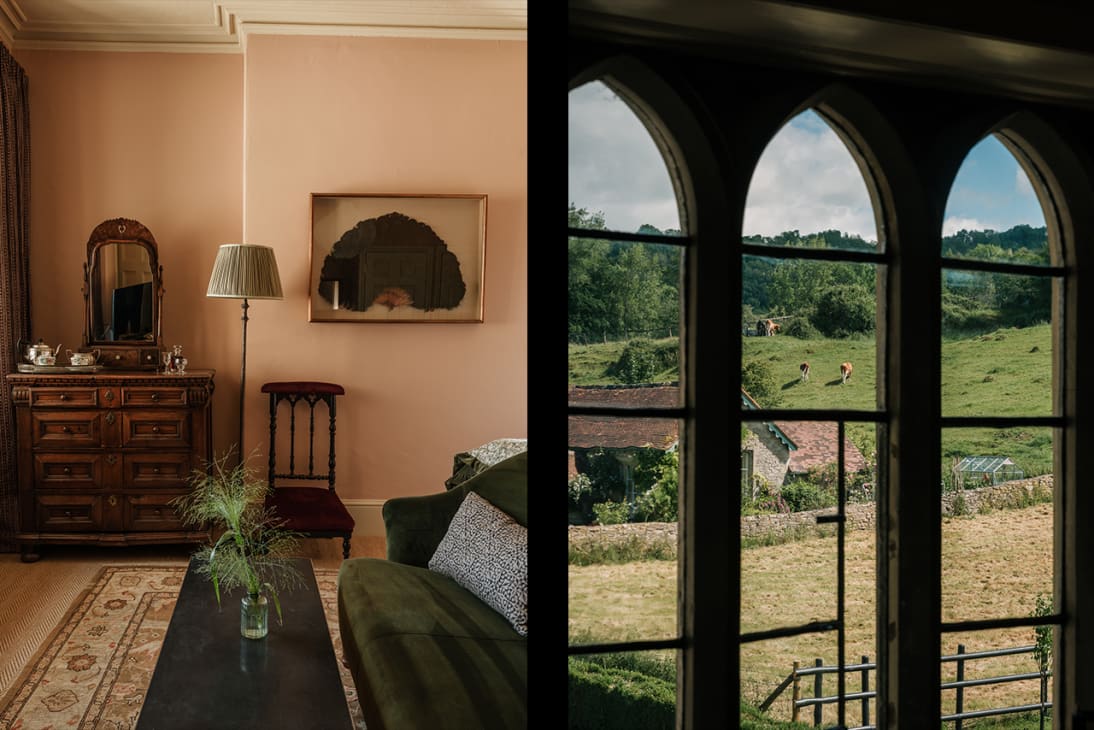
Teffont House, which opened recently in Wiltshire, offers a case study in how architecture can structure experience. Co-owned by designer Charlie Luxton, whose approach draws influence from Ilse Crawford, the property occupies a centuries-old stone house marked by gothic windows and dramatic eaves. Working with Natasha Hidvegi, Luxton carved the interior into a series of distinct zones: an orangery, a bar, a lounge, a brasserie-style dining room, an outdoor terrace furnished with Sénat chairs. Each space holds a different tempo. "You might have a high table where you do some work," Luxton explains, "a lounge where you sit back and read the paper, then a more upright setting where you can talk. It's about creating a series of vignettes."
The Beckford Group, which developed the property, did not isolate it from its surroundings. The reception opens directly onto the road running through Teffont Evias, a small village whose rhythms the hotel absorbs rather than resists. Badminton and croquet courts occupy a walled garden across the thoroughfare. The design assumes porosity, a willingness to engage with place rather than wall it off. This is a fundamentally different proposition from the peer-to-peer model, which offers proximity to a neighborhood but no real integration with it. A hotel, at its best, becomes a node in the social and spatial fabric of a place. It offers not just access but entry.
The Power of Orchestration
What has become clear, after years of experimentation with alternative lodging, is that good hotel design is less about individual flourishes than about the orchestration of an entire experience. It is the sequence of spaces, the modulation of light and volume, the provision of settings for different moods and needs. Luxton describes the phenomenon as almost behavioral: "It's fascinating, the power that the design of a hotel has over how people behave when they're staying." A thoughtfully arranged interior invites certain patterns of use. It encourages lingering in one spot, movement through another. It creates conditions for chance encounter or quiet solitude.
This kind of spatial intelligence is difficult to achieve in a residential setting not designed for transience. Homes are optimized for their owners' habits, their particular routines of cooking, sleeping, working. A guest occupies that space as an interloper, navigating someone else's logic. A hotel, by contrast, is built around the guest's experience from the ground up. It anticipates needs, provides options, structures time. It does not ask you to adapt to its rhythms; it adapts to yours.
The Decline of Borrowed Domesticity
The initial appeal of staying in someone else's home rested on the promise of authenticity, a glimpse into how locals actually lived. But that promise has eroded under the weight of professionalization. Many listings are now managed by property companies, stripped of personal touches, furnished with the same mass-market sofas and generic art. The illusion of intimacy has given way to a new kind of anonymity, one without the compensating virtues of a well-run hotel: consistent service, reliable amenities, spaces designed for hospitality.
There are practical considerations, too. Checkout procedures have grown onerous, laden with chore lists that transform guests into unpaid housekeepers. Property quality varies wildly, and the gap between listing photos and reality can be vast. These frustrations are not incidental; they reflect a fundamental misalignment between what a home is designed to do and what a traveler needs.
Why Place Still Matters
The resurgence of interest in hotels is not merely a reaction against the shortcomings of peer-to-peer platforms. It is an acknowledgment that architecture matters, that the design of a space profoundly shapes how we inhabit it. A hotel like Chesa Grischuna, with its painted facade and century of accumulated character, offers something irreducible: a sense of place grounded in craft and intention. Guests do not come just for a bed. They come for the bowling alley, the murals, the way the building holds the light. They come because the hotel itself is a destination.
This is the distinction that the past decade has clarified. A well-designed hotel is not a neutral container for sleep. It is an active participant in the experience of travel, shaping movement and mood, facilitating connection or solitude as needed. It offers not just proximity to a place but a way of being in it. And that, increasingly, is what travelers are seeking: not the illusion of living like a local, but a thoughtfully designed framework for experiencing somewhere new. The hotel, written off too soon, has proven more durable than predicted. Not because it resisted change, but because it remembered what it was built to do.