When Luxury Travel Becomes a Curated Flight Between Worlds
Aman and Remote Lands have reimagined the private-jet itinerary for 2028, shortening the length but sharpening the cultural depth of each journey.
The Evolution of High-Altitude Hospitality
There is a particular kind of traveller who no longer measures distance in kilometres but in the quality of immersion between landings. For them, the aircraft is not a means to an end but a seamless bridge between deeply considered experiences, each one calibrated to reveal a place through its most resonant cultural gestures. Aman and Remote Lands have spent more than a decade refining this calculus, and their 2028 collection of private-jet expeditions represents a subtle but significant shift in how ultra-luxury travel is conceived.
The partnership, now in its fourteenth year, has introduced two new itineraries that prioritise cultural depth over sheer duration. Both journeys are flown aboard an Airbus ACJ 319, a long-range business jet that seats a small group and eliminates the friction of commercial routing. What has changed is the recognition that even the most committed traveller has finite attention and energy. The new expeditions are shorter, more focused, and more willing to linger in a single place long enough for it to reveal something beyond its postcard identity.
Cultural Treasures of Asia
The first of the new itineraries spans fifteen nights, beginning on 4 March and concluding on 19 March. The journey opens at Aman Tokyo, where the programme includes sushi preparation under the guidance of a master chef and instruction in the handling of a samurai sword. These are not passive demonstrations but participatory encounters, designed to place guests in direct contact with disciplines that require years to master.
From Tokyo, the group travels to Angkor Wat in Cambodia, the largest religious structure in the world by area. A private helicopter offers an aerial perspective on the temple complex, revealing the geometry of its layout and the scale of its moats and causeways. The itinerary then moves to Yunnan Province in China, where Tiger Leaping Gorge cuts through the Haba and Jade Dragon Snow Mountains, and onward to Bhutan, where the Tiger's Nest Monastery clings to a cliffside at 3,120 metres. The journey concludes in India with a visit to the Taj Mahal, a structure that requires no introduction but benefits from the kind of unhurried access this type of travel affords. The expedition is priced from 164,888 US dollars per person, based on double occupancy, according to Aman.
From Islands to Ancient Worlds
The second itinerary, scheduled for October, extends over seventeen nights and traverses Asia, the Middle East, and Europe. It begins at Aman Kyoto, where the programme includes a private geisha evening and guided Zen meditation. The route then moves to the Philippines, where Aman operates a private island, and to Central Java in Indonesia, a region dense with UNESCO-listed temple sites that predate the arrival of Islam in the archipelago.
A significant stop on this journey is the Maldives, where Aman is scheduled to open Amanpulo in 2028. The property will occupy a setting defined by white sand and shallow turquoise lagoons, the kind of environment that has become synonymous with the Indian Ocean but remains difficult to access in a way that feels both exclusive and ecologically considered. From there, the itinerary continues to the United Arab Emirates, Montenegro's Adriatic coastline, and finally Istanbul, a city that has served as a hinge between continents for more than two millennia. Rates for this expedition begin at 198,888 US dollars per person, based on double occupancy, according to Aman.
The Architecture of Personalisation
What distinguishes these journeys from conventional group travel is the degree of customisation embedded in the structure. Each couple or solo traveller is assigned a private vehicle, driver, and guide at every destination, allowing them to diverge from the group itinerary and pursue interests that may not align with the broader programme. This is not a concession to individual preference but a foundational principle of the offering. The result is a journey that is both collective and solitary, shared in its infrastructure but personal in its execution.
Remote Lands, the tour operator behind the ground arrangements, has spent years cultivating relationships with cultural gatekeepers, historians, and artisans in each destination. These connections enable access that cannot be purchased through standard channels: private viewings of collections not open to the public, meals prepared by chefs who do not operate restaurants, conversations with scholars whose work is published in academic journals rather than travel magazines. The value lies not in exclusivity for its own sake but in the quality of insight these encounters provide.
Why Shorter Itineraries Matter
The decision to shorten the length of these expeditions is not a retreat from ambition but an acknowledgement of how luxury travellers allocate their time. A three-week journey, no matter how meticulously planned, can feel like an endurance test rather than a pleasure. By condensing the itinerary, Aman and Remote Lands have created space for deeper engagement at each stop. The pace is slower, the transitions less frequent, and the risk of cultural fatigue significantly reduced.
This approach also reflects a broader shift in the luxury travel sector, where the emphasis has moved from ticking off landmarks to understanding the systems of meaning that give those landmarks their resonance. A temple is not just a structure but the product of a particular cosmology, a set of labour practices, and a relationship to the landscape. A meal is not just sustenance but a window into agricultural cycles, trade routes, and aesthetic philosophies. The shorter itinerary allows these layers to emerge without the pressure of a relentless schedule.
The Mechanics of Seamlessness
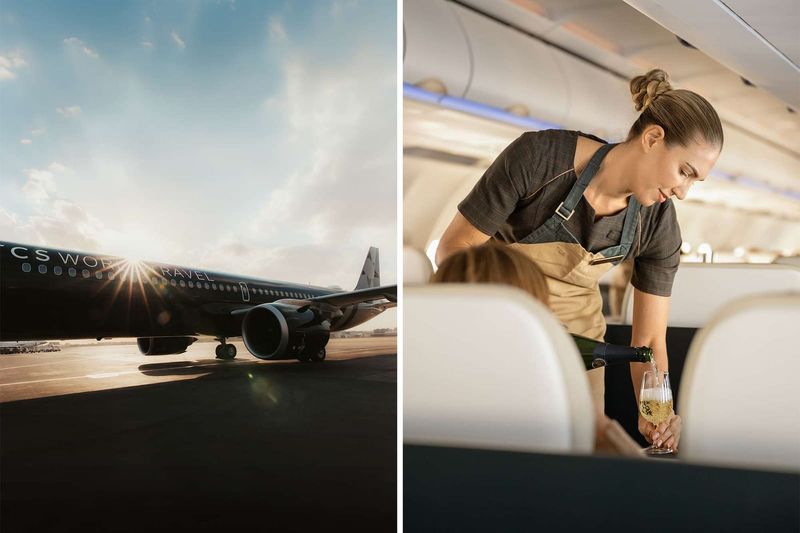
The Airbus ACJ 319 that serves as the expedition's mobile base is configured for comfort rather than capacity, with sleeping berths, a lounge area, and a galley capable of producing restaurant-quality meals at altitude. The aircraft eliminates the need to navigate commercial airports, customs queues, and the unpredictability of connecting flights. It is, in effect, a private residence that happens to be capable of crossing continents.
But the logistics extend beyond the aircraft itself. Each journey is coordinated by a team that manages visas, ground transport, and the kind of contingencies that can derail even the most carefully planned trip. The goal is to render the mechanics of travel invisible, allowing guests to focus entirely on the experience rather than the infrastructure that makes it possible.
A Partnership Refined Over Time
Aman and Remote Lands began collaborating in 2013, and the 2028 expeditions represent the maturation of that partnership. The early itineraries were ambitious in scope but sometimes overwhelming in their density. Over the years, the two companies have learned to calibrate the balance between movement and stillness, between spectacle and intimacy. The result is a product that feels less like a tour and more like a series of carefully orchestrated encounters, each one designed to leave room for reflection and absorption.
Catherine Heald, the founder and chief executive of Remote Lands, has described the partnership as an exercise in redefining what private-jet travel can accomplish. The focus is not on speed or convenience, though both are present, but on the quality of connection between traveller and place. This requires not only logistical expertise but also a curatorial sensibility, an ability to distinguish between what is merely impressive and what is genuinely revelatory.
The Horizon of Ultra-Luxury Travel
The 2028 expeditions arrive at a moment when the luxury travel sector is grappling with questions of sustainability, cultural sensitivity, and the ethics of access. Private-jet travel, by its nature, carries a significant environmental cost, and neither Aman nor Remote Lands has articulated a comprehensive carbon-offset strategy in their public communications. At the same time, the model they have developed offers a counterpoint to mass tourism, which often overwhelms fragile sites and reduces cultural heritage to a series of selfie opportunities.
The question is whether this model can scale, or whether it will remain the province of a small cohort who can afford six-figure travel budgets. For now, the answer seems to be the latter. But the principles underlying these expeditions, particularly the emphasis on cultural immersion and personalised pacing, may influence how other operators design their offerings. The challenge will be to retain the integrity of the experience while making it accessible to a broader audience, a balance that has eluded the luxury sector for decades.
What 2028 Promises
Beyond the two new itineraries, Aman and Remote Lands have confirmed additional journeys for 2028, including routes through China's UNESCO World Heritage sites and circuits of Southeast Asia. Each is designed with the same attention to cultural context and logistical fluidity, and each assumes a traveller who values understanding over mere presence.
The opening of Amanpulo in the Maldives will add a new anchor point to the portfolio, a property that promises to combine the brand's signature restraint with the natural drama of the Indian Ocean. It will join a constellation of Aman properties that serve not as hotels in the conventional sense but as gateways to regions that reward patience and curiosity.
For those who measure travel in the quality of what they learn rather than the quantity of what they see, the 2028 expeditions offer a compelling proposition. They are expensive, logistically complex, and unapologetically exclusive. But they are also thoughtfully constructed, culturally serious, and willing to prioritise depth over breadth. In an industry that often confuses luxury with excess, that distinction matters.