
Where the Milky Way Unfolds Like a Map: Oregon's Forgotten Outback
In a remote corner of the Pacific Northwest, thermal springs and endless night skies meet frontier-era saloons - a landscape where darkness is the most valuable resource.
SI
18 Jul 2026 · 5 MIN READ · UPDATED 17 AUG 2026
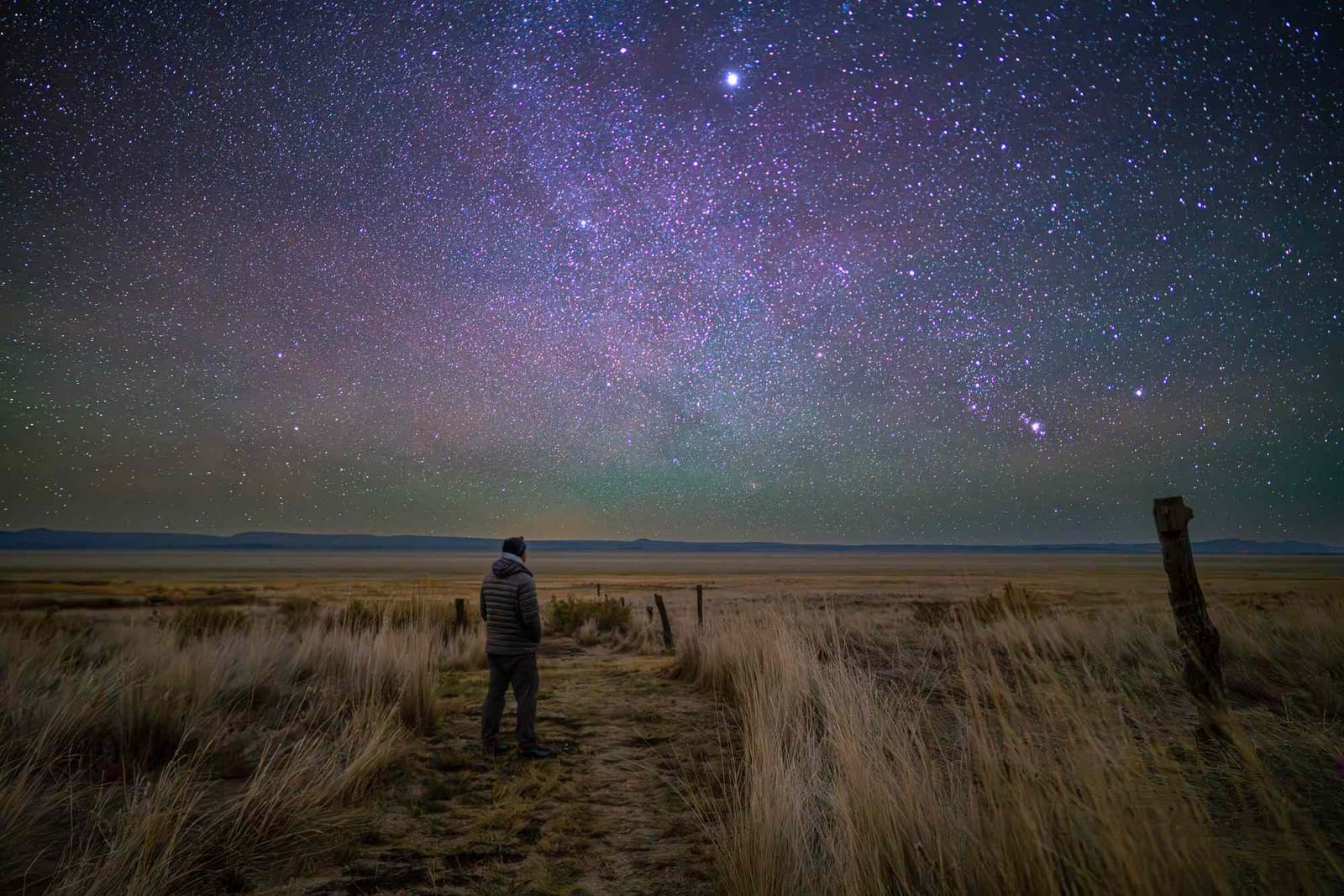
A Geography of Silence
There are places in the American West where the land still refuses to accommodate human ambition. Oregon's Outback is one of them: a vast, semi-arid expanse in the southeastern corner of the state, where the sky outnumbers the people and darkness, once night falls, is absolute. At Global Chic Voyage, we've watched the global race to preserve dark skies accelerate over the past decade, but few sanctuaries match the sheer scale of what exists here. This is the world's largest designated dark sky sanctuary, a territory where celestial observation isn't an activity but a condition of being.
The landscape itself resists easy categorization. Geysers puncture the earth's crust with rhythmic violence. Hot springs pool in basins edged by mineral deposits that look like spilled watercolors. And scattered across this high desert plateau are weathered saloons that seem lifted from a different century entirely, places where swinging doors and whiskey still feel like the natural order of things. It is a region that operates on its own terms, indifferent to trends, immune to haste.
The Architecture of Darkness
Dark sky sanctuaries are not simply places without streetlights. They are territories where light pollution is actively managed, where ordinances protect the night as fiercely as parkland protects old-growth forests. The Oregon Outback International Dark Sky Sanctuary covers more than 2.5 million acres, an area roughly the size of Yellowstone National Park. Its designation, granted by the International Dark-Sky Association, reflects not just the absence of artificial light but the presence of something increasingly rare: a horizon unbroken by human infrastructure.
We've traveled to dark sky reserves in Namibia, Chile's Atacama, and New Zealand's Aoraki Mackenzie. What distinguishes the Oregon Outback is its accessibility paired with its remoteness. You can drive here. You can stay in modest lodgings. And yet, once you step outside after sunset, the Milky Way unfurls with a clarity that renders most celestial photography redundant. The night sky becomes three-dimensional, layered, a reminder that we live inside the galaxy rather than beneath it.
The sanctuary encompasses a mosaic of public lands: Bureau of Land Management holdings, national wildlife refuges, state parks. There are no grand lodges here, no interpretive centers with interactive exhibits. The experience is unmediated. You bring a sleeping bag, a thermos, perhaps a star chart, and you reckon with the sky on its own terms.
Geothermal Spectacle in a Forgotten Corner
The same tectonic forces that built the Cascade Range to the west also left their signature here, in the form of geothermal features that erupt and steam with little fanfare. Geysers in the Oregon Outback lack the celebrity of Yellowstone's Old Faithful, but they possess their own austere beauty. Some are small, spurting columns of boiling water at irregular intervals. Others are little more than fumaroles, venting steam into the cold desert air.
Hot springs dot the region, many of them undeveloped and accessible only by dirt roads that test the suspension of even rugged vehicles. These are not spa destinations. The pools are often ringed by alkali flats, the water tinged with minerals that leave rust-colored stains on the rocks. Soaking in one at dawn, as the first light touches the rimrock and the stars fade, is an exercise in temporal dislocation. It feels both ancient and immediate, a practice humans have engaged in for millennia, stripped of commercial gloss.
At Global Chic Voyage, we've observed a growing appetite among travelers for geothermal landscapes that haven't been sanitized for mass tourism. The Oregon Outback delivers precisely that: raw, functional geology, where the earth's heat is a fact rather than an amenity. There are no railings, no admission fees, no gift shops. You navigate by instinct and topographic map, and the reward is a landscape that still feels discovered rather than designed.
Saloons and the Frontier Echo
The towns here are few and small: Plush, population in the double digits. Frenchglen, barely larger. Fields, a crossroads with more cattle than residents. But what these settlements lack in size, they compensate for in character. The saloons, in particular, are remarkable for their stubborn anachronism. Swinging doors. Wood-plank floors. Bartenders who know every customer by name because there are so few of them.
These are not theme bars engineered to evoke the Old West. They are the Old West, persisting through inertia and isolation. The interiors are dim, the décor accidental: faded photographs, antler mounts, a jukebox that might or might not work. Conversations happen slowly, punctuated by long silences that would feel uncomfortable in a city but here seem entirely natural.
We've written before about the commodification of frontier aesthetics, the way saloon culture has been repackaged as entertainment in places like Jackson Hole and Telluride. The Oregon Outback offers the inverse: authenticity born not from curation but from neglect. These establishments survive because they serve a real function for ranchers, federal land managers, and the occasional traveler who has driven hours across empty road to reach them. There is no performance here, no Instagram backdrop. Just whiskey, conversation, and the slow accretion of local history.
The Logic of Remoteness
Why does a region this striking remain so obscure? The answer is logistical. The Oregon Outback is hours from any major airport. Cell service is nonexistent across vast stretches. Services are minimal: fuel, basic groceries, little else. The roads are long and straight, the scenery austere rather than dramatic. It is not a landscape that photographs well in the compressed, saturated style that dominates social media. Its beauty is cumulative, requiring time and attention.
This remoteness is also its preservation. The lack of infrastructure has kept light pollution at bay. The sparse population means there is no political pressure to develop, no tax base to justify expansion. The result is a landscape frozen in a state that much of the American West abandoned decades ago. For travelers weary of crowds at national parks or the performative wilderness of boutique eco-lodges, the Oregon Outback offers something increasingly rare: the possibility of solitude.
At Global Chic Voyage, we've watched the definition of luxury shift over the past decade. Exclusivity no longer means marble and champagne; it means access to places untouched by the machinery of tourism. By that metric, the Oregon Outback is among the most luxurious destinations in North America. It offers the one thing money cannot easily buy: absence. Absence of crowds, of light, of noise, of the infrastructure that mediates most contemporary travel experiences.
Navigating the Expanse
Visiting the Oregon Outback requires preparation. Fuel tanks should be full; the distance between gas stations can exceed a hundred miles. Water is essential, as is a paper map, since GPS signals are unreliable. Accommodations are rudimentary: a handful of motels, a few campgrounds, and the occasional ranch that rents rooms. This is not a destination for spontaneity.
The best times to visit are spring and fall, when temperatures are moderate and the skies are clear. Summer brings heat that can be punishing, and winter can close roads without warning. But for those willing to accept the constraints, the rewards are profound. A night spent beneath the Milky Way, soaking in a hot spring as coyotes call from the ridgelines, sitting at a bar where the bartender remembers your name after a single visit - these are experiences that resist commodification.
The Future of Darkness
Dark sky sanctuaries are not merely nostalgic gestures. They represent a recognition that darkness, like silence, is an ecological resource with measurable value. Light pollution disrupts migration patterns, alters predator-prey dynamics, and affects human circadian rhythms. The preservation of dark skies is, in this sense, a form of environmental stewardship as critical as watershed protection or habitat conservation.
The Oregon Outback's designation as the world's largest dark sky sanctuary is both an achievement and a challenge. It signals that this landscape is worth protecting, but it also invites attention. The question, as always, is whether a place can be celebrated without being destroyed by that celebration. The remoteness that has preserved the Oregon Outback may prove its best defense. This is not a landscape that will ever accommodate tour buses or luxury resorts. It is too unforgiving, too austere, too indifferent to comfort.
And perhaps that is precisely the point. In an era when nearly every corner of the globe has been mapped, monetized, and made accessible, the Oregon Outback remains a place where the terms of engagement are set by the land itself. You arrive on its schedule, accept its conditions, and leave with the understanding that you were a guest in a territory that owes you nothing. That kind of humility is rare in contemporary travel. It is also, we would argue, essential.
Photo: Joey Hamilton
Spot something wrong? Email editors@globalchicvoyage.com. We log every correction publicly.
RELATED
SEE ALL →
8 Aug 2026 / 5 min
7 Aug 2026 / 5 min

31 Jul 2026 / 5 min
31 Jul 2026 / 5 min