
Where Garden Cities Meet Garden Hotels: Singapore's New Architecture of Sustainable Luxury
From rooftop wormeries to aquaponics farms, the city-state's hospitality sector is rewriting the rules of eco-conscious design—one biophilic lobby at a time.
SI
12 Jun 2026 · 5 MIN READ · UPDATED 17 AUG 2026
The Lobby That Breathes
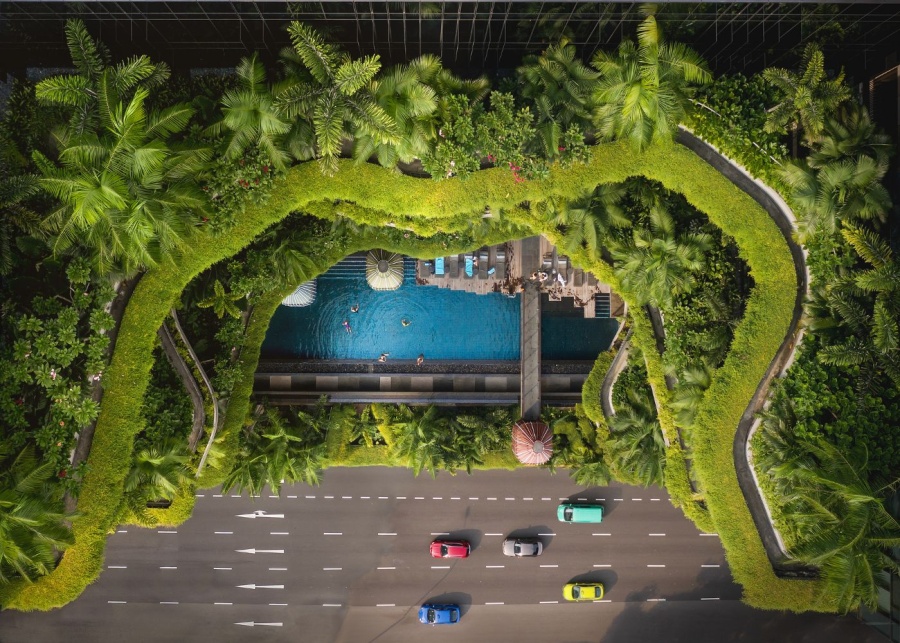
Stand in the atrium of Parkroyal Collection Pickering at dusk and you might mistake the rustling overhead for a breeze through a forest canopy. It is not. It is the sound of over fifteen thousand square meters of sky gardens and terraced greenery doing what living architecture does best: moderating temperature, filtering air, and quietly dismantling the notion that urban hotels must be sealed glass boxes. The building, designed with a biophilic spine, has become something of a manifesto—a proof of concept that luxury hospitality in dense tropical cities can double as vertical farmland, rainwater catchment, and thermal regulator all at once.
At Global Chic Voyage, we have watched Singapore's hotel sector evolve from early greenwashing—bamboo soap dishes, LED bulbs, and little else—to a second generation of properties where sustainability is structural, not decorative. The shift has been technical and cultural: energy-saving sensors that adjust lighting by occupancy, weather-responsive irrigation, food waste digesters that convert kitchen scraps into compost within twenty-four hours. What was once the domain of eco-lodges in Bali or off-grid resorts in Patagonia has migrated to the high-rises of Marina Bay and the garden precincts of Sentosa.
From Rooftop to Table: The New Agrarian Luxury
The top floor of Parkroyal Collection Pickering is not a helipad or a penthouse suite. It is a working urban farm—over fifty varieties of edible plants, harvested weekly and sent directly to the hotel's restaurant, bar, and spa. A mushroom-growing capsule supplies premium fungi for the kitchen. According to the Singapore Food Agency, the property has earned the highest tier of recognition under the national Farm-to-Table programme, a designation that underscores both traceability and carbon reduction.
This is not novelty horticulture. It is supply-chain redesign. At Equarius Hotel on Sentosa, herbs grown in the on-site garden supply not only the hotel's own restaurant, Tangerine, but sister properties across Resorts World Sentosa. At Swissotel The Stamford, an aquaponics farm—jointly operated with Fairmont Singapore—produces fresh greens and fish in a closed-loop system that recycles water and nutrients. The initiative aligns with Singapore's broader ambition to produce thirty percent of its nutritional needs domestically by 2030, a goal that transforms hotel kitchens into nodes of urban agriculture.
What distinguishes these efforts from earlier green hotel gestures is integration. The farms are not add-ons; they are load-bearing elements of the operational model. At Grand Copthorne Waterfront, the seafood line at buffet restaurant Food Capital sources only sustainably fished and farmed species. At Capella Singapore, procurement contracts prioritize local and regenerative suppliers. The language has shifted from "locally inspired" to "locally sourced," and the difference is measurable in food miles, waste tonnage, and menu transparency.
Engineering Comfort Without Excess
Marina Bay Sands, the city's most recognizable silhouette, generates solar energy via five hundred thirty-six panels installed on its iconic infinity pool cantilever—enough to power the entire structure's lighting. Inside guest rooms, smart control units adjust air-conditioning and lighting based on real-time occupancy, a system that has contributed to a twenty-four percent reduction in the property's carbon footprint since 2014. The building holds Singapore's largest single Green Mark certification, a national standard administered by the Building and Construction Authority.
At Grand Copthorne Waterfront, smart thermostats reduce per-stay energy consumption by up to twenty-five percent. Filtered drinking water dispensers in every room—part of a pilot program developed with the Singapore Tourism Board—have eliminated the need for single-use plastic bottles. The property was the first in the city-state to roll out the initiative at scale, a move since adopted by others including Parkroyal Collection Pickering.
Lloyd's Inn, a compact boutique property in the Orchard corridor, relies on natural ventilation to reduce air-conditioning load, a passive design strategy uncommon in equatorial climates but effective when paired with cross-ventilation corridors and strategic landscaping. Low-flow fixtures and water-saving devices throughout the property have earned it Green Mark certification. The aesthetic is minimalist—concrete, light wells, potted greenery—but the engineering is deliberate.
The Wormery, The Eco-Pond, and Other Invisible Infrastructure
On the rooftop of Siloso Beach Resort, the longest green roof in Singapore stretches above guest villas. Beneath the soil layer: a wormery that converts food scraps into fertilizer, which is then cycled back into the rooftop garden. Rainwater is harvested, stored, and used for irrigation and greywater applications. The system is closed-loop, low-maintenance, and invisible to guests—unless they take the sustainability tour offered at check-in.
At Equarius Hotel, an eco-pond collects stormwater runoff and provides habitat for resident egrets and hornbills. The water is filtered naturally through aquatic plants before being reused for landscaping. At Oasia Hotel Downtown, whose rust-red living facade has become a CBD landmark, a similar rainwater harvesting system waters the green walls, flushes toilets, and cleans common areas. The building's vertical gardens—over twenty-one species of climbing plants—reduce heat gain and improve air quality, functions that double as both environmental service and architectural statement.
These are not features designed for Instagram captions. They are systems: biological, hydrological, thermal. They require maintenance contracts, horticultural expertise, and a willingness to let infrastructure share space with aesthetics. The best examples are those where guests encounter the technology only obliquely—a motion sensor that dims lights when they leave the room, a recycling chute in the hallway, a menu note indicating the herbs were grown on-site.
Why It Matters Beyond the Island
Singapore's hotel sector operates within constraints that make it an interesting laboratory. Land is limited. Energy is imported. Water is expensive. Climate is hot and humid year-round. These conditions incentivize efficiency in ways that less resource-constrained markets do not. The result is a hospitality model where sustainability is not a premium add-on but a cost-management strategy that happens to align with guest expectations.
The certifications matter. Green Mark, GSTC, and BCA standards are rigorous and audited. Properties like Parkroyal Collection Pickering, Marina Bay Sands, and Lloyd's Inn have earned recognition not for aspirational pledges but for quantifiable reductions in energy, water, and waste. Unesco Sustainable Travel badges and Travel Sustainable designations on booking platforms translate these achievements into consumer-facing signals, a development that closes the loop between operational practice and market demand.
But the more significant shift is cultural. When a city's flagship properties—Marina Bay Sands, Capella, Swissotel—integrate urban farms, eliminate single-use plastics, and install EV charging stations as standard, they normalize these practices. They set a baseline. Mid-tier and boutique properties follow. Eventually, the question is not whether a hotel has sustainability features but which ones, and how transparent the reporting is.
The Long View from the Sky Garden
Stand again in the atrium of Parkroyal Collection Pickering, this time in the morning light. The plants are being misted. A guest on the third-floor sky terrace is reading. The filtered water dispenser in the hallway hums quietly. It is unremarkable, which is the point. The best sustainable infrastructure is the kind you do not notice until you think about what is missing: plastic bottles, excessive air-conditioning, food waste bins overflowing with uneaten buffet plates.
Singapore's green hotels are not utopias. They are working buildings in a working city, subject to the same economic pressures and guest expectations as any other luxury property. But they are also proof that the tradeoff between comfort and sustainability is not binary. That sky gardens can cool buildings. That rooftop farms can supply kitchens. That a wormery can be both waste solution and guest amenity. That a hotel can be a garden, and a garden can be a hotel, and the line between the two need not be as fixed as we once assumed.
Spot something wrong? Email editors@globalchicvoyage.com. We log every correction publicly.
RELATED
SEE ALL →
8 Apr 2026 / 5 min
31 Jul 2026 / 5 min

28 Jul 2026 / 5 min
27 Jul 2026 / 5 min