
Where Cloud Forest Meets Pacific Tide: Costa Rica's New Landscape of Retreat
From volcanic hillsides to quartz mountains, the country's evolving luxury hospitality reveals a deeper conversation about place, wellness, and the art of staying still.
SI
25 Jun 2026 · 5 MIN READ · UPDATED 17 AUG 2026
The Vertical Landscape
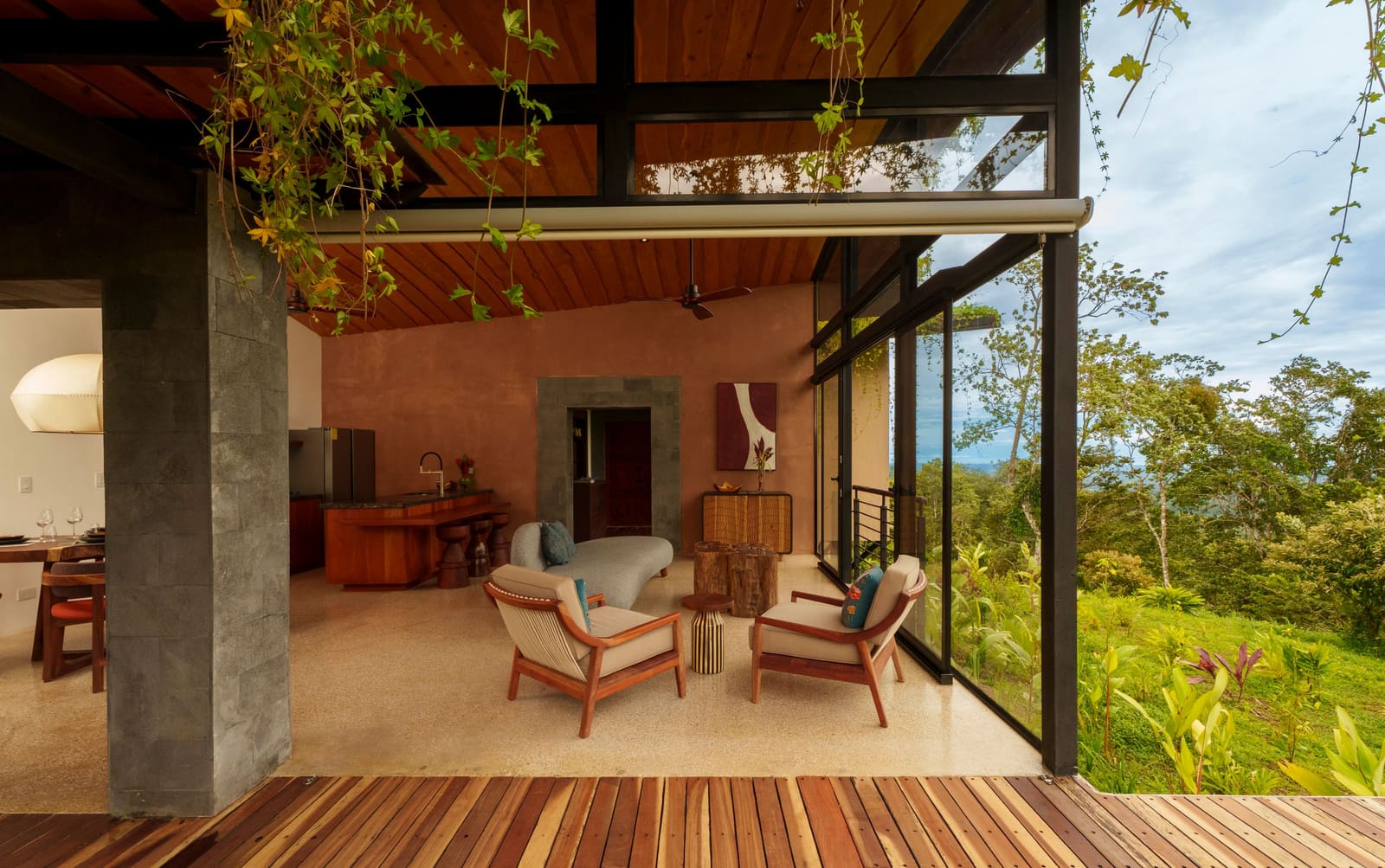
There is a particular quality of light that filters through cloud forest canopy at dawn - neither golden nor silver, but something suspended between the two. We first noticed it years ago, hiking the ridgelines above central Costa Rica's volcanic corridor, long before the current wave of eco-luxury resorts claimed these altitudes. Today, that same light spills across private decks and infinity edges, filtered through architectural gestures that have learned, finally, to frame rather than compete with the view.
The country's hospitality landscape has undergone a quiet but profound transformation. What was once a straightforward proposition - beach, surf, zip-line, repeat - has evolved into a more nuanced conversation about altitude, microclimate, and the particular character of place. Resorts now occupy not just coastline but cloud forest, not just lowland jungle but hillside and volcanic slope, each elevation offering its own atmospheric grammar.
At Global Chic Voyage, we've watched this shift with interest. The properties that have emerged in recent years reflect a more sophisticated understanding of what luxury travel can mean in a biodiverse setting: not extraction or spectacle, but a kind of careful attention. The best among them function less as destinations and more as thresholds - portals into ecosystems that would otherwise remain inaccessible, interpreted through design languages that range from barefoot minimalism to tented elegance.
The Architecture of Immersion
Canvas and hardwood have become the materials of choice for a new generation of Costa Rican retreats, a deliberate move away from concrete and glass toward structures that breathe with their surroundings. The tented camp format, borrowed from African safari tradition but adapted to rainforest context, allows for a particular kind of permeability. Walls that can be drawn back. Floors that acknowledge rather than seal off the ground beneath. Rooflines that echo the pitch of forest canopy.
We've seen this approach executed with varying degrees of success across the country, but the most compelling iterations share a common trait: they understand that luxury in this context is not about insulation but about mediated exposure. The goal is not to keep nature out but to invite it in selectively, filtered through mesh and timber, framed by sightlines that have been considered with the care of a museum curator arranging a collection.
One property perched on volcanic slopes above the rainforest floor exemplifies this philosophy. Twenty-one canvas accommodations rise in tiers among the trees, each positioned to capture the morning spectacle of Arenal's smoking cone as dawn light spreads across the valley. The rooms themselves are exercises in restrained opulence - locally sourced coffee delivered tent-side before sunrise, private pools fed by natural hot springs, daybeds oriented toward views that shift hourly as cloud cover moves through the canopy.
The design vocabulary here is deliberate in its references. Safari, yes, but also the vernacular architecture of Costa Rica's agricultural past: open structures built for airflow, materials that age gracefully in humid conditions, a respect for the slope of the land. The result feels neither imported nor overly romanticized, but rooted in a specific understanding of what it means to build at this altitude, in this climate, with these views.
The Wellness Imperative
Somewhere along the way, wellness ceased to be a resort amenity and became a structural principle. We noticed the shift first in the programming - meditation and sound baths folded into daily schedules, farm-to-table dining presented not as luxury but as baseline expectation. Then it appeared in the architecture itself: treatment rooms open to jungle, yoga decks cantilevered over creeks, spa facilities that occupy as much square footage as sleeping quarters.
The Retreat, situated atop a quartz mountain west of San José, operates according to a different logic entirely. Here wellness is not additive but foundational. There are no menus in the dining room; meals arrive as colorful compositions determined by seasonal harvest and nutritional philosophy. Peacocks wander the grounds. The property markets itself explicitly to solo travelers at transitional moments - those seeking not vacation but recalibration.
This represents a broader trend we've observed across Costa Rica's luxury hospitality sector: the reframing of retreat as transformative rather than restorative. It's a subtle but significant distinction. Restorative implies a return to previous state; transformative suggests movement toward something new. The former is passive; the latter requires participation.
Whether this imperative is driven by guest demand or aspirational marketing is difficult to parse. What's clear is that properties increasingly position themselves as sites of personal evolution, with nature cast in the role of catalyst. The cloud forest, the volcanic landscape, the biodiverse jungle - these are not backdrops but active participants in whatever inner work the guest has arrived to undertake.
The Question of Scale
Fifty acres. One hundred eighty acres. Five hundred acres. The numbers recur like a refrain in property descriptions, a quantification of privacy that doubles as environmental credential. But scale alone reveals little about how space is actually inhabited or what relationship a resort maintains with the land it occupies.
We've encountered properties that sprawl across vast acreage yet feel cramped in their ambition, and intimate lodges on modest footprints that seem to expand the landscape around them. The difference lies not in hectares but in choreography - how arrival is staged, how pathways meander, how the eye is directed or allowed to wander.
El Silencio Lodge, spread across five hundred acres of cloud forest, arranges its accommodations in tiers that follow the natural contour of the land. Bamboo ceiling tiles and raw-wood furnishings nod to regional craft traditions without veering into theme-park vernacular. The property operates a four-thousand-square-foot greenhouse that supplies its restaurant, a closed-loop gesture toward the kind of self-sufficiency that was once practical necessity and has now become luxury signifier.
This tension between scale and intimacy defines much of Costa Rica's current resort landscape. Properties tout their acreage as proof of commitment to conservation, yet the guest experience is often one of careful containment - curated trails, designated viewpoints, experiences that unfold according to schedule. True wildness, the kind that cannot be programmed or predicted, remains mostly at the margins.
The Pacific Turn
While the interior highlands have claimed much of the design conversation, the Pacific coast continues to evolve along its own trajectory. Here the aesthetic skews more polished, the amenities more abundant. Infinity pools multiply. Marinas appear. The architecture speaks in the international language of resort modernism - clean lines, vast glazing, a studied neutrality that could as easily be Bali or Cabo.
Yet even here, a certain Costa Rican sensibility persists. Properties emphasize their proximity to blue zones, those rare regions where residents live measurably longer lives. They highlight community partnerships and sustainability initiatives, conscious that today's luxury traveler arrives with an ethical checklist alongside their packing list. Art programs feature local makers. Menus specify not just organic but the specific finca where produce was grown.
The Papagayo Peninsula, long the domain of international hotel groups, has seen recent additions that attempt to marry branded luxury with sense of place. One property perches atop a wooded hillside with views straight down to the Pacific, accessible via funicular. The entry courtyard centers on a ceiba tree, its branches symbolically reaching toward heaven according to indigenous cosmology. It's a gesture toward rootedness, toward narrative, toward something beyond the transactional nature of hospitality.
Whether such gestures constitute genuine engagement with place or simply a more sophisticated form of theming is a question we return to often. The line between honoring local culture and commodifying it remains uncomfortably fine, and the luxury sector has a long history of mistaking the latter for the former.
The Solo Traveler's Geography
An unexpected subplot in Costa Rica's resort evolution: the rise of properties designed explicitly for solo travelers. Not couples seeking romance, not families chasing adventure, but individuals in search of solitude, reflection, or transformation. This represents a significant departure from the traditional luxury resort model, which has long optimized for pairs and groups.
The implications ripple through every aspect of design and programming. Single-occupancy pricing that doesn't penalize the solo guest. Communal dining options that facilitate connection without forcing it. Schedules that balance structured activity with unscripted time. The recognition that solitude and loneliness are not synonyms, and that luxury can mean the freedom to be alone without feeling isolated.
We've observed this shift with particular interest because it suggests a maturing of the luxury travel market. The solo traveler - especially the solo female traveler - has long been an afterthought in hospitality design, accommodated but not truly welcomed. Properties that center this guest from the outset represent not just demographic savvy but a philosophical reorientation toward what travel can offer beyond the shared experience.
The Glamping Paradox
Isla Chiquita, hidden on a small island in the Gulf of Nicoya, bills itself as Costa Rica's only glamping-style island retreat. The designation raises immediate questions about terminology. At what point does a tent with premium amenities cease to be camping and become simply a room with canvas walls? When does glamping tip from playful oxymoron into redundancy?
The property offers bioluminescence excursions, bird watching, whale watching, sport fishing - a catalog of activities that reads like an adventure outfitter's brochure. Yet the experience is framed as retreat, as escape, as return to something essential. This is the central paradox of the glamping proposition: it promises authenticity through artifice, simplicity through elaboration, connection to nature through a carefully constructed buffer.
We don't say this to dismiss the format, which when done well can offer genuine pleasure and a kind of access to landscape that traditional resort architecture forecloses. But the tension is worth naming. There's something revealing about our current moment in luxury travel - that we require nature to be both immediate and mediated, raw and refined, wild and utterly safe.
The View from Here
Costa Rica's luxury hospitality landscape in 2026 presents a study in contradictions. Properties that market sustainability while catering to guests who arrived via international air travel. Retreats that promise transformation through consumption. Eco-resorts that occupy precisely the kind of pristine environments their existence inevitably alters.
These are not new tensions, but they feel particularly acute in Costa Rica, a country that has staked much of its international identity on environmental stewardship and biodiversity conservation. The question of how luxury tourism fits within that framework - whether it supports or undermines those values - remains unresolved.
What we can say is that the properties that succeed in this landscape are those that engage seriously with place rather than simply occupying it. They understand that luxury in a biodiverse setting cannot be about dominance or spectacle, but about attention, care, and a kind of humble reciprocity. They build at the scale of the landscape rather than against it. They hire locally, source regionally, and maintain genuine rather than performative relationships with surrounding communities.
The best among them also acknowledge their own contradictions rather than papering over them with greenwashing rhetoric. They recognize that there is no such thing as impact-neutral luxury travel, only varying degrees of thoughtfulness about the exchange. They offer not escape from the complexities of our current moment but a different vantage point from which to consider them - ideally one with a view of cloud forest or volcanic peak, coffee in hand, the morning light just beginning to break through the canopy.
Photo: Origins Luxury Lodges
Spot something wrong? Email editors@globalchicvoyage.com. We log every correction publicly.
RELATED
SEE ALL →
7 Jul 2026 / 5 min
27 Jul 2026 / 5 min
14 Jul 2026 / 5 min
27 Jul 2026 / 5 min