
Where Ancient Ayurveda Meets Operating Theatres and Spinal Cord Scans
On the slopes of Kerala's Western Ghats, a new wellness sanctuary fuses 5,000 years of herbal wisdom with MRI machines, FDA-approved brain stimulators, and a sound dome that may be the world's largest.
SI
23 Jun 2026 · 5 MIN READ · UPDATED 17 AUG 2026
A View That Feels Like Medicine
The Western Ghats arrive in Calicut already softened by a thousand miles of travel, their ridges blurred into a haze that seems less meteorological than metaphysical. We've watched these mountains from many terraces over the years - from colonial tea estates, from jungle lodges perched on cliff edges - but the view from Tulåh Clinical Wellness carries a different weight. Perhaps it's the knowledge that UNESCO has named this range among the planet's eight most biodiverse zones, or that more than eight hundred medicinal plants cling to these slopes, species that inform both millennia-old Ayurvedic formularies and contemporary oncology labs. Or perhaps it's simply that wellness, when done with enough conviction, reshapes how we see landscape: not as backdrop but as participant.
Tulåh opened quietly in early 2026 on thirty acres outside the old port city, a futuristic complex of curves and glass that reads, at first glance, like an architectural thesis on Zaha Hadid's legacy. Dubai-based Lami Architects designed the central hub - home to treatment rooms, dining spaces, and thirty-five of sixty-five guest rooms - as a sinuous ribbon of white punctuated by two vast courtyards where eighty-year-old rain trees spread their canopies. The effect is both monastic and vaguely extraterrestrial, a quality that mirrors the retreat's governing philosophy: that the spiritual and the scientific need not occupy separate worlds.
At Global Chic Voyage, we've grown weary of wellness concepts that gesture vaguely toward "integration" while remaining firmly planted in one camp or the other. Tulåh's ambition is more literal, more operational. Here, Ayurvedic physicians consult alongside neurologists and sports scientists. Guests receive both dosha assessments and Dexa bone-density scans. Four-handed oil massages segue into sessions inside an FDA-approved brain stimulator. It is a model born not from marketing strategy but from personal crisis - and that origin story matters.
The Billionaire, the Goat Meat, and the MRI
Faizal Kottikollon made his fortune in logistics and industrial supply chains, the kind of empire built on spreadsheets and optimization algorithms. Then came the numbness in his left hand, the persistent neck pain, the MRI that revealed spinal cord compression severe enough to warrant surgery. His doctors framed the choice starkly: operate, or risk permanent nerve damage.
Kottikollon, a Kerala native, chose a third path. He assembled a team that included neurologists, physiotherapists, and Ayurvedic practitioners, asking them to work in concert rather than in competition. The Ayurvedic protocol included daily massages using heated muslin bundles filled with goat meat, rice, milk, and spices - a traditional treatment rooted in the belief that goat muscle tissue's molecular structure allows its proteins to nourish human tissue at a cellular level. To the Western-trained specialists on his team, the approach must have seemed closer to culinary arts than medicine.
Yet follow-up imaging told a different story. Subsequent MRIs showed measurable reversal of nerve degeneration and improvement in spinal cord health. Kottikollon describes the moment as proof that ancient wisdom and modern diagnostics could not only coexist but amplify one another. Four years and nearly one hundred million dollars later, that conviction became Tulåh - Sanskrit for "balance" - a facility designed to make his hybrid model replicable and scalable.
The infrastructure reflects his forensic attention to both traditions. An on-site MRI eliminates the half-day hospital transfers that plague other wellness retreats. An operating theatre and intensive care unit sit ready for emergencies, backed by two hundred physicians at Meitra, the state-of-the-art private hospital Kottikollon built nearby in 2017 to care for his aging parents. Thirteen full-time doctors staff Tulåh itself, their specialties ranging from clinical psychology to dentistry - a nod to the emerging research linking oral microbiome health to systemic wellness.
Diagnostics as Ritual
The guest experience begins not with a spa menu but with a cascade of data collection. An initial consultation with an Ayurvedic physician maps constitutional type, lifestyle patterns, dietary habits, and health goals through the traditional lens of doshas - the three energetic forces Ayurveda holds responsible for physical and mental balance. Hours later, an allopathic doctor orders a different kind of map: blood panels, body composition analysis, cardiovascular and metabolic markers.
What distinguishes Tulåh from the growing field of longevity-focused retreats is the caliber of technology deployed on-site. Guests undergo shockwave and high-intensity laser therapies for deep-tissue regeneration. A CT calcium scan measures arterial plaque and heart disease risk. Genome and microbiome sequencing provide insights into genetic predispositions and gut health. The Exomind, an FDA-cleared transcranial brain stimulator, treats memory loss, addiction, and depression - the first of its kind installed in India, according to Tulåh.
Even dentistry enters the protocol. Every guest meets with an in-house dentist for an oral health assessment, reflecting the growing understanding that periodontal bacteria influence inflammation, cardiovascular disease, and cognitive decline. A clinical psychologist rounds out the intake process, offering cognitive behavioral strategies or, in less urgent cases, productivity coaching for the perpetually distracted.
By day two, results feed into what Tulåh calls its Life Index algorithm, a proprietary scoring system that synthesizes physical, mental, and emotional health markers into a single number. Scores above sixty fall within acceptable range; higher numbers indicate robust vitality. The algorithm then guides the design of each guest's personalized program, determining the ratio of Ayurvedic treatments to physical therapy, the intensity of fitness training, the composition of meals.
It is wellness as systems engineering - hardly romantic, but undeniably thorough.
The Vichy Shower Bed and the Sufi Cover Band
For all its clinical rigor, Tulåh has not neglected the sensory dimensions of healing. Kottikollon tasked his in-house engineers with reimagining the traditional wooden Ayurvedic massage table, a design unchanged for centuries. Their solution: a heated platform integrated with a Vichy shower system. After each four-handed oil massage - performed in synchronized rhythm by two therapists - warm water cascades from overhead nozzles, rinsing the guest without requiring them to move. Therapists then gently towel-dry the body before it rises.
The effect is less spa treatment than return to infancy, a state of total care that borders on the absurd and yet delivers a profound relaxation. We emerged from each session in what can only be described as a trance, the kind of loose-limbed euphoria that makes stairs feel optional.
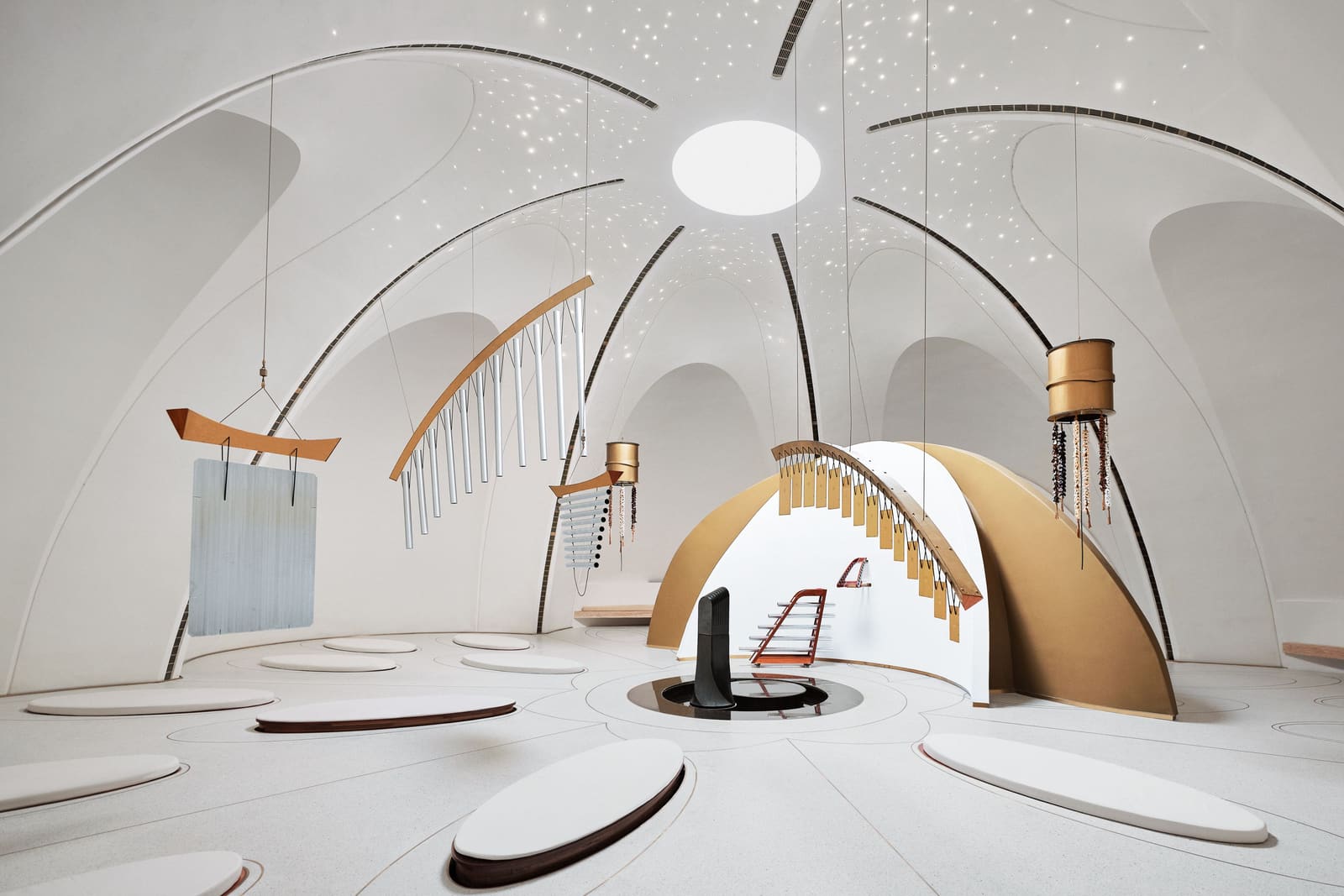
Then there is the Sonorium, a domed sound-healing chamber that Tulåh claims is the largest such space in the world. Whether or not the superlative holds, the room's acoustic design is meticulous: custom-made instruments - singing bowls, crystal harps, gongs - tuned for tonal coherence, their vibrations calibrated to specific frequencies believed to influence brainwave states and cellular repair. Lying on a mat beneath the dome's apex, sound washes over the body not as noise but as pressure, a physical force that seems to lift the ribcage and hum through bone.
One evening the Sonorium doubles as a concert hall, hosting a seven-piece Sufi ensemble whose lead vocalist takes requests from the audience. The performance veers toward crowd-pleasers - Sufi standards delivered with the energy of a greatest-hits set - but the acoustic purity of the space elevates even familiar melodies into something close to ceremony.
The Limits of Location
Tulåh's interiors favor a palette of cream, white, and pale wood, surfaces that photograph beautifully but lack the textural warmth that might soften the clinical atmosphere. Guest rooms are spacious, their terraces oriented toward the Ghats, yet careful positioning is required to avoid glimpsing the advertising billboards and unfinished construction that mark Calicut's outskirts. Planes pass overhead with some regularity; highway noise intrudes during certain hours.
These are not trivial compromises. The world's most acclaimed wellness retreats - Kamalaya in Thailand, Vivamayr in Austria, SHA in Spain - often occupy landscapes so pristine they feel removed from the twenty-first century altogether. Tulåh does not. Its location is convenient - Calicut's international airport lies less than an hour away - but convenience and transcendence rarely share the same coordinates.
Still, discerning guests have proven willing to overlook imperfect settings when clinical outcomes justify the trade-off. SHA, for instance, sits near a highway on Spain's Costa Blanca, yet its medical program has earned it a fiercely loyal clientele. Tulåh appears to be making a similar wager: that the integration of Ayurvedic and allopathic care, executed at this level of sophistication, will matter more than the view.
Meals Without Phones, Recipes on an App
Nutritionist oversight extends beyond the kitchen into the dining room itself, where a no-phones policy enforces a rare contemporary luxury: undistracted eating. Menus adapt to each guest's program - spice levels modulated for digestive sensitivity, portion sizes adjusted for metabolic goals. Keralan fish curries appear alongside Mediterranean preparations; a second restaurant specializing in pan-Asian cuisine was scheduled to open shortly after our visit.
Departure involves a final consultation in which every recommendation - from Ayurvedic protocols to yoga sequences to cognitive exercises - is loaded onto a mobile app. Recipe videos, guided meditations, and recorded consultations travel home with the guest. Future iterations of the platform will integrate with a proprietary wearable device, allowing Tulåh's medical team to monitor biometrics remotely and adjust protocols in real time, a model of continuous care that few retreats have attempted at scale.
What Balance Looks Like in Practice
Tulåh remains a young property, still calibrating the choreography required to make two medical traditions speak the same language. Some elements feel over-engineered; others, like the Sonorium and the reinvented massage table, suggest what's possible when capital and conviction align.
What we found most compelling was not the technology itself but the willingness to let Ayurveda lead. The allopathic consultants do not merely tolerate the herbal treatments and oil therapies; they defer to them, using diagnostics to measure outcomes rather than dictate methods. It is a subtle but significant inversion of the usual hierarchy, one that required a billionaire's spinal crisis - and his refusal to choose sides - to come into being.
The Western Ghats will continue to shimmer beyond Tulåh's terraces long after this first wave of guests departs, their slopes still heavy with the plants that have healed bodies for five thousand years. What happens inside the curved glass walls is newer, stranger: a experiment in whether the future of medicine might look less like conquest and more like conversation.
Spot something wrong? Email editors@globalchicvoyage.com. We log every correction publicly.
RELATED
SEE ALL →
1 Jul 2026 / 5 min
3 Jul 2026 / 5 min
2 Jul 2026 / 5 min
30 Jun 2026 / 5 min