
When Steel Meets Sculpture: Delta Marine's New Hybrid Fleet
A Seattle shipyard and a British design studio have reimagined the superyacht silhouette, trading traditional curves for angular geometry and electric propulsion.
SI
14 Jul 2026 · 5 MIN READ · UPDATED 17 AUG 2026
A New Vocabulary in Hull Design
There is a particular kind of light that falls across the Pacific Northwest in late afternoon, the kind that makes industrial steel look almost soft. It is this light, perhaps, that has informed Delta Marine's aesthetic for decades: vessels built for distance, for weather, for the kind of owner who measures a yacht not by its Instagram moments but by how many ocean miles it can swallow without complaint.
Now, the Seattle shipyard has partnered with Bannenberg & Rowell, the British design studio known for interiors that feel more like residences than floating hotels, to produce something that breaks quietly with tradition. The result is a new family of hybrid superyachts spanning 164 to 246 feet, each one distinguished by a hull form that reads less like a boat and more like a piece of kinetic sculpture.
At Global Chic Voyage, we have watched the superyacht industry oscillate between two poles: the nostalgic classicism of varnished teak and brass fittings, and the aggressive futurism of carbon fiber and glass. This collaboration feels like neither. Instead, it proposes a third path, one rooted in geometry and restraint.
The Triangle as Motif
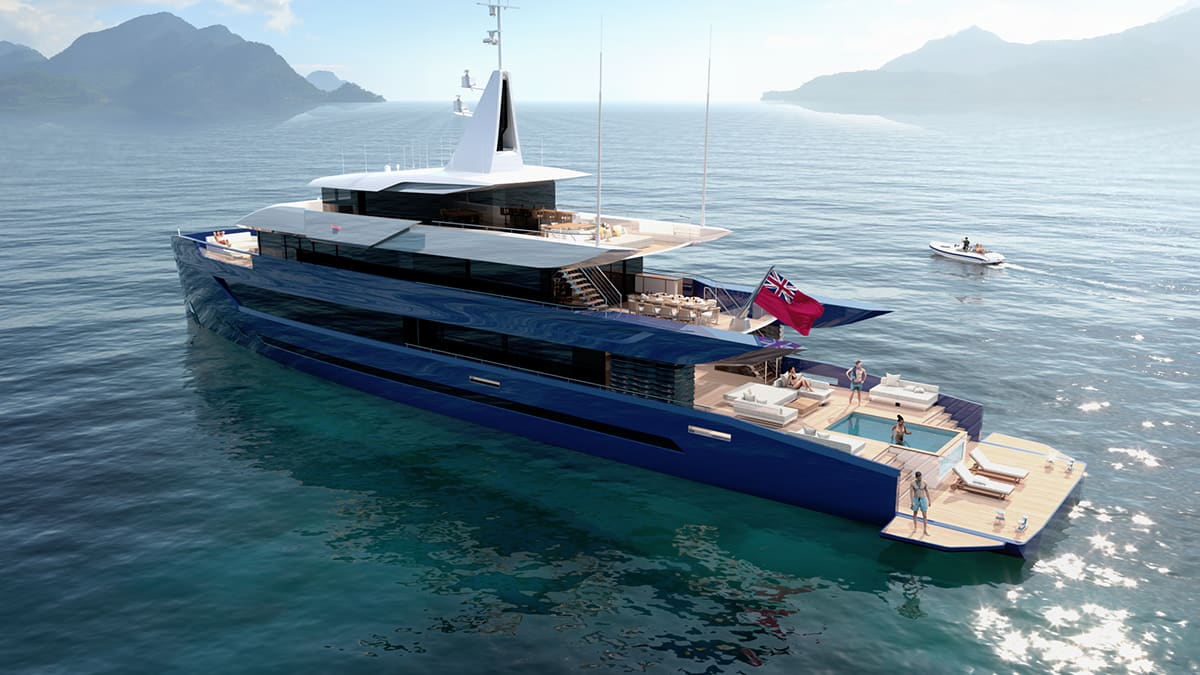
The most striking feature is the hull itself. Where conventional superyachts favor smooth, sweeping lines, Delta and Bannenberg & Rowell have introduced a series of intersecting creases that form a subtle triangle motif, a visual nod to the delta symbol that gives the yard its name. The effect is both sharp and organic, as if the vessel has been folded rather than molded.
This angular language extends across the superstructure. Canopies are aerodynamic and slanted, bulwarks are sculpted rather than flat, and the glazing follows geometric patterns that shift depending on the angle of view. It is a design vocabulary that feels considered, even restrained, yet unmistakably contemporary.
Simon Rowell, creative director at Bannenberg & Rowell, has spoken about the intention to create vessels that feel "unmistakably Delta" while introducing a sense of dynamism and physicality. It is a delicate balance, honoring a shipyard's heritage without becoming a museum piece. The triangle motif, repeated across hull, superstructure, and interior detailing, serves as a unifying thread, a signature that does not announce itself with volume but with consistency.
Hybrid Propulsion as Standard
Aesthetics aside, the real story here is propulsion. Every vessel in this new lineup will be equipped with a hybrid diesel-electric system that combines traditional diesel generators with electric drive units and integrated energy storage. The configuration allows for silent cruising in harbors and protected waters, where noise restrictions are increasingly common, while maintaining the range and reliability required for transoceanic passages.
Delta Marine has not released specific performance figures, but the company has emphasized that the system is designed to reduce both fuel consumption and emissions without compromising the kind of global range that defines its brand. It is a pragmatic approach to sustainability, one that acknowledges the realities of long-distance cruising while making incremental progress toward cleaner propulsion.
The hybrid setup also includes advanced podded drive units, which improve maneuverability and reduce mechanical complexity. For owners who plan to spend weeks at sea, this translates to fewer maintenance headaches and quieter onboard life, a consideration that is often overlooked in favor of more photogenic features.
Indoor-Outdoor Flow and Spatial Generosity
The layout philosophy across the lineup prioritizes seamless transitions between interior and exterior spaces. On the 164-foot model, which Delta has unveiled as the entry point to the range, the interior volume has been deliberately kept under 500 gross tons. This constraint, rather than limiting the yacht, has pushed the design team to expand exterior real estate.
The result is a vessel with a large aft pool, a swim platform fitted with fold-out terraces, a bow lounge, and multiple al fresco dining and lounging areas. It is a configuration that reflects how owners actually use their yachts: not sequestered in air-conditioned salons, but outside, under awnings, with the breeze and the sound of water.
This indoor-outdoor continuity is particularly relevant for cruising grounds in Asia and the Mediterranean, where climate and culture encourage outdoor living. We have seen this shift across luxury hospitality, from resorts in Bali to private villas in the Greek islands, where walls dissolve and thresholds blur. Delta and Bannenberg & Rowell have applied the same logic to yacht design, treating the deck not as an afterthought but as the primary living space.
Scalability and Customization
While the 164-foot model has been fully detailed, Delta has also confirmed that a 213-foot variant is under development, with the design scalable across the entire lineup. This modularity allows owners to choose a size that fits their cruising style and operational preferences without sacrificing the coherence of the design language.
Importantly, materials and finishes remain customizable. Delta has positioned this not as a bespoke program, which can sometimes feel like an excuse for indecision, but as a framework within which owners can express personal taste. The bones of the design are fixed; the surfaces are not.
This approach mirrors trends we have observed in luxury real estate, where architects provide a strong conceptual shell and clients collaborate on interiors with their own designers. It is a recognition that true luxury lies not in infinite choice, but in the freedom to refine within a well-considered structure.
A Broader Vision for Delta Marine
Michelle Jones, vice president at Delta Marine, has described the collaboration as part of the shipyard's broader vision, one that embraces international partnerships and evolving owner expectations while maintaining a commitment to engineering excellence. It is a positioning statement that acknowledges the realities of a changing market.
The superyacht industry, like many luxury sectors, is in the midst of generational transition. Younger buyers expect sustainability credentials, not as marketing but as baseline practice. They value design that feels current without chasing trends. And they are increasingly global in their references, drawing on architectural and cultural influences from Asia, Europe, and the Americas.
Delta's partnership with a British design studio signals an openness to cross-pollination, a willingness to look beyond the Pacific Northwest for aesthetic inspiration while retaining the engineering rigor that has defined the yard for decades. It is a model that other American builders may follow, particularly as European yards continue to dominate the design conversation.
What This Signals for the Superyacht Market
The introduction of a full lineup, rather than a single concept, suggests confidence. Delta is not testing the waters with a one-off; it is committing to a new design direction that it believes will resonate with owners over the next decade.
The emphasis on hybrid propulsion, outdoor living, and geometric design also reflects broader shifts in luxury travel. Sustainability is no longer a niche concern but an expectation. Indoor-outdoor flow is not a tropical novelty but a global standard. And design that feels sculptural, that invites contemplation rather than spectacle, is increasingly valued over the maximalist excess that defined the pre-pandemic era.
For those of us who have spent years watching yachts come and go, this lineup feels like a quiet recalibration. It is not revolutionary, but it is thoughtful. It does not shout, but it does not need to. In an industry often dominated by the loudest statement, that restraint may be the most radical gesture of all.
Photo: Delta Marine
Spot something wrong? Email editors@globalchicvoyage.com. We log every correction publicly.
RELATED
SEE ALL →
14 Jul 2026 / 5 min
8 Aug 2026 / 5 min

7 Aug 2026 / 5 min

31 Jul 2026 / 5 min