When Print Becomes a Season: The Summer Newspaper Tradition Returns
Monocle's latest edition pairs political interviews, fiction, and a glossy travel supplement in a format that refuses to hurry.
SI
30 Jul 2026 · 5 MIN READ · UPDATED 17 AUG 2026
The Weight of Paper in Summer Hands
There is something almost defiant about launching a newspaper in high summer, when most readers have traded their commutes for beach towels and their morning routines for something looser, less tethered to the clock. Yet that is precisely when certain publications choose to arrive - not despite the season, but because of it. At Global Chic Voyage, we've watched this counter-intuitive rhythm take hold: the seasonal print edition that positions itself not as news delivery but as companion, as object, as the thing you fold into your bag alongside sunscreen and novels.
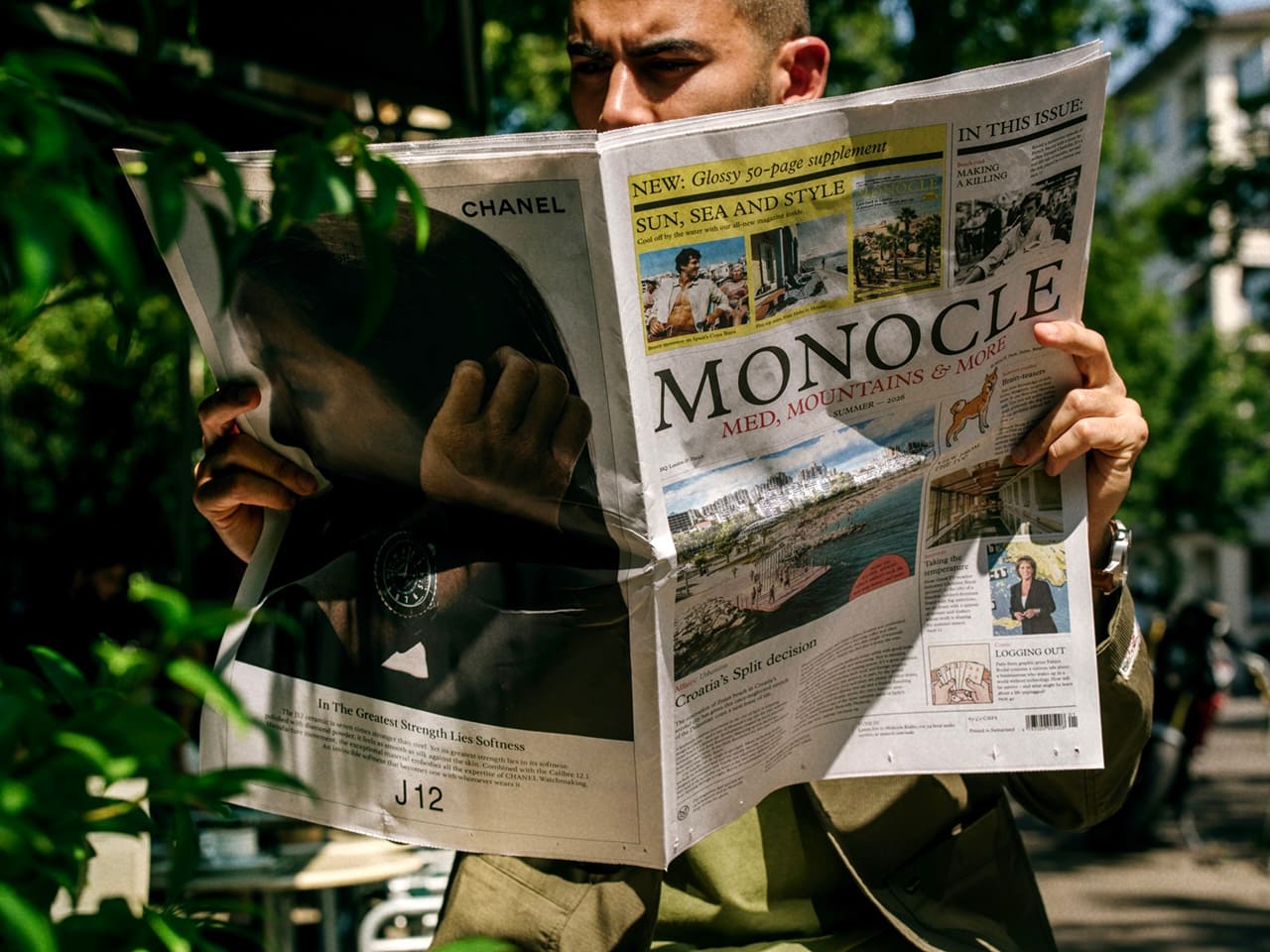
Monocle's latest offering, titled Med, Mountains & More, embodies this philosophy. It is a publication designed for the pace of vacation, where time moves differently and attention can linger. The format itself - newspaper rather than magazine - signals a certain editorial confidence. Newsprint has always carried an inherent temporality, a sense that what you hold will be outdated by tomorrow. But when you remove the urgency of daily news cycles and replace it with long-form interviews, fiction, and curated travel recommendations, the medium transforms. It becomes less about speed and more about texture, about the physical experience of unfolding large pages under open sky.
What Lives Between the Folds
The content mix reveals an editorial strategy that refuses easy categorization. A conversation with Albanian Prime Minister Edi Rama sits alongside original fiction from author Edward Chisholm - a beach read, the publication promises, with drama woven through its pages. There are puzzles, the kind that invite you to pause with a pen, to fill in squares while waiting for your coffee to cool or for the afternoon heat to pass.
This is the vocabulary of leisure, but it is also the vocabulary of attention. In an era when most travel content arrives in scrollable bursts - the Instagram carousel, the TikTok reel, the listicle optimized for mobile - a newspaper asks you to spread it out, to commit to its unwieldy dimensions. You cannot read it discreetly on a crowded train. You must make space for it, literally and temporally.
The inclusion of a political interview alongside travel content is particularly telling. It suggests an audience that does not compartmentalize - that sees travel not as escape from the world but as a way of understanding it differently. Rama, who leads a country increasingly positioning itself within European tourism circuits while navigating complex geopolitical terrain, represents exactly this intersection. His presence in a summer newspaper is not incongruous but essential: a reminder that even our seasonal wanderings are shaped by policy, by leadership, by decisions made in rooms far from the beach.
The Supplement as Statement
Then there is the glossy insert, fifty pages devoted to what Monocle describes as top stays from Malta to Merano, alongside menswear photographed on Spain's Costa Brava. This is where the newspaper model bends toward magazine sensibility - where paper quality shifts, where images dominate, where the aesthetic argument becomes as important as the informational one.
We have seen this hybrid approach gain traction across luxury publishing. The idea is to offer texture, both literal and metaphorical. The newsprint sections provide context, narrative, the slower build. The glossy pages deliver visual immersion, the kind of photography that makes you want to book a flight or, at minimum, reconsider your summer wardrobe. It is a push-pull between contemplation and desire, between reading and looking.
The geographical span - Malta to Merano - is deliberate. It traces a line through the Mediterranean and up into the Alpine foothills, capturing the dual impulses of summer travel in Europe: the pull toward coastlines and the retreat into elevation. These are not exotic destinations in the traditional sense. They are places where European travelers have been going for generations, places that carry cultural weight, that appear in novels and films and family photo albums. The editorial choice here is not about discovery but about re-seeing, about what happens when you approach familiar territory with fresh attention.
The Economics of Seasonal Print
There is also a business model embedded in this format. Monocle positions the newspaper as part of its subscriber package, a value-add that reinforces the membership model many publications now depend on. But it is also available for individual purchase, which means it must function as both loyalty reward and standalone product.
This dual identity shapes everything about the publication. It must reward existing readers with depth and insider perspective - the kind of content that justifies a subscription fee. But it must also be accessible enough, visually compelling enough, to attract someone browsing a newsstand or bookstore shelf. The seasonal cadence helps here. A summer newspaper does not compete with weekly or monthly issues. It is an event, a special edition, something you can market as limited and therefore worth acquiring.
For luxury travel audiences, this model has particular resonance. Print, especially at this scale and with this level of production value, is expensive. It is also increasingly rare. By making it seasonal, by tying it to specific times of the year when readers are most likely to be traveling or planning travel, publishers can justify both the cost and the format. It becomes part of the ritual of the season itself - something you pick up as you prepare for August in the same way you might stock up on books or update your travel kit.
Why Newsprint Still Matters
We return often to the question of why print persists in categories like travel and lifestyle, where digital platforms offer obvious advantages: instant updates, interactive maps, user reviews, booking integration. The answer, we think, lies partly in what print refuses to do. It does not update. It does not link out. It does not track your behavior or serve you ads based on your browsing history. It simply sits there, complete and finite, asking only that you engage with what it has chosen to present.
For travel content, this can be a feature rather than a limitation. It forces editorial curation in a way that digital platforms often do not. When you have finite pages, every choice matters - which destinations make the cut, which interviews run long, which photographs earn a full spread. The result, when done well, is a coherent editorial vision rather than an endless feed.
The newspaper format adds another layer. Because newsprint is associated with immediacy and disposability, using it for evergreen content creates a productive tension. You are holding something that looks temporary but contains material designed to be useful across an entire season. It is a reminder that not all journalism needs to be permanent, but not all temporary media needs to be shallow either.
The Reader It Imagines
Ultimately, a publication like this succeeds or fails based on how accurately it imagines its reader. The person who picks up a summer newspaper full of long interviews, original fiction, and curated travel recommendations is someone who still values the experience of reading as an activity unto itself - not just as a means to an end, not just as research before booking, but as part of the pleasure of anticipation and reflection that travel, at its best, invites.
This reader might be on holiday already, or might be planning one, or might simply be someone who wants to carry the atmosphere of summer travel into their everyday life. They are willing to wrestle with large pages on a windy terrace. They will read the political interview even though they came for the hotel recommendations. They understand that the fiction and the puzzles are not filler but part of the texture, the pacing, the refusal to be purely utilitarian.
At Global Chic Voyage, we recognize this reader because we write for them too. They are the ones who still believe that the how of consuming content matters as much as the what - that the medium shapes the message, that paper has qualities pixels do not, that summer deserves its own editorial cadence. As digital platforms accelerate and fragment, these seasonal print projects offer something increasingly rare: permission to slow down, to spread out, to let your attention wander across pages rather than tabs. Whether that is nostalgia or wisdom depends, perhaps, on how you choose to spend your summer afternoons.
Credit: GBP
Spot something wrong? Email editors@globalchicvoyage.com. We log every correction publicly.
RELATED
SEE ALL →
27 Jul 2026 / 5 min
27 Jul 2026 / 5 min

25 Jul 2026 / 5 min
23 Jul 2026 / 5 min