
When a Phoenix Couple Brought 100 Guests to the Bulgarian Riviera
A wedding at a former royal palace, meals under kaleidoscopic florals, and why the Black Sea coast deserves to be on your radar.
SI
30 Jul 2026 · 5 MIN READ · UPDATED 17 AUG 2026
The Forgotten Coast
There is a particular stretch of European coastline that still evades the Instagram hordes: the western shore of the Black Sea, where Bulgaria meets the water in a collision of cliffs, beach towns, and belle-époque villas built for aristocrats who no longer exist. Jessica Haag discovered it in 2018, on a road trip through her then-boyfriend's homeland. Fields of sunflowers rolled past the car windows. Medieval Plovdiv gave way to Varna, a port city that felt, to a woman raised in Arizona's high desert, like a parallel universe. The sea was warm. The architecture spoke a language she'd never heard. And when she and Atanas Dimov - Nasko to friends - began planning their wedding five years later, the question wasn't whether guests could come, but whether they would.
They did. Nearly a hundred of them.
At Global Chic Voyage, we've watched destination weddings evolve from intimate elopements to full-scale cultural exchanges. What Jessica and Nasko orchestrated in September 2024 was less a wedding and more a week-long argument for why Bulgaria, a country routinely bypassed for Greece or Croatia, deserves a place on the luxury traveler's map. Their venue was Euxinograd, a soft-pink palace built in the 1880s for Bulgarian royalty, now a government building that occasionally hosts cabinet meetings between bookings. The florals were a maximalist ombre explosion - kiwi green bleeding into cantaloupe orange, hot-pink roses climbing stone arches. Guests learned a traditional circle dance before they left Phoenix. And the whole affair unfolded on a coast that Nasko, who emigrated to the United States at five, has spent a lifetime trying to convince people to visit.
A Venue With a Caveat
The couple spent a full month in Bulgaria scouting locations. They worked remotely, bouncing between Sofia and the coast with Sharon from IDo Events, a Berlin-based planning firm Jess had followed for years on Instagram. What drew her to the company wasn't polish - though the firm has that in abundance - but specificity. Each wedding IDo posted felt less like a template and more like a portrait.
Varna, Nasko's mother's hometown, became the geographic anchor. The beaches there rival anything on the Adriatic, he insists, but without the crowds or the price tags. Still, the couple wanted to avoid the cookie-cutter resort packages common to the region. They toured a handful of properties - beautiful, but generic - before their planner drove them to Euxinograd.
The palace sits above the sea, surrounded by manicured gardens and crowned with mansard roofs in the Bulgarian Revival style. Guests would approach from the water, walking up a flower-lined path. It was, Jessica recalls, like stepping into a fairy tale. There was one problem: because Euxinograd remains a working government building, the Prime Minister's office reserved the right to cancel their event up to a month before the date. The couple signed the contract anyway. IDo had already arranged a backup venue - the Boutique Hotel Oasis, a luxury property built inside a former aristocrat's villa along a private beach - but Jessica and Nasko were willing to gamble.
Color as Strategy
How do you dress a palace? With restraint, most designers would say. Jessica had other ideas.
"Rainbow is my favorite color," she explains, only half joking. She and Nasko, both Arizona residents, wanted the wedding to feel like a collision between old-world grandeur and West Coast midcentury modernism. That meant bold, saturated hues in quantities that would make a traditionalist wince. Many of the Bulgarian florists they interviewed tried to steer them toward the regional standard: red roses, white linens, rinse, repeat. Then they found Lussó by Borisovi, a Sofia-based studio willing to take the brief as a challenge.
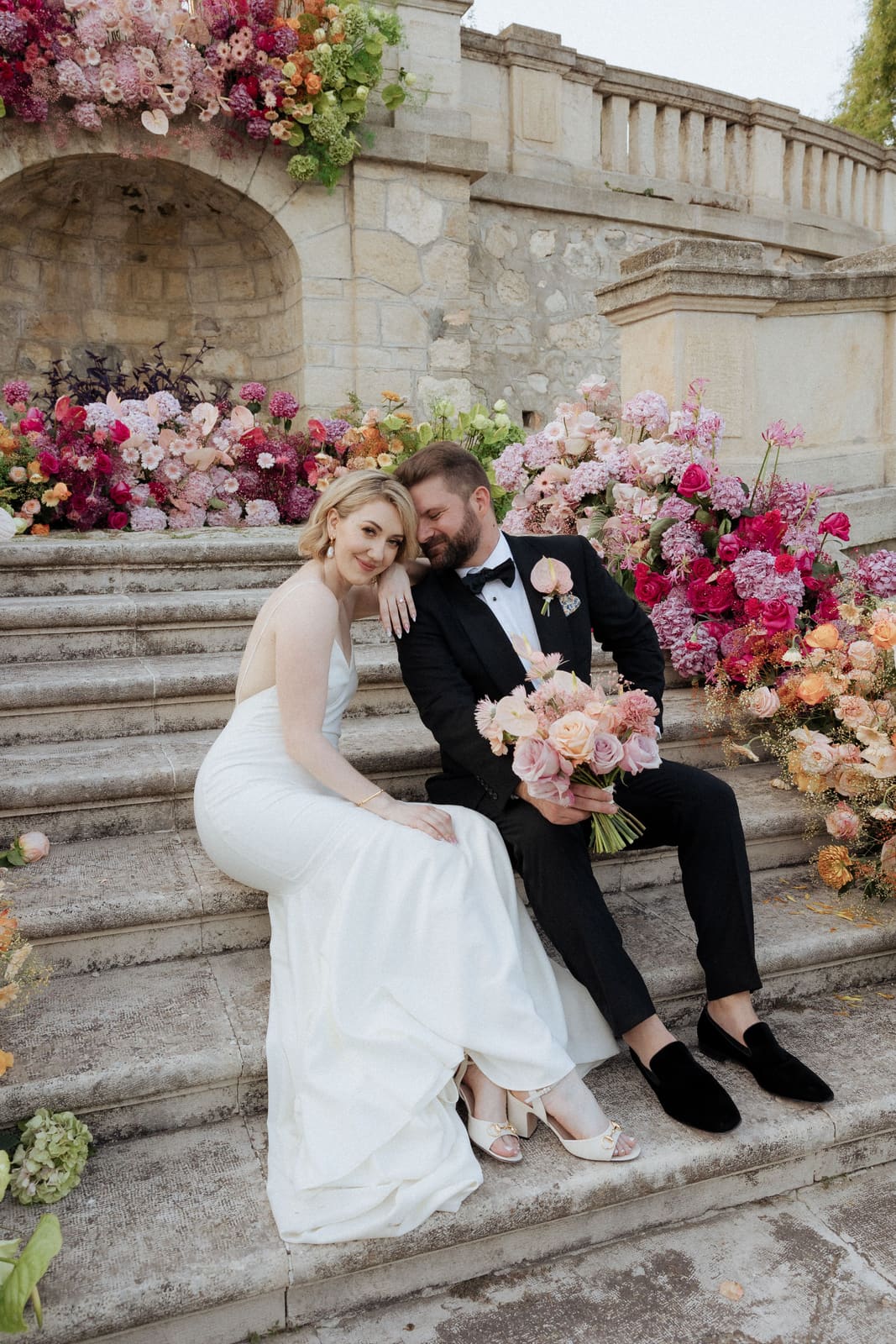
The result was two major floral moments. The first was a recessed stone arch where the couple exchanged vows, framed by an exuberant spray of roses, hydrangea, anthurium, and gerbera daisies in shades that ranged from lemonade pink to electric orange. The second was a long, linear installation suspended above the dinner tables, a river of blooms that seemed to float in midair. Taper candles in violet and tangerine punctuated the tablescape. Even the printed materials - menus, place cards - were drenched in jubilant botanicals.
It was maximal, yes, but also strategic. In a setting as historically weighty as Euxinograd, the florals didn't compete; they translated. They said: this is a celebration, not a museum visit.
The Vendor Ecosystem
One advantage of planning a wedding in a smaller market is that everyone knows everyone. IDo arrived with a network of trusted contacts across Central and Eastern Europe, and the couple quickly learned that Bulgaria's event industry operates like a tight-knit guild. Their florist recommended the Julist Quartet for ceremony strings. The caterer, L'Instant from Sofia, vouched for the same group. When Jessica and Nasko hired Everso - an adaptive artist collective that moves through crowds rather than performing from a stage - their other vendors nodded in approval.
"The cool thing about the Bulgarian community, especially in the event space, is everyone knows each other," Jessica says. That interconnectedness became a safety net. If one vendor flagged a logistical issue, others had already anticipated it.
Everso, in particular, set the tone for the reception. The band is immersive by design, walking among guests, adjusting their sound and energy in real time. It's the kind of live music you'd expect at a high-concept art installation, not a wedding. But that was precisely the point. Jessica and Nasko wanted their celebration to feel less like a scripted event and more like a living, breathing experience.
Teaching the Horo in Phoenix
Before anyone boarded a plane, the couple hosted an informal gathering at Nasko's mother's house in Phoenix. The purpose: to teach their American guests the Horo, a traditional Bulgarian wedding dance where participants link arms and execute a series of coordinated steps. It's a staple of Bulgarian celebrations, and Nasko wanted his friends and family to feel prepared rather than awkward.
The gesture was small, but it signaled something larger. At Global Chic Voyage, we talk often about the difference between tourism and immersion. The former is transactional; the latter requires preparation, context, and a willingness to meet a culture halfway. By the time guests arrived in Varna, they'd already begun that process. At hotel check-in, they were greeted with glasses of rakia, Bulgaria's national fruit brandy - a drink strong enough to double as jet-lag remedy and cultural initiation.
The wedding week itself was structured around a series of touchpoints. On the Monday before the ceremony, a smaller group gathered for golf and spa treatments at the Thracian Cliffs, a dramatic stretch of coast where green land drops abruptly into the Black Sea. Tuesday brought a welcome dinner on the terrace of the Boutique Hotel Oasis, with dancing that lasted long past midnight. The wedding took place on Wednesday, followed by a leisurely brunch the next morning. Many guests extended their trips to explore Sofia or spend additional days in Varna, guided by recommendations the couple had compiled.
Two Languages, One Celebration
Bilingualism wasn't an afterthought - it was woven into the event's architecture. Invitations were printed in English on one side and Cyrillic on the other, designed by Anticipate Invitations. The ceremony was officiated by two sisters, childhood friends of Nasko's, who alternated between English and Bulgarian so that every guest could follow along. Speeches at the reception were translated in real time. Even the napkins featured a handful of translated phrases, a cheat sheet for cross-cultural mingling.
This kind of linguistic hospitality is rare, and it matters. Weddings are inherently performative, but the best ones make space for everyone in the room to feel seen. By refusing to privilege one language over the other, Jessica and Nasko ensured that neither side of the family felt like a guest in someone else's story.
What the Black Sea Teaches
There's a broader lesson here, beyond the logistics of floral installations and bilingual menus. The Bulgarian coast remains undervalued in the European travel hierarchy, overshadowed by Italy's Amalfi, Greece's Cyclades, Croatia's Dalmatian islands. But that obscurity is also its advantage. The beaches are uncrowded. The infrastructure is sophisticated without being overbuilt. The history is deep - Varna has been a port city since the Greeks founded it as Odessos in the sixth century BCE - but it doesn't perform its past for tourists.
Jessica and Nasko didn't choose Bulgaria because it was easy. They chose it because it was specific, because it meant something to them, and because they believed their guests would rise to the occasion. The fact that nearly a hundred people did - flying across continents, navigating visa renewals, learning a circle dance in a Phoenix living room - suggests that travelers are hungrier for authenticity than the industry often assumes.
After the wedding, the couple spent a few days in Italy's Lake Como and Florence, a mini-moon before returning to Arizona. But it was Bulgaria, not Italy, that lingered. The palace with its soft-pink walls. The rakia toasts. The moment during the Horo when a hundred people, from two continents, moved in sync under a canopy of roses.
The Black Sea, it turns out, has been waiting all along.
Credit: EMÈS Weddings
Spot something wrong? Email editors@globalchicvoyage.com. We log every correction publicly.
RELATED
SEE ALL →
8 Aug 2026 / 5 min

7 Aug 2026 / 5 min

31 Jul 2026 / 5 min
31 Jul 2026 / 5 min