
Inside the Thirteen-Day Private Jet Journey Linking Two of South America's Last Wilderness Frontiers
TCS World Travel's airborne odyssey stitches together volcanic archipelagos and glacial fjords with the unhurried luxury of a bygone era
SI
8 Jul 2026 · 5 MIN READ · UPDATED 17 AUG 2026
The Geography of Desire
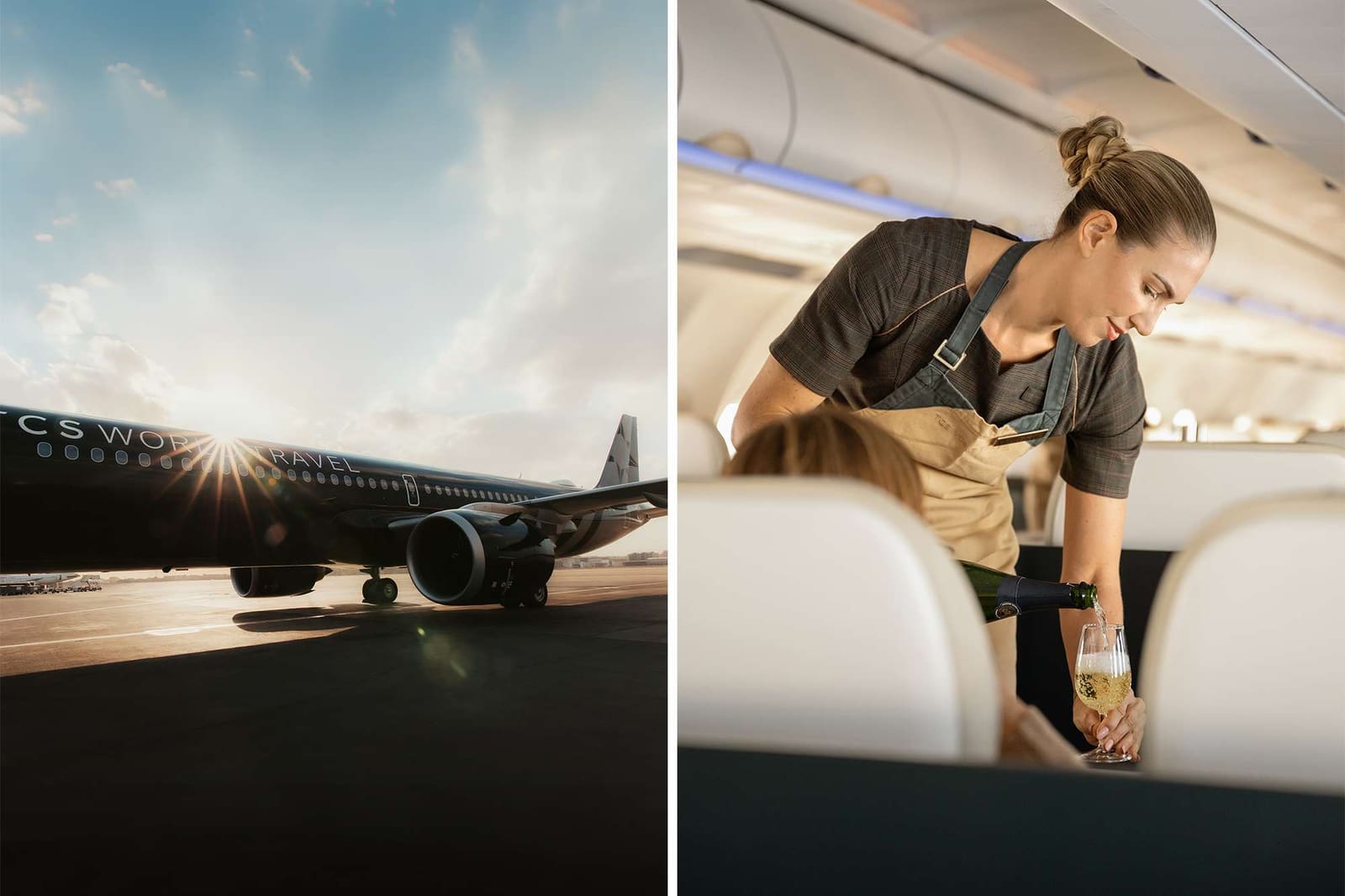
There exists a particular kind of traveler who measures distance not in miles but in ecosystems traversed. For them, the appeal of a thirteen-day itinerary lies less in its brevity than in its audacity: to wake among Darwin's finches one morning and, within the same fortnight, stand beneath the jagged spires of Torres del Paine. TCS World Travel has built its reputation on collapsing such geographic improbabilities into seamless journeys, and their South American private jet expedition exemplifies the philosophy. Recognized as the leading tour operator in the 2026 World's Best Awards, the company orchestrates itineraries that feel less like vacations and more like carefully choreographed acts of witness.
At Global Chic Voyage, we've watched the private aviation segment of luxury travel evolve from novelty to necessity for a certain stratum of explorer. What distinguishes this particular route is not merely the conveyance but the curation: two landscapes so profoundly different in character that the passage between them becomes a meditation on the planet's biodiversity.
Volcanic Beginnings
The Galápagos archipelago announces itself long before landfall. From the air, the islands appear as dark punctuation marks scattered across an improbably blue sentence. The volcanic origins remain visible in the scorched earth tones, the absence of lush greenery, the sense that the land is still cooling from some ancient forge. To arrive by private jet is to bypass the logistical friction that typically attends remote destinations: no layovers in Quito, no overnight delays, no negotiation with commercial airline schedules that treat the archipelago as an afterthought.
TCS World Travel structures its Galápagos days around close encounters rather than checklist sightings. Guests spend mornings in pangas, the small inflatable boats that navigate shallow waters where sea lions drowse on black lava shelves and marine iguanas congregate in prehistoric huddles. The guides here are naturalists in the old sense, versed not only in taxonomy but in the behavioral subtleties that distinguish one blue-footed booby courtship dance from another.
What strikes visitors most forcefully is the absence of fear in the wildlife. Frigatebirds perch at arm's length. Giant tortoises lumber past without altering course. The islands function as a living seminar in evolutionary adaptation, each species a case study in how isolation breeds peculiarity. For travelers accustomed to wildlife that flees or performs, the Galápagos offers something rarer: indifference. The animals here have no reason to regard humans as either threat or benefactor, and that neutrality feels, paradoxically, like intimacy.
The Mechanics of Movement
The private jet itself is a Boeing 757 reconfigured to seat fewer than sixty passengers, each assigned a window and an aisle in a layout that prioritizes space over density. Between destinations, the cabin becomes a floating salon where naturalists offer briefings, guest lecturers unpack regional history, and fellow travelers swap stories over meals prepared by an onboard culinary team. There is something pleasantly anachronistic about this mode of travel, a throwback to an era when the journey itself warranted as much attention as the destination.
Flight time from the Galápagos to Patagonia spans several hours, yet the experience lacks the tedium of commercial long-haul routes. The aircraft touches down at intervals, pausing in cities that serve as narrative bridges: Lima for a taste of coastal Peruvian cuisine, perhaps, or Santiago for a vineyard visit in the Maipo Valley. These interludes are calibrated to prevent fatigue, offering just enough engagement to maintain momentum without overwhelming.
The logistics are invisible by design. Luggage moves from plane to hotel without passenger intervention. Boarding passes do not exist. Immigration formalities are handled discreetly, often while guests linger over coffee. This frictionless choreography is the true luxury, the elimination of every minor irritation that typically punctuates international travel.
Southern Ice and Stone
Patagonia arrives as a shock of scale. Where the Galápagos is intimate and insular, Patagonia is vast and indifferent, a landscape of horizontal wind and vertical granite. The region sprawls across the southern reaches of Chile and Argentina, encompassing fjords, glaciers, pampas, and peaks. TCS World Travel's itinerary focuses on the most iconic corridors: the cerulean ice fields of Perito Moreno, the wind-scoured trails of Torres del Paine, the Beagle Channel where Darwin himself once sailed.
The accommodations here lean toward lodges that embrace rather than resist their environment. Floor-to-ceiling windows frame the Paine Massif. Guanaco herds graze within sight of the dining terrace. At night, the absence of light pollution renders the Milky Way so vivid it seems three-dimensional. These properties understand that in Patagonia, the architecture should serve as a viewing platform, not a distraction.
Excursions unfold at a measured pace. Morning hikes lead to glacier overlooks where the ice emits low groans as it calves into turquoise lakes. Afternoons might be spent aboard a catamaran navigating fjords stippled with icebergs, each one a shade of blue that defies linguistic precision. The guides here are often former mountaineers or marine biologists, individuals whose expertise is matched by their comfort with silence. They know when to narrate and when to let the landscape speak for itself.
The Arithmetic of Experience
Thirteen days is both generous and constrained. Generous in that it allows for genuine immersion in two wildly disparate ecosystems, for the kind of repeated exposure that shifts perception from novelty to nuance. Constrained in that Patagonia alone could absorb weeks, and the Galápagos rewards return visits across different seasons. The itinerary represents a calculated wager: that breadth of experience, when executed with sufficient depth, can rival the rewards of extended single-destination stays.
For travelers who measure value in access rather than time, the proposition holds. The private jet unlocks itineraries that would be prohibitively complex to arrange independently. The curated programming eliminates the research burden, the second-guessing, the nagging sense that one might be missing the essential sight or experience. There is a particular kind of traveler for whom this delegation of logistical labor is not laziness but wisdom, a recognition that expertise in travel planning is as legitimate a specialization as expertise in any other domain.
What Returns With You
The memories that linger from such journeys are often the least photogenic. The texture of volcanic rock underfoot in the Galápagos, still warm from the equatorial sun. The sound of wind in Patagonian lenga forests, a susurration that feels older than language. The sight of a condor riding thermals above the Paine massif, wings spread in a geometry that seems to defy physics. These sensory fragments accumulate into something more substantial than a travelogue, closer to a recalibration of scale, a reminder that wildness persists in forms both miniature and monumental.
TCS World Travel's recognition in the 2026 World's Best Awards reflects a broader shift in how discerning travelers define excellence. It is no longer sufficient to visit extraordinary places; the manner of arrival, the quality of interpretation, and the seamlessness of execution have become equally weighted in the calculus of satisfaction. The thirteen-day South American itinerary succeeds because it honors both the destinations and the travelers, assuming an audience that values depth over superficiality and curation over chaos.
In an era when travel can feel like a series of frictionless transactions mediated by apps and algorithms, there remains something deeply appealing about a model that prioritizes human expertise and analog pacing. The private jet is merely the vehicle; the real journey is the one from observation to understanding, from arrival to belonging, however temporary.
Photo: TCS World Travel
Spot something wrong? Email editors@globalchicvoyage.com. We log every correction publicly.
RELATED
SEE ALL →
8 Aug 2026 / 5 min
7 Aug 2026 / 5 min

31 Jul 2026 / 5 min

30 Jul 2026 / 5 min