
In the Limestone Valleys of Southern Thailand, a New Language of Travel Is Taking Root
How community-led experiences in Krabi, Phang-nga, and Surat Thani are redefining what it means to arrive—and to leave a place well
SI
9 May 2026 · 5 MIN READ · UPDATED 17 AUG 2026
A Different Kind of Gathering
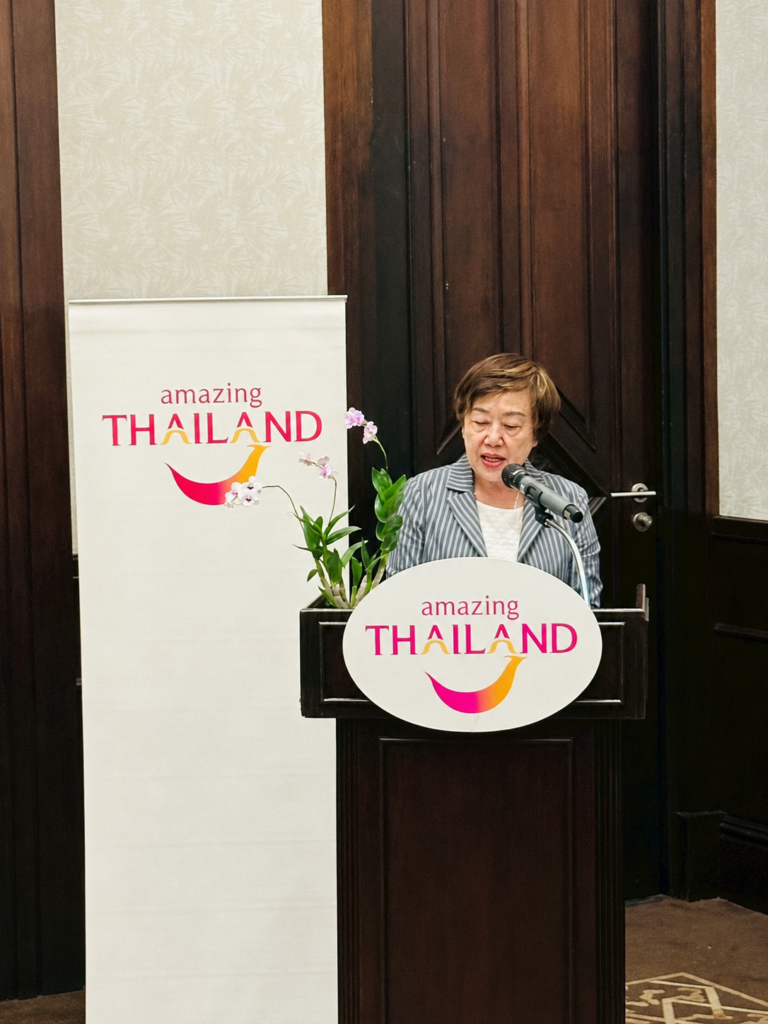
On a humid morning in early May, inside the vaulted ballroom of a resort overlooking the Andaman Sea, two dozen small-scale tourism operators from southern Thailand sat across white-linen tables from travel buyers and content creators flown in from six countries. There were no PowerPoints. No pitch decks. Just stories—about hot springs run by village committees, tea rooms powered by solar panels, homestays where the same family has cooked breakfast for three generations.
This was not a trade fair in the conventional sense. It was a recalibration: an attempt to introduce the international travel industry to a version of Thailand that does not shout, does not discount, and does not conform to the well-worn circuit of beaches, temples, and tuk-tuks. It was, in the language of the Tourism Authority of Thailand, an exercise in responsible tourism—a term that has been overused to the point of near-meaninglessness, but which here, in the limestone valleys and mangrove estuaries of Krabi, Phang-nga, and Surat Thani, is being tested with unusual seriousness.
The event, held on May 8 at the Sofitel Krabi Phokeethra Golf & Spa Resort, was the centerpiece of a week-long immersion program designed to connect international tour operators and media with community-based enterprises that have built their businesses around principles of environmental stewardship, cultural preservation, and equitable benefit-sharing. Twenty-two sellers met nineteen buyers from India, Vietnam, Singapore, Malaysia, Indonesia, and Australia. Sixteen media representatives—bloggers, influencers, and content creators—joined the program to document what they found.
What they found was not a marketing exercise. It was a quiet reckoning with what tourism can be when it is designed from the ground up, rather than imposed from above.
The Architecture of Accountability
Responsible tourism, as articulated by the Tourism Authority of Thailand, is not a certification or a badge. It is a framework—one that asks operators to demonstrate measurable impact in three domains: environmental sustainability, social equity, and economic resilience. Some of the businesses represented at the trade meet have been recognized through the Thailand Tourism Awards. Others participate in the TAT STAR rating system, which evaluates everything from waste management protocols to the percentage of revenue that stays within the local community. Still others are part of the CF Hotels program, an initiative that supports small and medium-sized accommodations in adopting responsible practices.
But the real architecture of accountability is more intimate. It is found in places like Ban Nai Nang, a fishing village turned tourism community where visitors learn to weave crab traps and cook southern Thai curry from scratch. Or Wareerak Hot Spring and Wellness, a family-run retreat in Phang-nga that sources ingredients from its own organic farm and employs women from surrounding villages. Or Thung Yee Pheng, an ecotourism community in Surat Thani where former loggers have become forest guides, leading visitors through lowland rainforest that was, a generation ago, slated for clear-cutting.
These are not luxury experiences in the conventional sense. There are no infinity pools, no Michelin-starred chefs, no helicopter transfers. What they offer instead is something increasingly rare in the global travel economy: the opportunity to see how a place works, to meet the people who sustain it, and to leave knowing that your presence has contributed to its continuity rather than its erosion.
Ms. Patsee Permvongsenee, Executive Director for ASEAN, South Asia, and South Pacific at the Tourism Authority of Thailand, framed the initiative in pragmatic terms. "By connecting international travel trade partners and media with local operators," she explained, "we are creating practical opportunities for sustainable tourism products to reach global markets. This helps Thai businesses apply responsible practices in ways that deliver real value to communities, visitors, and the environment."
It is a modest articulation of an ambitious project: to shift the center of gravity in Thai tourism away from volume and toward value.
The Buyers, the Believers, and the Bottom Line
The challenge, of course, is economic. Community-based tourism operators cannot compete on price with large-scale resorts. They cannot absorb the commissions demanded by online travel agencies. They cannot scale in the way that investors expect. What they can do—what they must do, if they are to survive—is appeal to a different kind of traveler: one who is willing to pay more for less, if what they receive in return is authenticity, intimacy, and impact.
The buyers who gathered in Krabi were, by definition, believers. They represented tour operators and destination management companies that specialize in experiential travel, wellness tourism, and cultural immersion. Many had come from markets—India, Vietnam, Indonesia—where domestic tourism is booming and where a new middle class is beginning to ask different questions about what it means to travel well.
The business-to-business sessions that followed the opening briefing were structured but unhurried. Sellers had fifteen minutes with each buyer to present their offerings, discuss pricing, and explore potential partnerships. Some conversations led to concrete commitments: inclusions in upcoming itineraries, site inspections scheduled for later in the year, collaborations with content creators who could help amplify their stories. Others were more speculative, the kind of slow-building relationships that may or may not bear fruit.
But the very fact of the conversation—the willingness of international buyers to sit down with village-based enterprises and treat them as viable commercial partners—was itself a form of validation. It signaled that the market for responsible tourism, while still niche, is no longer marginal.
Why It Matters
Thailand has long been one of the world's most visited countries, a status that has brought immense economic benefit and equally immense environmental and social strain. Over-tourism in places like Phuket, Koh Phi Phi, and Chiang Mai has led to reef degradation, water shortages, traffic congestion, and the displacement of local communities. The COVID-19 pandemic, which brought international arrivals to a near-standstill, forced a reckoning: what kind of tourism does Thailand want to rebuild?
The Amazing Green Experience initiative is part of the answer. It is an acknowledgment that the old model—high volume, low margin, extractive—is not sustainable, either ecologically or economically. It is an attempt to cultivate a different kind of visitor economy, one that prioritizes depth over breadth, quality over quantity, and reciprocity over extraction.
This is not a uniquely Thai challenge. From Bali to Bhutan, from Kyoto to the Galápagos, destinations that have been loved to the brink of collapse are experimenting with ways to manage tourism more intentionally. What distinguishes the Thai approach is its emphasis on market readiness: the recognition that responsible tourism will only scale if it can be integrated into existing distribution channels and if it can deliver returns that justify the investment.
The familiarization program that accompanied the trade meet—six days of site visits, tastings, and immersive experiences—was designed to give buyers and media the context they need to sell these experiences credibly. It is not enough to say that a community is "eco-friendly" or "authentic." Buyers need to know how many rooms are available, what the cancellation policy is, whether the Wi-Fi works, whether the food is safe for international guests. Media need stories, images, moments that translate across cultures and platforms.
The operators who participated in the program are, in this sense, pioneers. They are building the infrastructure—logistical, narrative, relational—that will allow responsible tourism to become not just an ideal, but a functioning market segment.
What Comes Next
As the networking lunch drew to a close and the participants dispersed—some to continue their site visits, others to return to their home markets—the mood was cautiously optimistic. Deals had been discussed. Contacts had been exchanged. Stories had been gathered. But the real work, everyone understood, would happen in the months and years to come, as those initial conversations either solidified into partnerships or faded into the noise of a crowded inbox.
What is certain is that the conversation itself has shifted. Responsible tourism is no longer a fringe concern, the province of backpackers and eco-warriors. It is becoming a commercial imperative, driven by a new generation of travelers who want to know where their money goes, who benefits from their presence, and what they leave behind.
In the limestone valleys of southern Thailand, that shift is being written in small, deliberate gestures: a village elder teaching a visitor to cook, a forest guide explaining the symbiosis between fig trees and wasps, a tea room owner calculating the carbon footprint of a single pot of oolong. These are not grand gestures. But they are, perhaps, the beginning of a different kind of arrival—and a more thoughtful way of leaving.
Based on reporting from TAT Newsroom (https://www.tatnews.org/2026/05/amazing-green-experience-in-thailand-strengthens-responsible-tourism-for-international-markets/), with additional context and analysis.
Spot something wrong? Email editors@globalchicvoyage.com. We log every correction publicly.
RELATED
SEE ALL →
28 Jul 2026 / 5 min
2 Jun 2026 / 5 min
6 May 2026 / 5 min
6 May 2026 / 5 min