
In Singapore, Brunch Now Lasts Until Sunset
A Mediterranean-inspired afternoon that stretches from noon to dusk, anchored by champagne towers, live culinary theatre and a post-brunch DJ set overlooking the city's colonial core.
SI
12 Jun 2026 · 5 MIN READ · UPDATED 17 AUG 2026
The Ritual Begins at Noon
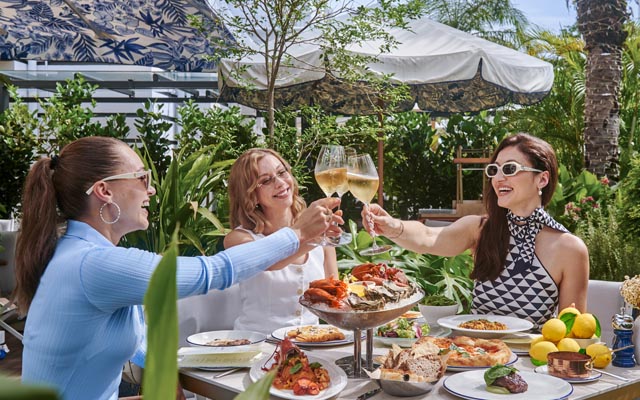
Saturday light filters through the canopy above Fort Canning, pooling on white tablecloths set across L'Amo Bistrò del Mare. By noon, the first champagne flutes are already beaded with condensation. Mett Singapore has introduced a new weekend ritual—a brunch that refuses to end at three, stretching instead into an after-party that carries guests from midday aperitifs to sunset cocktails without ever leaving the hill.
The Riviera Champagne Brunch, launched this month, is less a meal than a daylong tableau. It unfolds across two venues—the bistro and Canning Bar & Lounge—beginning at noon and concluding only when the DJ set winds down at seven. For a city accustomed to brunch as a two-hour interlude, the format is a quiet provocation: what if Saturday afternoon became a destination in itself?
A Menu Built Around the Mediterranean Arc
The culinary programme draws from the coastal arc that stretches from Provence to the Ligurian coast. Antipasti arrive on marble slabs; seafood is grilled to order at live stations; pasta is tossed in copper pans within view of the dining room. Roaming bites—small plates carried between tables—keep the rhythm irregular, preventing the meal from settling into predictable courses.
At Global Chic Voyage, we've observed a shift in how luxury hospitality approaches weekend dining. The traditional brunch buffer, with its regimented stations and fixed exit times, is giving way to experiences that blur the boundaries between lunch, lounge and evening aperitivo. Mett's model—anchored by live culinary theatre rather than static chafing dishes—reflects this evolution. The kitchen becomes part of the choreography, not hidden backstage.
Champagne selection spans three tiers. The entry package features Boizel Brut Réserve; mid-tier guests receive Ruinart Rosé; the top offering pours Krug Grande Cuvée throughout the afternoon. Each tier reshapes the economics of the experience: at S$228 for the base package, the proposition is accessible; at S$888, it becomes a daylong residence with pool access included.
The Architecture of an Extended Afternoon
What distinguishes this format is its refusal to punctuate. Brunch guests are not ushered out at three; instead, the environment shifts around them. Live entertainment begins during the meal—acoustic sets that transition into DJ programming as the afternoon wears on. By four, the after-party has begun, though the boundary is porous. Brunch attendees receive a complimentary drink to bridge the transition; those arriving fresh at three can purchase beverage packages starting at S$78.
Roaming pinsa service—Roman-style flatbreads with airy, fermented dough—begins at half-past five, a nod to the Italian aperitivo tradition of light bites accompanying early-evening drinks. The gesture acknowledges that by late afternoon, appetites have returned, though not yet for dinner.
Fort Canning's geography plays a quiet role. Elevated above the city, the hill offers a sense of remove without requiring guests to travel far. The colonial-era parkland frames the experience in a way that Singapore's high-rise hotel rooftops cannot—there is greenery, historical architecture, and the sense of occupying a landmark rather than merely looking down on one.
Why the Format Resonates Now
The extended brunch model speaks to a post-pandemic recalibration of how urbanites structure leisure time. The compressed, appointment-driven weekend—brunch at one venue, drinks at another, dinner elsewhere—has softened. In its place: longer, more fluid gatherings that justify the effort of dressing up and leaving home.
Mett's pricing architecture reflects this. The top-tier package, which includes an overnight stay and breakfast, transforms the brunch into a weekend micro-retreat. At S$1,188, it positions the experience not as a meal but as a 24-hour escape, a category more commonly associated with resort properties than urban hotels.
For the non-drinking cohort, the S$158 package offers full access to the culinary programme without alcohol. It's a minor but telling detail: the experience is designed to stand on its own merits, not as a vehicle for free-flow consumption. The food, the setting, the rhythm of the afternoon—these are the anchors, with champagne as accent rather than raison d'être.
The Riviera as Template, Not Theme
The "Riviera" framing is more atmospheric than literal. There are no faux-Mediterranean props, no enforced dress codes in linen and espadrilles. Instead, the reference functions as shorthand for a certain quality of leisure: unhurried, sun-dappled, oriented toward pleasure rather than productivity. It's the Riviera as state of mind—a Saturday that stretches, that resists the clock, that treats afternoon as its own category of time.
We've seen similar gestures across the region—Bali's beach clubs that transition from lunch to sunset without pause, Bangkok's rooftop venues that programme entire afternoons around a single meal. What makes Mett's iteration notable is its urban setting. Fort Canning is not a resort; it is a park in the city centre, accessible by MRT, surrounded by office towers. The Riviera, in this context, is not somewhere else. It is a temporary condition, conjured every Saturday, dissolved by Sunday morning.
What It Signals for Singapore's Dining Landscape
The launch arrives as Singapore's hospitality sector recalibrates post-reopening strategies. Multi-hour, experience-driven dining concepts have proliferated, but most remain tethered to dinner service. Brunch, by contrast, has been slower to evolve—still dominated by hotel buffets and café all-day menus. Mett's model suggests a third path: brunch as anchor for a daylong programme, with the meal itself as just one element in a longer arc.
It also reflects a broader tension in luxury hospitality: how to justify premium pricing when guests have become fluent in the cost structures of ingredients, labour and pours. The answer, increasingly, is not to hide the math but to expand the scope. A S$888 brunch is difficult to justify as a meal; as a seven-hour experience with pool access, live entertainment and champagne service, the value proposition clarifies.
Whether the format finds a permanent foothold depends on execution. The risk with extended experiences is that they sag in the middle—guests arrive at noon, depart by two, leaving the after-party to fend for itself. Mett's success will hinge on whether the programming can sustain momentum across all seven hours, whether the transition from brunch to party feels seamless rather than forced, and whether the culinary programme remains dynamic enough to justify lingering.
The Afternoon as Canvas
What the Riviera Champagne Brunch ultimately offers is permission—to occupy an afternoon without agenda, to let one meal bleed into the next, to treat Saturday as something other than a series of appointments. In a city where efficiency is cultural reflex, the format is a small act of resistance. Not every weekend requires optimization. Some Saturdays are best measured not in accomplishments but in hours spent at a table, watching light shift across Fort Canning, the champagne flute refilled before it empties, the DJ set beginning just as you realize you have nowhere else to be.
Spot something wrong? Email editors@globalchicvoyage.com. We log every correction publicly.
RELATED
SEE ALL →
16 Jul 2026 / 5 min
4 May 2026 / 5 min
10 Mar 2026 / 5 min
27 Jul 2026 / 5 min